Graphical abstract template · Graphical abstracts · Graphical abstract
Hydrogen embrittlement of steels: trap the hydrogen before it finds the crack
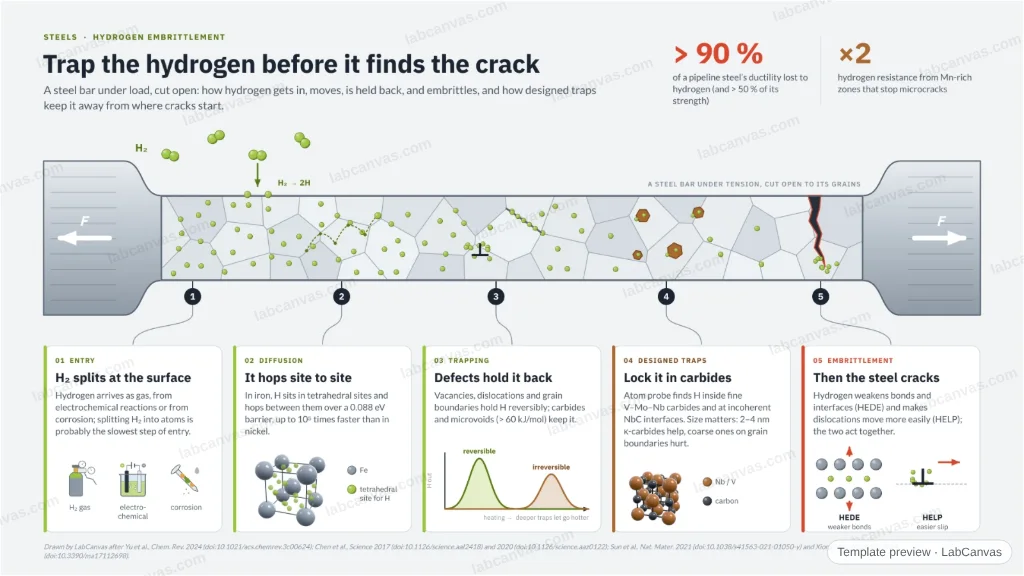
A tensile specimen cut open to its grains and read as the path of one hydrogen atom: H₂ splits at the surface, the atoms hop between tetrahedral sites of the iron lattice, defects hold some back, fine carbides lock them away and, where hydrogen gets through, a crack opens. Five cards explain each station, from the sources of hydrogen to the two mechanisms (HEDE and HELP) and the designed traps that make steels more resistant.
Updated 6 cited papers306 editable layers
At a glance
- Category
- Graphical abstracts
- Method
- Graphical abstract
- Starting materials
- Hydrogen from gas, electrochemical charging or corrosion
- Product
- A steel whose designed traps keep hydrogen away from crack-prone sites
- Key result
- Diffusion barrier 0.088 eV in iron; diffusivity in α-Fe up to 10⁵ × that in Ni; irreversible traps > 60 kJ/mol; pipeline steel: strength −50 %, ductility −90 % (Yu et al. 2024); κ-carbides 2–4 nm (Xiong et al. 2024); ×2 HE resistance (Sun et al. 2021)
- Figure
- 1920 × 1080 px (16:9), 306 editable layers, 3 generated objects
Step by step
- EntryH₂ dissociates into atoms at the surface, probably the rate-limiting step of entry (H–H bond about 4.48 eV, lowered at a surface); gas, electrochemical reactions and corrosion all supply hydrogen (Yu et al. 2024; Shulin et al. 2026)
- DiffusionIn iron, H sits in tetrahedral interstitial sites and hops between them over a barrier of 0.088 eV; its diffusivity in α-Fe can be five orders of magnitude higher than in nickel (Yu et al. 2024)
- TrappingVacancies, dislocations, grain boundaries and phase boundaries trap H reversibly; carbides and microvoids trap it irreversibly (binding energy > 60 kJ/mol); deeper traps release H at higher temperature in thermal desorption (Yu et al. 2024)
- Designed trapsAtom probe shows H inside fine V–Mo–Nb carbides (Chen et al. 2017) and at incoherent NbC interfaces, dislocations and grain boundaries (Chen et al. 2020); 2–4 nm κ-carbides mitigate embrittlement, coarse grain-boundary carbides worsen it (Xiong et al. 2024)
- EmbrittlementHEDE (weakened lattice and interfaces) and HELP (more mobile dislocations) act together; H cut a pipeline steel’s strength by over 50 % and its ductility by over 90 % (Yu et al. 2024); Mn-rich zones that arrest microcracks doubled HE resistance (Sun et al. 2021)
Uses
- Graphical abstracts on hydrogen embrittlement and hydrogen-compatible steels
- Talks on pipelines, tanks and materials for the hydrogen economy
- Teaching hydrogen diffusion and trapping in metals
Papers this template follows
- Yu et al., “Hydrogen Embrittlement as a Conspicuous Material Challenge─Comprehensive Review and Future Directions”, Chemical Reviews 2024. doi:10.1021/acs.chemrev.3c00624review
- Chen et al., “Direct observation of individual hydrogen atoms at trapping sites in a ferritic steel”, Science 2017. doi:10.1126/science.aal2418primary
- Chen et al., “Observation of hydrogen trapping at dislocations, grain boundaries, and precipitates”, Science 2020. doi:10.1126/science.aaz0122primary
- Sun et al., “Chemical heterogeneity enhances hydrogen resistance in high-strength steels”, Nature Materials 2021. doi:10.1038/s41563-021-01050-yprimary
- Xiong et al., “Impact of Size and Distribution of k-Carbides on the Hydrogen Embrittlement and Trapping Behaviors of a Fe-Mn-Al-C Low-Density Steel”, Materials 2024. doi:10.3390/ma17112698primary
- Shulin et al., “Mechanisms of hydrogen embrittlement, mitigation strategies, and emerging materials for hydrogen energy and advanced manufacturing”, Frontiers in Chemistry 2026. doi:10.3389/fchem.2026.1957974further reading
Drawn by LabCanvas after Yu et al., Chem. Rev. 2024 (doi:10.1021/acs.chemrev.3c00624); Chen et al., Science 2017 (doi:10.1126/science.aal2418) and 2020 (doi:10.1126/science.aaz0122); Sun et al., Nat. Mater. 2021 (doi:10.1038/s41563-021-01050-y) and Xiong et al., Materials 2024 (doi:10.3390/ma17112698).
How templates are written and checked: editorial guidelines.
Questions
What does the “Hydrogen embrittlement of steels: trap the hydrogen before it finds the crack” template show?
A tensile specimen cut open to its grains and read as the path of one hydrogen atom: H₂ splits at the surface, the atoms hop between tetrahedral sites of the iron lattice, defects hold some back, fine carbides lock them away and, where hydrogen gets through, a crack opens. Five cards explain each station, from the sources of hydrogen to the two mechanisms (HEDE and HELP) and the designed traps that make steels more resistant.
What are the steps shown in “Hydrogen embrittlement of steels: trap the hydrogen before it finds the crack”?
1. Entry: H₂ dissociates into atoms at the surface, probably the rate-limiting step of entry (H–H bond about 4.48 eV, lowered at a surface); gas, electrochemical reactions and corrosion all supply hydrogen (Yu et al. 2024; Shulin et al. 2026). 2. Diffusion: In iron, H sits in tetrahedral interstitial sites and hops between them over a barrier of 0.088 eV; its diffusivity in α-Fe can be five orders of magnitude higher than in nickel (Yu et al. 2024). 3. Trapping: Vacancies, dislocations, grain boundaries and phase boundaries trap H reversibly; carbides and microvoids trap it irreversibly (binding energy > 60 kJ/mol); deeper traps release H at higher temperature in thermal desorption (Yu et al. 2024). 4. Designed traps: Atom probe shows H inside fine V–Mo–Nb carbides (Chen et al. 2017) and at incoherent NbC interfaces, dislocations and grain boundaries (Chen et al. 2020); 2–4 nm κ-carbides mitigate embrittlement, coarse grain-boundary carbides worsen it (Xiong et al. 2024). 5. Embrittlement: HEDE (weakened lattice and interfaces) and HELP (more mobile dislocations) act together; H cut a pipeline steel’s strength by over 50 % and its ductility by over 90 % (Yu et al. 2024); Mn-rich zones that arrest microcracks doubled HE resistance (Sun et al. 2021).
What are the starting materials and the product?
Starting materials: Hydrogen from gas, electrochemical charging or corrosion. Product: A steel whose designed traps keep hydrogen away from crack-prone sites.
Which papers is “Hydrogen embrittlement of steels: trap the hydrogen before it finds the crack” based on?
Yu et al., “Hydrogen Embrittlement as a Conspicuous Material Challenge─Comprehensive Review and Future Directions”, Chemical Reviews 2024 (doi:10.1021/acs.chemrev.3c00624); Chen et al., “Direct observation of individual hydrogen atoms at trapping sites in a ferritic steel”, Science 2017 (doi:10.1126/science.aal2418); Chen et al., “Observation of hydrogen trapping at dislocations, grain boundaries, and precipitates”, Science 2020 (doi:10.1126/science.aaz0122); Sun et al., “Chemical heterogeneity enhances hydrogen resistance in high-strength steels”, Nature Materials 2021 (doi:10.1038/s41563-021-01050-y); Xiong et al., “Impact of Size and Distribution of k-Carbides on the Hydrogen Embrittlement and Trapping Behaviors of a Fe-Mn-Al-C Low-Density Steel”, Materials 2024 (doi:10.3390/ma17112698); Shulin et al., “Mechanisms of hydrogen embrittlement, mitigation strategies, and emerging materials for hydrogen energy and advanced manufacturing”, Frontiers in Chemistry 2026 (doi:10.3389/fchem.2026.1957974).
Can I edit the “Hydrogen embrittlement of steels: trap the hydrogen before it finds the crack” template?
Yes. Open it in the LabCanvas editor: all 306 layers are editable, including 3 generated objects (structures, plots, equipment) with their own settings. Change the text, colours and layout, then export PNG, TIFF, SVG or PDF.
Do I need an account to use this template?
Not to view it here. To open and edit it, sign in to LabCanvas or create a free account (the free plan keeps up to 3 designs). Downloading the figure is part of LabCanvas Pro (US$19 a month or US$199 a year).





