Graphical abstract template · Materials graphical abstracts · Graphical abstract
Hydrogen storage materials: four ways to hold H₂
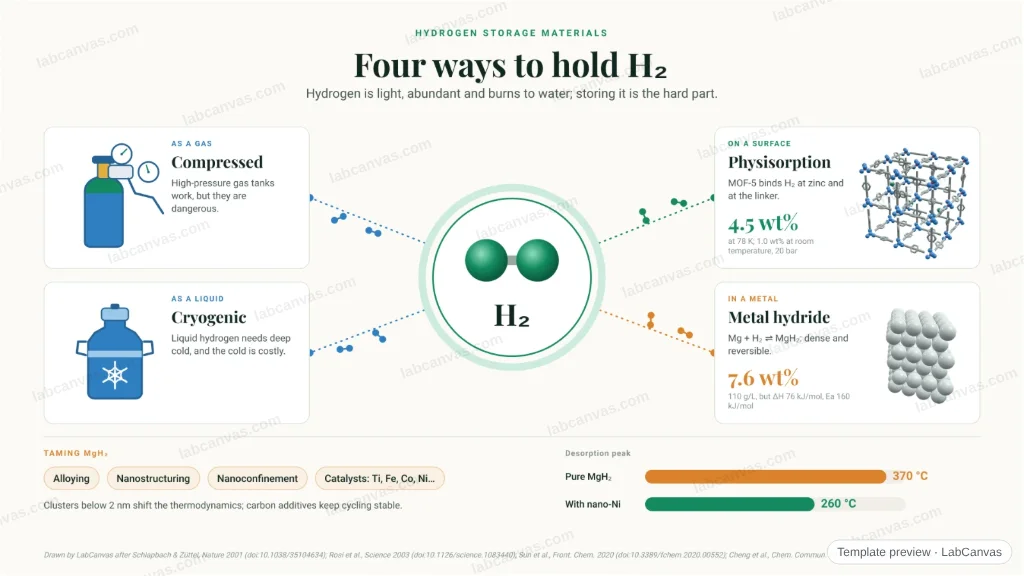
A radial graphical abstract with a hydrogen molecule at the hub and the four ways to store it on the spokes: compressed gas, cryogenic liquid, physisorption in a metal–organic framework and chemical binding in magnesium hydride. A bottom strip shows how alloying, nanostructuring, nanoconfinement and catalysts tame magnesium hydride.
Updated 4 cited papers87 editable layers
At a glance
- Category
- Materials graphical abstracts
- Method
- Graphical abstract
- Starting materials
- Hydrogen gas: light, abundant, burns to water
- Product
- Hydrogen held as a gas, a liquid, on a porous framework or inside a metal hydride
- Key result
- MOF-5: 4.5 wt% at 78 K, 1.0 wt% at room temperature and 20 bar (Rosi et al. 2003); MgH2: 7.6 wt%, 110 g/L, ΔH 76 kJ/mol, Ea 160 kJ/mol; desorption peak 370 °C → 260 °C with nano-Ni (Sun et al. 2020)
- Figure
- 1920 × 1080 px (16:9), 87 editable layers, 2 generated objects
Step by step
- Compressed gasHigh-pressure tanks hold hydrogen as a gas but are dangerous (Sun et al. 2020)
- Cryogenic liquidLiquid hydrogen storage is costly (Sun et al. 2020)
- Physisorption in a MOFMOF-5, Zn4O(BDC)3, adsorbs 4.5 wt% at 78 K and 1.0 wt% at room temperature and 20 bar, binding H2 at zinc and at the linker (Rosi et al. 2003)
- Metal hydrideMgH2 stores 7.6 wt% (110 g/L) reversibly, but ΔH = 76 kJ/mol and Ea = 160 kJ/mol make release hot and slow (Sun et al. 2020)
- Taming MgH2Alloying, nanostructuring, nanoconfinement and transition-metal catalysts; nano-Ni moved the desorption peak from 370 °C to 260 °C (Sun et al. 2020); clusters below 2 nm change the thermodynamics (Cheng et al. 2012)
Uses
- Graphical abstracts on hydrogen storage materials
- Talks comparing physisorption and metal hydrides
- Teaching the hydrogen economy
Papers this template follows
- Schlapbach & Züttel, “Hydrogen-storage materials for mobile applications”, Nature 2001. doi:10.1038/35104634review
- Rosi et al., “Hydrogen storage in microporous metal-organic frameworks”, Science 2003. doi:10.1126/science.1083440primary
- Sun et al., “Enhancing hydrogen storage properties of MgH2 by transition metals and carbon materials: a brief review”, Front. Chem. 2020. doi:10.3389/fchem.2020.00552review
- Cheng et al., “Efficient hydrogen storage with the combination of lightweight Mg/MgH2 and nanostructures”, Chem. Commun. 2012. doi:10.1039/c2cc30740ereview
Drawn by LabCanvas after Schlapbach & Züttel, Nature 2001 (doi:10.1038/35104634); Rosi et al., Science 2003 (doi:10.1126/science.1083440); Sun et al., Front. Chem. 2020 (doi:10.3389/fchem.2020.00552); Cheng et al., Chem. Commun. 2012 (doi:10.1039/c2cc30740e).
How templates are written and checked: editorial guidelines.
Questions
What does the “Hydrogen storage materials: four ways to hold H₂” template show?
A radial graphical abstract with a hydrogen molecule at the hub and the four ways to store it on the spokes: compressed gas, cryogenic liquid, physisorption in a metal–organic framework and chemical binding in magnesium hydride. A bottom strip shows how alloying, nanostructuring, nanoconfinement and catalysts tame magnesium hydride.
What are the steps shown in “Hydrogen storage materials: four ways to hold H₂”?
1. Compressed gas: High-pressure tanks hold hydrogen as a gas but are dangerous (Sun et al. 2020). 2. Cryogenic liquid: Liquid hydrogen storage is costly (Sun et al. 2020). 3. Physisorption in a MOF: MOF-5, Zn4O(BDC)3, adsorbs 4.5 wt% at 78 K and 1.0 wt% at room temperature and 20 bar, binding H2 at zinc and at the linker (Rosi et al. 2003). 4. Metal hydride: MgH2 stores 7.6 wt% (110 g/L) reversibly, but ΔH = 76 kJ/mol and Ea = 160 kJ/mol make release hot and slow (Sun et al. 2020). 5. Taming MgH2: Alloying, nanostructuring, nanoconfinement and transition-metal catalysts; nano-Ni moved the desorption peak from 370 °C to 260 °C (Sun et al. 2020); clusters below 2 nm change the thermodynamics (Cheng et al. 2012).
What are the starting materials and the product?
Starting materials: Hydrogen gas: light, abundant, burns to water. Product: Hydrogen held as a gas, a liquid, on a porous framework or inside a metal hydride.
Which papers is “Hydrogen storage materials: four ways to hold H₂” based on?
Schlapbach & Züttel, “Hydrogen-storage materials for mobile applications”, Nature 2001 (doi:10.1038/35104634); Rosi et al., “Hydrogen storage in microporous metal-organic frameworks”, Science 2003 (doi:10.1126/science.1083440); Sun et al., “Enhancing hydrogen storage properties of MgH2 by transition metals and carbon materials: a brief review”, Front. Chem. 2020 (doi:10.3389/fchem.2020.00552); Cheng et al., “Efficient hydrogen storage with the combination of lightweight Mg/MgH2 and nanostructures”, Chem. Commun. 2012 (doi:10.1039/c2cc30740e).
Can I edit the “Hydrogen storage materials: four ways to hold H₂” template?
Yes. Open it in the LabCanvas editor: all 87 layers are editable, including 2 generated objects (structures, plots, equipment) with their own settings. Change the text, colours and layout, then export PNG, TIFF, SVG or PDF.
Do I need an account to use this template?
Not to view it here. To open and edit it, sign in to LabCanvas or create a free account (the free plan keeps up to 3 designs). Downloading the figure is part of LabCanvas Pro (US$19 a month or US$199 a year).