Graphical abstract template · Graphical abstracts · Graphical abstract
Lead-free piezoceramics: a family tree that grows d₃₃
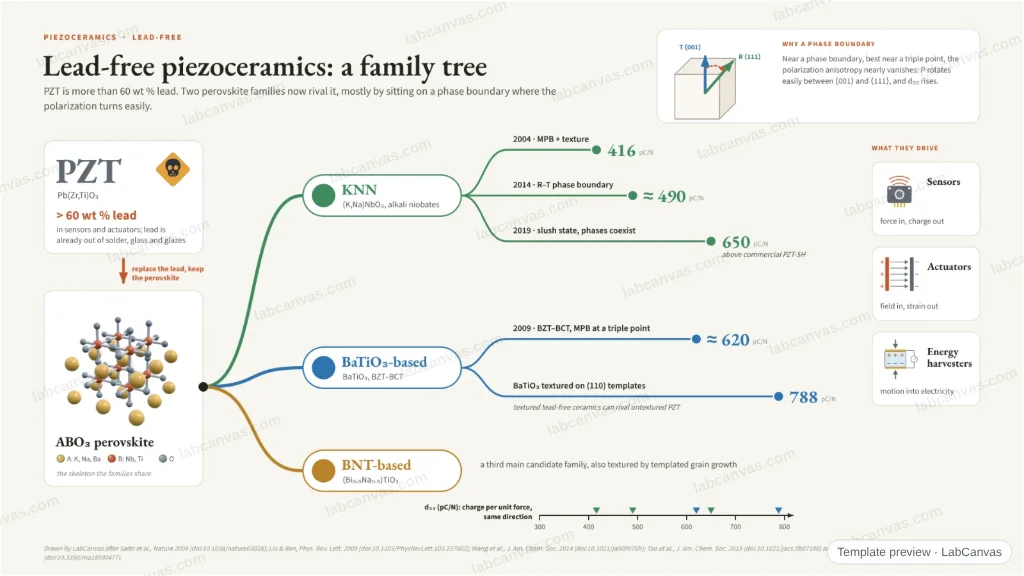
A family tree of lead-free piezoelectric ceramics rooted in PZT (more than 60 wt % lead) and the perovskite skeleton all candidates share. Branches lead to potassium sodium niobate, barium titanate and bismuth sodium titanate; each landmark result is a leaf placed on a shared d₃₃ axis, from 416 pC/N (2004) to 650 pC/N in untextured KNN and 788 pC/N in textured BaTiO₃, mostly by sitting on a phase boundary where polarization rotates easily.
Updated 5 cited papers110 editable layers
At a glance
- Category
- Graphical abstracts
- Method
- Graphical abstract
- Starting materials
- PZT, more than 60 wt % lead (Saito et al. 2004)
- Product
- Lead-free perovskite ceramics with d₃₃ from 416 to 788 pC/N
- Key result
- d₃₃ = 416 pC/N (textured KNN-based, Saito et al. 2004); ≈ 490 pC/N, TC 217–304 °C (Wang et al. 2014); 650 ± 20 pC/N (Tao et al. 2019); ≈ 620 pC/N (BZT–BCT, Liu & Ren 2009); 788 pC/N (textured BaTiO₃, in Zate et al. 2025)
- Figure
- 1920 × 1080 px (16:9), 110 editable layers, 4 generated objects
Step by step
- Why replace PZTPZT, used in sensors, actuators and other electronic devices, contains more than 60 wt % lead, which has been expelled from solder, glass and glazes over its toxicity (Saito et al. 2004)
- KNNAn alkali-niobate MPB plus <001> texture gave 416 pC/N (Saito et al. 2004); a new R–T phase boundary ≈ 490 pC/N by solid-state processing (Wang et al. 2014); a slush polar state with coexisting phases 650 ± 20 pC/N, above PZT-5H (Tao et al. 2019)
- BaTiO₃-basedBZT–BCT reaches ≈ 620 pC/N at an MPB that starts from a tricritical triple point (Liu & Ren 2009); BaTiO₃ textured on (110) templates reached 788 pC/N (Zate et al. 2025)
- Why phase boundaries workWhere polarization anisotropy nearly vanishes, polarization rotates easily between ⟨001⟩ (tetragonal) and ⟨111⟩ (rhombohedral) directions (Liu & Ren 2009; Tao et al. 2019)
- UsesSensors, actuators and energy harvesters, which interconvert mechanical and electrical energy (Zate et al. 2025; Saito et al. 2004)
Uses
- Graphical abstracts on lead-free piezoelectric ceramics
- Talks on replacing PZT in sensors, actuators and harvesters
- Teaching morphotropic phase boundaries and polarization rotation
Papers this template follows
- Saito et al., “Lead-free piezoceramics”, Nature 2004. doi:10.1038/nature03028primary
- Liu & Ren, “Large piezoelectric effect in Pb-free ceramics”, Physical Review Letters 2009. doi:10.1103/PhysRevLett.103.257602primary
- Wang et al., “Giant piezoelectricity in potassium-sodium niobate lead-free ceramics”, Journal of the American Chemical Society 2014. doi:10.1021/ja500076hprimary
- Tao et al., “Ultrahigh Performance in Lead-Free Piezoceramics Utilizing a Relaxor Slush Polar State with Multiphase Coexistence”, Journal of the American Chemical Society 2019. doi:10.1021/jacs.9b07188primary
- Zate et al., “Textured Lead-Free Piezoelectric Ceramics: A Review of Template Effects”, Materials 2025. doi:10.3390/ma18030477review
Drawn by LabCanvas after Saito et al., Nature 2004 (doi:10.1038/nature03028); Liu & Ren, Phys. Rev. Lett. 2009 (doi:10.1103/PhysRevLett.103.257602); Wang et al., J. Am. Chem. Soc. 2014 (doi:10.1021/ja500076h); Tao et al., J. Am. Chem. Soc. 2019 (doi:10.1021/jacs.9b07188) and Zate et al., Materials 2025 (doi:10.3390/ma18030477).
How templates are written and checked: editorial guidelines.
Questions
What does the “Lead-free piezoceramics: a family tree that grows d₃₃” template show?
A family tree of lead-free piezoelectric ceramics rooted in PZT (more than 60 wt % lead) and the perovskite skeleton all candidates share. Branches lead to potassium sodium niobate, barium titanate and bismuth sodium titanate; each landmark result is a leaf placed on a shared d₃₃ axis, from 416 pC/N (2004) to 650 pC/N in untextured KNN and 788 pC/N in textured BaTiO₃, mostly by sitting on a phase boundary where polarization rotates easily.
What are the steps shown in “Lead-free piezoceramics: a family tree that grows d₃₃”?
1. Why replace PZT: PZT, used in sensors, actuators and other electronic devices, contains more than 60 wt % lead, which has been expelled from solder, glass and glazes over its toxicity (Saito et al. 2004). 2. KNN: An alkali-niobate MPB plus <001> texture gave 416 pC/N (Saito et al. 2004); a new R–T phase boundary ≈ 490 pC/N by solid-state processing (Wang et al. 2014); a slush polar state with coexisting phases 650 ± 20 pC/N, above PZT-5H (Tao et al. 2019). 3. BaTiO₃-based: BZT–BCT reaches ≈ 620 pC/N at an MPB that starts from a tricritical triple point (Liu & Ren 2009); BaTiO₃ textured on (110) templates reached 788 pC/N (Zate et al. 2025). 4. Why phase boundaries work: Where polarization anisotropy nearly vanishes, polarization rotates easily between ⟨001⟩ (tetragonal) and ⟨111⟩ (rhombohedral) directions (Liu & Ren 2009; Tao et al. 2019). 5. Uses: Sensors, actuators and energy harvesters, which interconvert mechanical and electrical energy (Zate et al. 2025; Saito et al. 2004).
What are the starting materials and the product?
Starting materials: PZT, more than 60 wt % lead (Saito et al. 2004). Product: Lead-free perovskite ceramics with d₃₃ from 416 to 788 pC/N.
Which papers is “Lead-free piezoceramics: a family tree that grows d₃₃” based on?
Saito et al., “Lead-free piezoceramics”, Nature 2004 (doi:10.1038/nature03028); Liu & Ren, “Large piezoelectric effect in Pb-free ceramics”, Physical Review Letters 2009 (doi:10.1103/PhysRevLett.103.257602); Wang et al., “Giant piezoelectricity in potassium-sodium niobate lead-free ceramics”, Journal of the American Chemical Society 2014 (doi:10.1021/ja500076h); Tao et al., “Ultrahigh Performance in Lead-Free Piezoceramics Utilizing a Relaxor Slush Polar State with Multiphase Coexistence”, Journal of the American Chemical Society 2019 (doi:10.1021/jacs.9b07188); Zate et al., “Textured Lead-Free Piezoelectric Ceramics: A Review of Template Effects”, Materials 2025 (doi:10.3390/ma18030477).
Can I edit the “Lead-free piezoceramics: a family tree that grows d₃₃” template?
Yes. Open it in the LabCanvas editor: all 110 layers are editable, including 4 generated objects (structures, plots, equipment) with their own settings. Change the text, colours and layout, then export PNG, TIFF, SVG or PDF.
Do I need an account to use this template?
Not to view it here. To open and edit it, sign in to LabCanvas or create a free account (the free plan keeps up to 3 designs). Downloading the figure is part of LabCanvas Pro (US$19 a month or US$199 a year).





