Graphical abstract template · Graphical abstracts · Graphical abstract
Low-carbon cement: less clinker, and CO₂ back into the concrete
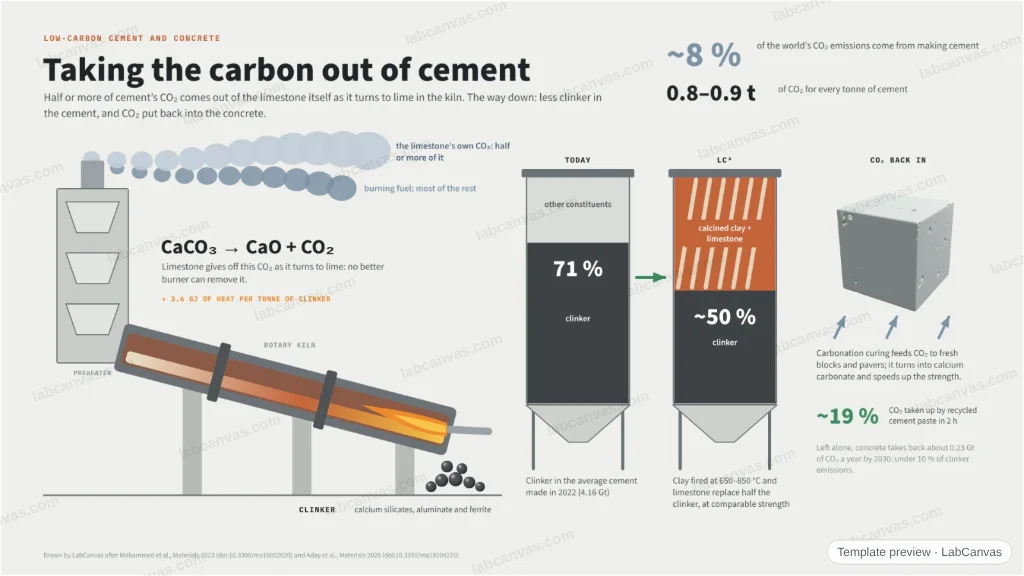
A cement works in elevation: the kiln where limestone gives off its own CO₂ as it turns to lime, beside the CO₂ of the fuel. In the yard, two silos filled like bar charts show the clinker share falling from 71 % in today’s average cement to about 50 % in limestone calcined clay cement, and precast blocks take CO₂ back in as calcium carbonate.
Updated 2 cited papers107 editable layers
At a glance
- Category
- Graphical abstracts
- Method
- Graphical abstract
- Starting materials
- Limestone and clay, fired to clinker in a rotary kiln
- Product
- A cement with half the clinker, and concrete that stores CO₂
- Key result
- ~8 % of global CO₂, 0.8–0.9 t CO₂/t cement (Mohammed et al. 2023); clinker ratio 0.71, 3.6 GJ/t clinker, LC³ clinker ~50 %, ~19 % CO₂ uptake, < 10 % passive (Aday et al. 2026)
- Figure
- 1920 × 1080 px (16:9), 107 editable layers
Step by step
- Where the CO₂ comes fromAbout 8 % of global CO₂; 0.8–0.9 t per tonne of cement; half or more from CaCO₃ → CaO + CO₂ itself, the rest mostly fuel (Mohammed et al. 2023); 3.6 GJ of heat per tonne of clinker (Aday et al. 2026)
- Clinker todayClinker is 71 % of the average cement made in 2022 (4.16 Gt) (Aday et al. 2026)
- Less clinker: LC³Calcined clay (650–850 °C) and limestone replace about half the clinker with comparable strength (Aday et al. 2026; Mohammed et al. 2023)
- CO₂ back inCarbonation curing turns CO₂ into calcium carbonate in precast blocks and pavers; recycled cement paste took up ~19 % CO₂ in 2 h; passive carbonation takes back under 10 % of clinker emissions (Aday et al. 2026)
Uses
- Graphical abstracts on low-carbon cement and concrete
- Talks on industrial decarbonization
- Teaching where cement’s CO₂ comes from
Papers this template follows
- Mohammed et al., “Calcium-based binders in concrete or soil stabilization: challenges, problems, and calcined clay as partial replacement to produce low-carbon cement”, Materials 2023. doi:10.3390/ma16052020review
- Aday et al., “Opportunities and challenges for next-generation cementitious materials under rising demand”, Materials 2026. doi:10.3390/ma19204270review
Drawn by LabCanvas after Mohammed et al., Materials 2023 (doi:10.3390/ma16052020) and Aday et al., Materials 2026 (doi:10.3390/ma19204270).
How templates are written and checked: editorial guidelines.
Questions
What does the “Low-carbon cement: less clinker, and CO₂ back into the concrete” template show?
A cement works in elevation: the kiln where limestone gives off its own CO₂ as it turns to lime, beside the CO₂ of the fuel. In the yard, two silos filled like bar charts show the clinker share falling from 71 % in today’s average cement to about 50 % in limestone calcined clay cement, and precast blocks take CO₂ back in as calcium carbonate.
What are the steps shown in “Low-carbon cement: less clinker, and CO₂ back into the concrete”?
1. Where the CO₂ comes from: About 8 % of global CO₂; 0.8–0.9 t per tonne of cement; half or more from CaCO₃ → CaO + CO₂ itself, the rest mostly fuel (Mohammed et al. 2023); 3.6 GJ of heat per tonne of clinker (Aday et al. 2026). 2. Clinker today: Clinker is 71 % of the average cement made in 2022 (4.16 Gt) (Aday et al. 2026). 3. Less clinker: LC³: Calcined clay (650–850 °C) and limestone replace about half the clinker with comparable strength (Aday et al. 2026; Mohammed et al. 2023). 4. CO₂ back in: Carbonation curing turns CO₂ into calcium carbonate in precast blocks and pavers; recycled cement paste took up ~19 % CO₂ in 2 h; passive carbonation takes back under 10 % of clinker emissions (Aday et al. 2026).
What are the starting materials and the product?
Starting materials: Limestone and clay, fired to clinker in a rotary kiln. Product: A cement with half the clinker, and concrete that stores CO₂.
Which papers is “Low-carbon cement: less clinker, and CO₂ back into the concrete” based on?
Mohammed et al., “Calcium-based binders in concrete or soil stabilization: challenges, problems, and calcined clay as partial replacement to produce low-carbon cement”, Materials 2023 (doi:10.3390/ma16052020); Aday et al., “Opportunities and challenges for next-generation cementitious materials under rising demand”, Materials 2026 (doi:10.3390/ma19204270).
Can I edit the “Low-carbon cement: less clinker, and CO₂ back into the concrete” template?
Yes. Open it in the LabCanvas editor: all 107 layers are editable. Change the text, colours and layout, then export PNG, TIFF, SVG or PDF.
Do I need an account to use this template?
Not to view it here. To open and edit it, sign in to LabCanvas or create a free account (the free plan keeps up to 3 designs). Downloading the figure is part of LabCanvas Pro (US$19 a month or US$199 a year).





