Graphical abstract template · Graphical abstracts · Graphical abstract
Making ammonia: Haber–Bosch on iron versus lithium-mediated electrosynthesis
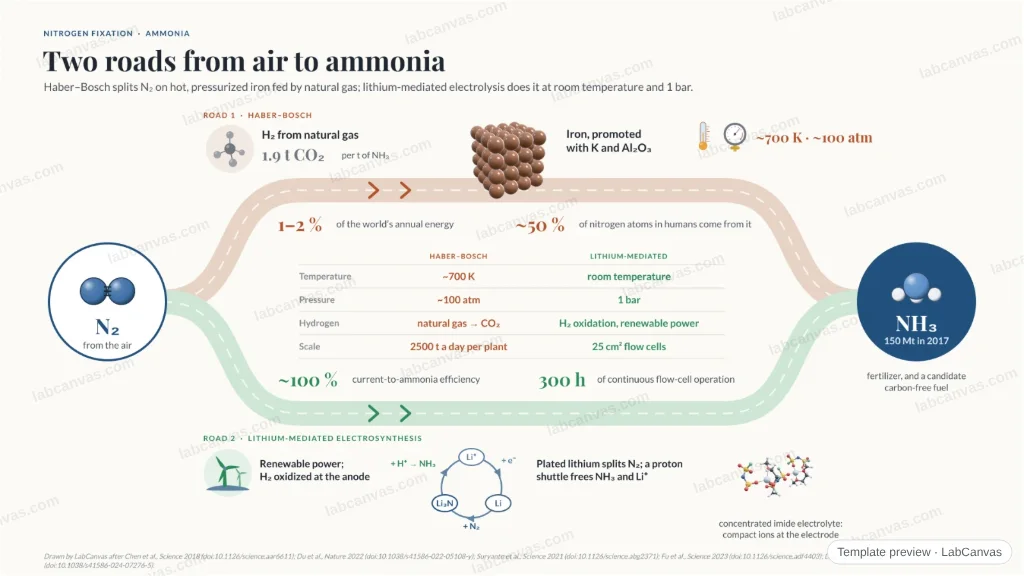
Two roads from nitrogen to ammonia drawn as a fork that rejoins: the Haber–Bosch process on a promoted iron catalyst at about 700 K and 100 atm, fed with hydrogen from natural gas, and lithium-mediated electrochemical nitrogen reduction at room temperature and 1 bar, where plated lithium splits N₂ and a proton shuttle turns the nitride into ammonia. A comparison of the two sits inside the fork.
Updated 7 cited papers89 editable layers
At a glance
- Category
- Graphical abstracts
- Method
- Graphical abstract
- Starting materials
- Nitrogen from the air and hydrogen (from natural gas, or from H₂ oxidation or water with renewable power)
- Product
- Ammonia for fertilizer and as a carbon-free fuel
- Key result
- Haber–Bosch ~700 K, ~100 atm, 1.9 t CO₂/t NH₃, 1–2% of world energy, 2500 t/day per plant, 150 Mt in 2017 (Chen et al. 2018); Li-mediated ~100% efficiency (Du et al. 2022), 61 ± 1% at 1 bar in flow (Fu et al. 2023), 300 h continuous (Li et al. 2024)
- Figure
- 1920 × 1080 px (16:9), 89 editable layers, 4 generated objects
Step by step
- Haber–Bosch: hydrogenUsually from natural gas: about 1.9 t CO₂ per t NH₃; the process takes 1–2% of the world’s annual energy (Chen et al. 2018)
- Haber–Bosch: ironIron promoted with Al₂O₃ and potassium, at ~700 K and ~100 atm; one plant makes about 2500 t NH₃ a day (Chen et al. 2018)
- Lithium: plate and splitLi⁺ is reduced to lithium metal, which dissociates N₂ into a nitride (Nguyen et al. 2026; Kim et al. 2017)
- Lithium: protonateA proton shuttle turns the nitride into NH₃ and frees Li⁺ (Suryanto et al. 2021); a concentrated imide electrolyte gives close to 100% current-to-ammonia efficiency (Du et al. 2022)
- Lithium: run continuously25 cm² flow cells at 1 bar coupling N₂ reduction to H₂ oxidation (Fu et al. 2023), 300 h at room temperature (Li et al. 2024)
Uses
- Graphical abstracts on green ammonia and nitrogen reduction
- Talks comparing thermocatalytic and electrochemical nitrogen fixation
- Teaching the Haber–Bosch process
Papers this template follows
- Chen et al., “Beyond fossil fuel-driven nitrogen transformations”, Science 2018. doi:10.1126/science.aar6611review
- Du et al., “Electroreduction of nitrogen with almost 100% current-to-ammonia efficiency”, Nature 2022. doi:10.1038/s41586-022-05108-yprimary
- Suryanto et al., “Nitrogen reduction to ammonia at high efficiency and rates based on a phosphonium proton shuttle”, Science 2021. doi:10.1126/science.abg2371primary
- Fu et al., “Continuous-flow electrosynthesis of ammonia by nitrogen reduction and hydrogen oxidation”, Science 2023. doi:10.1126/science.adf4403primary
- Li et al., “Long-term continuous ammonia electrosynthesis”, Nature 2024. doi:10.1038/s41586-024-07276-5primary
- Nguyen et al., “Pathways to sustainable lithium-mediated ammonia electrosynthesis: tuning reaction environment and advancing reactor design”, RSC Adv. 2026. doi:10.1039/d6ra02156ereview
- Kim et al., “Electrochemical synthesis of ammonia from water and nitrogen: a lithium-mediated approach using lithium-ion conducting glass ceramics”, ChemSusChem 2017. doi:10.1002/cssc.201701975primary
Drawn by LabCanvas after Chen et al., Science 2018 (doi:10.1126/science.aar6611); Du et al., Nature 2022 (doi:10.1038/s41586-022-05108-y); Suryanto et al., Science 2021 (doi:10.1126/science.abg2371); Fu et al., Science 2023 (doi:10.1126/science.adf4403); Li et al., Nature 2024 (doi:10.1038/s41586-024-07276-5).
How templates are written and checked: editorial guidelines.
Questions
What does the “Making ammonia: Haber–Bosch on iron versus lithium-mediated electrosynthesis” template show?
Two roads from nitrogen to ammonia drawn as a fork that rejoins: the Haber–Bosch process on a promoted iron catalyst at about 700 K and 100 atm, fed with hydrogen from natural gas, and lithium-mediated electrochemical nitrogen reduction at room temperature and 1 bar, where plated lithium splits N₂ and a proton shuttle turns the nitride into ammonia. A comparison of the two sits inside the fork.
What are the steps shown in “Making ammonia: Haber–Bosch on iron versus lithium-mediated electrosynthesis”?
1. Haber–Bosch: hydrogen: Usually from natural gas: about 1.9 t CO₂ per t NH₃; the process takes 1–2% of the world’s annual energy (Chen et al. 2018). 2. Haber–Bosch: iron: Iron promoted with Al₂O₃ and potassium, at ~700 K and ~100 atm; one plant makes about 2500 t NH₃ a day (Chen et al. 2018). 3. Lithium: plate and split: Li⁺ is reduced to lithium metal, which dissociates N₂ into a nitride (Nguyen et al. 2026; Kim et al. 2017). 4. Lithium: protonate: A proton shuttle turns the nitride into NH₃ and frees Li⁺ (Suryanto et al. 2021); a concentrated imide electrolyte gives close to 100% current-to-ammonia efficiency (Du et al. 2022). 5. Lithium: run continuously: 25 cm² flow cells at 1 bar coupling N₂ reduction to H₂ oxidation (Fu et al. 2023), 300 h at room temperature (Li et al. 2024).
What are the starting materials and the product?
Starting materials: Nitrogen from the air and hydrogen (from natural gas, or from H₂ oxidation or water with renewable power). Product: Ammonia for fertilizer and as a carbon-free fuel.
Which papers is “Making ammonia: Haber–Bosch on iron versus lithium-mediated electrosynthesis” based on?
Chen et al., “Beyond fossil fuel-driven nitrogen transformations”, Science 2018 (doi:10.1126/science.aar6611); Du et al., “Electroreduction of nitrogen with almost 100% current-to-ammonia efficiency”, Nature 2022 (doi:10.1038/s41586-022-05108-y); Suryanto et al., “Nitrogen reduction to ammonia at high efficiency and rates based on a phosphonium proton shuttle”, Science 2021 (doi:10.1126/science.abg2371); Fu et al., “Continuous-flow electrosynthesis of ammonia by nitrogen reduction and hydrogen oxidation”, Science 2023 (doi:10.1126/science.adf4403); Li et al., “Long-term continuous ammonia electrosynthesis”, Nature 2024 (doi:10.1038/s41586-024-07276-5); Nguyen et al., “Pathways to sustainable lithium-mediated ammonia electrosynthesis: tuning reaction environment and advancing reactor design”, RSC Adv. 2026 (doi:10.1039/d6ra02156e); Kim et al., “Electrochemical synthesis of ammonia from water and nitrogen: a lithium-mediated approach using lithium-ion conducting glass ceramics”, ChemSusChem 2017 (doi:10.1002/cssc.201701975).
Can I edit the “Making ammonia: Haber–Bosch on iron versus lithium-mediated electrosynthesis” template?
Yes. Open it in the LabCanvas editor: all 89 layers are editable, including 4 generated objects (structures, plots, equipment) with their own settings. Change the text, colours and layout, then export PNG, TIFF, SVG or PDF.
Do I need an account to use this template?
Not to view it here. To open and edit it, sign in to LabCanvas or create a free account (the free plan keeps up to 3 designs). Downloading the figure is part of LabCanvas Pro (US$19 a month or US$199 a year).





