Graphical abstract template · Graphical abstracts · Graphical abstract
Mechanical metamaterials: properties from geometry, not chemistry
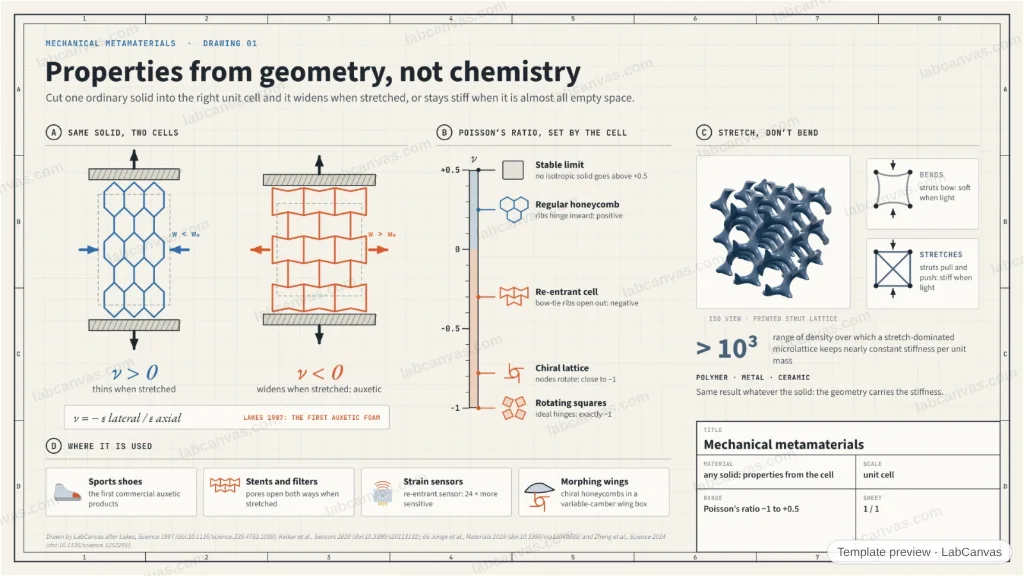
An engineering drawing sheet for architected materials: two specimens of the same solid, one a regular honeycomb that thins when pulled and one a re-entrant honeycomb that widens (a negative Poisson’s ratio), a ruler of Poisson’s ratio from +0.5 to −1 with the cells that reach it, and a 3D strut lattice whose members stretch instead of bending, keeping its stiffness per unit mass over three orders of magnitude in density.
Updated 4 cited papers274 editable layers
At a glance
- Category
- Graphical abstracts
- Method
- Graphical abstract
- Starting materials
- One ordinary solid (polymer, metal or ceramic)
- Product
- A lattice whose unit cell sets its Poisson’s ratio and its stiffness per unit mass
- Key result
- ν between −1 and +0.5 for stable isotropic solids; ν = −1 for ideal rotating squares (Kelkar et al. 2020); nearly constant stiffness per mass over > 3 orders of magnitude in density (Zheng et al. 2014)
- Figure
- 1920 × 1080 px (16:9), 274 editable layers, 2 generated objects
Step by step
- Same solid, two cellsA conventional material thins when stretched; a foam or honeycomb with re-entrant cells expands laterally instead, a negative Poisson’s ratio (Lakes 1987; Kelkar et al. 2020)
- The cell sets νFor a stable isotropic solid ν lies between −1 and +0.5; re-entrant cells give ν < 0, chiral lattices approach −1 and ideal rotating squares reach −1 (Kelkar et al. 2020)
- Stretch, don’t bendMembers that carry load in tension or compression keep stiffness per unit mass nearly constant over more than three orders of magnitude in density, in polymer, metal or ceramic (Zheng et al. 2014)
- UsesSports shoes (the first commercial auxetic products), stents and filters, a strain sensor 24 times more sensitive, chiral honeycombs in variable-camber morphing wings (Kelkar et al. 2020)
Uses
- Graphical abstracts on mechanical metamaterials and auxetics
- Talks on architected lattices and additive manufacturing
- Teaching Poisson’s ratio and cellular solids
Papers this template follows
- Lakes, “Foam Structures with a Negative Poisson's Ratio”, Science 1987. doi:10.1126/science.235.4792.1038method origin
- Kelkar et al., “Cellular Auxetic Structures for Mechanical Metamaterials: A Review”, Sensors 2020. doi:10.3390/s20113132review
- de Jonge, Kolken & Zadpoor, “Non-Auxetic Mechanical Metamaterials”, Materials 2019. doi:10.3390/ma12040635review
- Zheng et al., “Ultralight, ultrastiff mechanical metamaterials”, Science 2014. doi:10.1126/science.1252291primary
Drawn by LabCanvas after Lakes, Science 1987 (doi:10.1126/science.235.4792.1038); Kelkar et al., Sensors 2020 (doi:10.3390/s20113132); de Jonge et al., Materials 2019 (doi:10.3390/ma12040635) and Zheng et al., Science 2014 (doi:10.1126/science.1252291).
How templates are written and checked: editorial guidelines.
Questions
What does the “Mechanical metamaterials: properties from geometry, not chemistry” template show?
An engineering drawing sheet for architected materials: two specimens of the same solid, one a regular honeycomb that thins when pulled and one a re-entrant honeycomb that widens (a negative Poisson’s ratio), a ruler of Poisson’s ratio from +0.5 to −1 with the cells that reach it, and a 3D strut lattice whose members stretch instead of bending, keeping its stiffness per unit mass over three orders of magnitude in density.
What are the steps shown in “Mechanical metamaterials: properties from geometry, not chemistry”?
1. Same solid, two cells: A conventional material thins when stretched; a foam or honeycomb with re-entrant cells expands laterally instead, a negative Poisson’s ratio (Lakes 1987; Kelkar et al. 2020). 2. The cell sets ν: For a stable isotropic solid ν lies between −1 and +0.5; re-entrant cells give ν < 0, chiral lattices approach −1 and ideal rotating squares reach −1 (Kelkar et al. 2020). 3. Stretch, don’t bend: Members that carry load in tension or compression keep stiffness per unit mass nearly constant over more than three orders of magnitude in density, in polymer, metal or ceramic (Zheng et al. 2014). 4. Uses: Sports shoes (the first commercial auxetic products), stents and filters, a strain sensor 24 times more sensitive, chiral honeycombs in variable-camber morphing wings (Kelkar et al. 2020).
What are the starting materials and the product?
Starting materials: One ordinary solid (polymer, metal or ceramic). Product: A lattice whose unit cell sets its Poisson’s ratio and its stiffness per unit mass.
Which papers is “Mechanical metamaterials: properties from geometry, not chemistry” based on?
Lakes, “Foam Structures with a Negative Poisson's Ratio”, Science 1987 (doi:10.1126/science.235.4792.1038); Kelkar et al., “Cellular Auxetic Structures for Mechanical Metamaterials: A Review”, Sensors 2020 (doi:10.3390/s20113132); de Jonge, Kolken & Zadpoor, “Non-Auxetic Mechanical Metamaterials”, Materials 2019 (doi:10.3390/ma12040635); Zheng et al., “Ultralight, ultrastiff mechanical metamaterials”, Science 2014 (doi:10.1126/science.1252291).
Can I edit the “Mechanical metamaterials: properties from geometry, not chemistry” template?
Yes. Open it in the LabCanvas editor: all 274 layers are editable, including 2 generated objects (structures, plots, equipment) with their own settings. Change the text, colours and layout, then export PNG, TIFF, SVG or PDF.
Do I need an account to use this template?
Not to view it here. To open and edit it, sign in to LabCanvas or create a free account (the free plan keeps up to 3 designs). Downloading the figure is part of LabCanvas Pro (US$19 a month or US$199 a year).