Graphical abstract template · Materials graphical abstracts · Graphical abstract
Memristors for brain-inspired computing: the synapse and its electronic twin
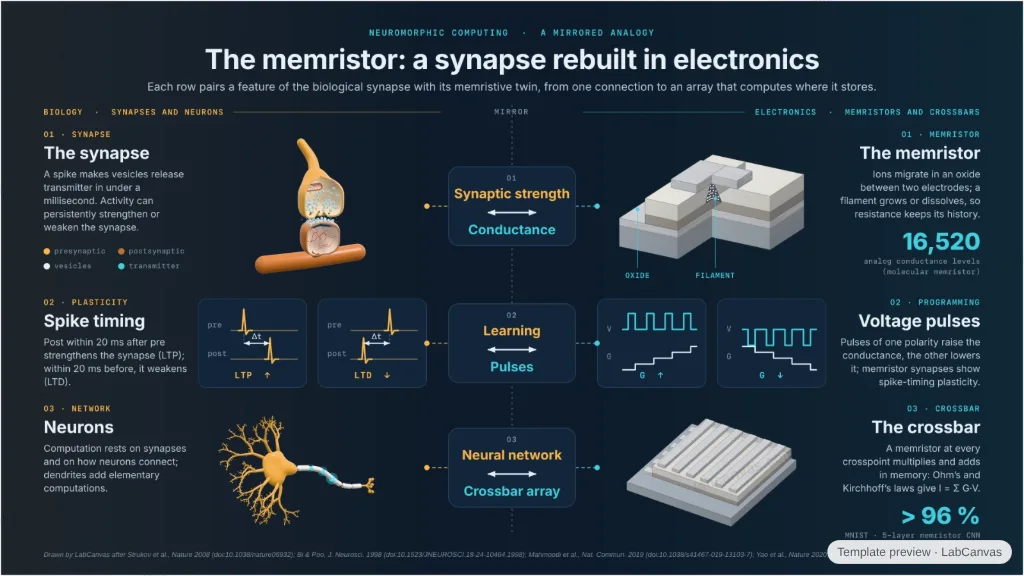
A mirrored graphical abstract: the biological synapse on the left, the memristor on the right, and a central spine that pairs them row by row. Synaptic strength maps to conductance, spike-timing learning to voltage pulses, and a neural network to a crossbar array that multiplies in memory.
Updated 12 cited papers113 editable layers
At a glance
- Category
- Materials graphical abstracts
- Method
- Graphical abstract
- Starting materials
- A biological synapse whose strength changes with activity
- Product
- A two-terminal memristor whose conductance plays the synaptic weight, in crossbars that compute in memory
- Key result
- Spike-timing window 20 ms either way (Bi & Poo 1998); 16,520 analog conductance levels, 14-bit, in a molecular memristor (Sharma et al. 2024); more than 96% MNIST accuracy for a five-layer memristor CNN on eight 2,048-cell arrays (Yao et al. 2020)
- Figure
- 1920 × 1080 px (16:9), 113 editable layers, 2 generated objects
Step by step
- Synaptic strength ↔ conductanceA spike makes vesicles release transmitter in under a millisecond (Südhof 2013) and a synapse can be persistently strengthened or weakened (Bi & Poo 1998); a memristor is a conductor/oxide/conductor stack whose resistance, set by ion motion and a filament that forms or dissolves, remembers its history (Yang et al. 2013; Kumar et al. 2016)
- Learning ↔ pulsesPost spiking within 20 ms after pre gives LTP, within 20 ms before gives LTD (Bi & Poo 1998); voltage pulses tune a memristor’s conductance, and memristor synapses show spike-timing-dependent plasticity (Jo et al. 2010)
- Neural network ↔ crossbar arrayNetwork computation rests on synapses and connectivity (London & Häusser 2005); a crossbar with a memristor at every crosspoint does the vector–matrix product by Ohm’s and Kirchhoff’s laws, I = Σ G·V (Mahmoodi et al. 2019; Xia & Yang 2019)
Uses
- Graphical abstracts on neuromorphic hardware
- Talks and posters on memristors and in-memory computing
- Teaching the synapse–memristor analogy
Papers this template follows
- Strukov, Snider, Stewart & Williams, “The missing memristor found”, Nature 2008. doi:10.1038/nature06932method origin
- Jo et al., “Nanoscale memristor device as synapse in neuromorphic systems”, Nano Lett. 2010. doi:10.1021/nl904092hprimary
- Bi & Poo, “Synaptic modifications in cultured hippocampal neurons: dependence on spike timing, synaptic strength, and postsynaptic cell type”, J. Neurosci. 1998. doi:10.1523/JNEUROSCI.18-24-10464.1998primary
- Kumar et al., “Conduction channel formation and dissolution due to oxygen thermophoresis/diffusion in hafnium oxide memristors”, ACS Nano 2016. doi:10.1021/acsnano.6b06275primary
- Prezioso et al., “Training and operation of an integrated neuromorphic network based on metal-oxide memristors”, Nature 2015. doi:10.1038/nature14441primary
- Mahmoodi, Prezioso & Strukov, “Versatile stochastic dot product circuits based on nonvolatile memories for high performance neurocomputing and neurooptimization”, Nat. Commun. 2019. doi:10.1038/s41467-019-13103-7primary
- Yao et al., “Fully hardware-implemented memristor convolutional neural network”, Nature 2020. doi:10.1038/s41586-020-1942-4primary
- Sharma et al., “Linear symmetric self-selecting 14-bit kinetic molecular memristors”, Nature 2024. doi:10.1038/s41586-024-07902-2primary
- Yang, Strukov & Stewart, “Memristive devices for computing”, Nat. Nanotechnol. 2013. doi:10.1038/nnano.2012.240review
- Xia & Yang, “Memristive crossbar arrays for brain-inspired computing”, Nat. Mater. 2019. doi:10.1038/s41563-019-0291-xreview
- Südhof, “Neurotransmitter release: the last millisecond in the life of a synaptic vesicle”, Neuron 2013. doi:10.1016/j.neuron.2013.10.022review
- London & Häusser, “Dendritic computation”, Annu. Rev. Neurosci. 2005. doi:10.1146/annurev.neuro.28.061604.135703further reading
Drawn by LabCanvas after Strukov et al., Nature 2008 (doi:10.1038/nature06932); Bi & Poo, J. Neurosci. 1998 (doi:10.1523/JNEUROSCI.18-24-10464.1998); Mahmoodi et al., Nat. Commun. 2019 (doi:10.1038/s41467-019-13103-7); Yao et al., Nature 2020 and Sharma et al., Nature 2024.
How templates are written and checked: editorial guidelines.
Questions
What does the “Memristors for brain-inspired computing: the synapse and its electronic twin” template show?
A mirrored graphical abstract: the biological synapse on the left, the memristor on the right, and a central spine that pairs them row by row. Synaptic strength maps to conductance, spike-timing learning to voltage pulses, and a neural network to a crossbar array that multiplies in memory.
What are the steps shown in “Memristors for brain-inspired computing: the synapse and its electronic twin”?
1. Synaptic strength ↔ conductance: A spike makes vesicles release transmitter in under a millisecond (Südhof 2013) and a synapse can be persistently strengthened or weakened (Bi & Poo 1998); a memristor is a conductor/oxide/conductor stack whose resistance, set by ion motion and a filament that forms or dissolves, remembers its history (Yang et al. 2013; Kumar et al. 2016). 2. Learning ↔ pulses: Post spiking within 20 ms after pre gives LTP, within 20 ms before gives LTD (Bi & Poo 1998); voltage pulses tune a memristor’s conductance, and memristor synapses show spike-timing-dependent plasticity (Jo et al. 2010). 3. Neural network ↔ crossbar array: Network computation rests on synapses and connectivity (London & Häusser 2005); a crossbar with a memristor at every crosspoint does the vector–matrix product by Ohm’s and Kirchhoff’s laws, I = Σ G·V (Mahmoodi et al. 2019; Xia & Yang 2019).
What are the starting materials and the product?
Starting materials: A biological synapse whose strength changes with activity. Product: A two-terminal memristor whose conductance plays the synaptic weight, in crossbars that compute in memory.
Which papers is “Memristors for brain-inspired computing: the synapse and its electronic twin” based on?
Strukov, Snider, Stewart & Williams, “The missing memristor found”, Nature 2008 (doi:10.1038/nature06932); Jo et al., “Nanoscale memristor device as synapse in neuromorphic systems”, Nano Lett. 2010 (doi:10.1021/nl904092h); Bi & Poo, “Synaptic modifications in cultured hippocampal neurons: dependence on spike timing, synaptic strength, and postsynaptic cell type”, J. Neurosci. 1998 (doi:10.1523/JNEUROSCI.18-24-10464.1998); Kumar et al., “Conduction channel formation and dissolution due to oxygen thermophoresis/diffusion in hafnium oxide memristors”, ACS Nano 2016 (doi:10.1021/acsnano.6b06275); Prezioso et al., “Training and operation of an integrated neuromorphic network based on metal-oxide memristors”, Nature 2015 (doi:10.1038/nature14441); Mahmoodi, Prezioso & Strukov, “Versatile stochastic dot product circuits based on nonvolatile memories for high performance neurocomputing and neurooptimization”, Nat. Commun. 2019 (doi:10.1038/s41467-019-13103-7); Yao et al., “Fully hardware-implemented memristor convolutional neural network”, Nature 2020 (doi:10.1038/s41586-020-1942-4); Sharma et al., “Linear symmetric self-selecting 14-bit kinetic molecular memristors”, Nature 2024 (doi:10.1038/s41586-024-07902-2); Yang, Strukov & Stewart, “Memristive devices for computing”, Nat. Nanotechnol. 2013 (doi:10.1038/nnano.2012.240); Xia & Yang, “Memristive crossbar arrays for brain-inspired computing”, Nat. Mater. 2019 (doi:10.1038/s41563-019-0291-x); Südhof, “Neurotransmitter release: the last millisecond in the life of a synaptic vesicle”, Neuron 2013 (doi:10.1016/j.neuron.2013.10.022); London & Häusser, “Dendritic computation”, Annu. Rev. Neurosci. 2005 (doi:10.1146/annurev.neuro.28.061604.135703).
Can I edit the “Memristors for brain-inspired computing: the synapse and its electronic twin” template?
Yes. Open it in the LabCanvas editor: all 113 layers are editable, including 2 generated objects (structures, plots, equipment) with their own settings. Change the text, colours and layout, then export PNG, TIFF, SVG or PDF.
Do I need an account to use this template?
Not to view it here. To open and edit it, sign in to LabCanvas or create a free account (the free plan keeps up to 3 designs). Downloading the figure is part of LabCanvas Pro (US$19 a month or US$199 a year).