Graphical abstract template · Graphical abstracts · Graphical abstract
Molecular solar thermal storage: sunlight kept as strain, released as heat
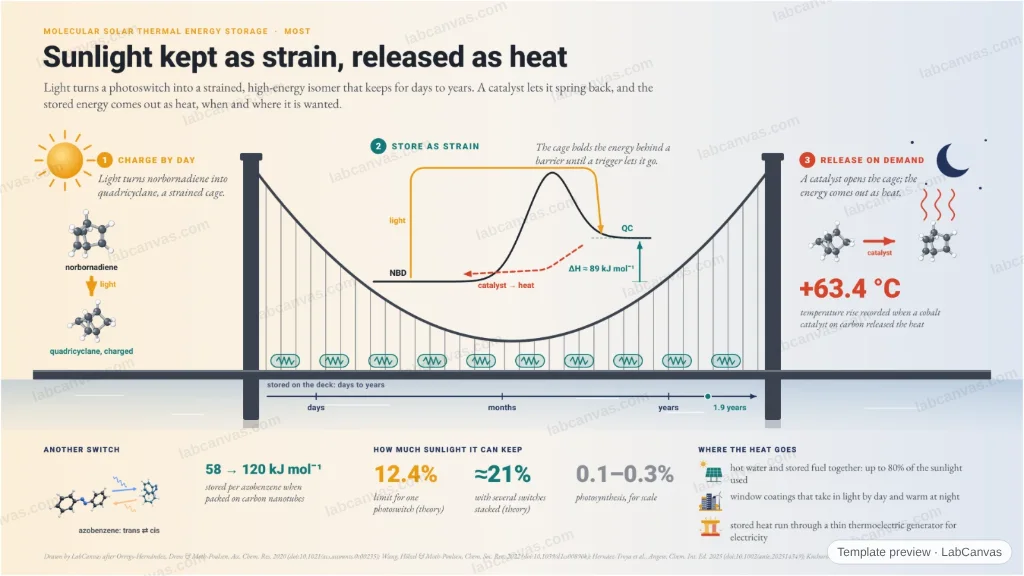
A photoswitch charged by sunlight keeps the energy as the strain of a high-energy isomer: norbornadiene becomes quadricyclane, which can be stored for days to years and turned back by a catalyst to release heat. Drawn as a bridge from day to night, with azobenzene as a second switch, the efficiency ceiling and the first devices.
Updated 5 cited papers162 editable layers
At a glance
- Category
- Graphical abstracts
- Method
- Graphical abstract
- Starting materials
- A photoswitch such as norbornadiene (NBD), often with donor–acceptor substituents
- Product
- The strained, high-energy photoisomer (quadricyclane, QC) that stores the energy until a trigger releases it as heat
- Key result
- 0.40 MJ kg⁻¹ (89 kJ mol⁻¹), ΔT 63.4 °C, efficiency limits 12.4% and ≈21% vs 0.1–0.3% photosynthesis, 80% combined in a hybrid (Wang et al. 2022); 1.9 years storage (Hernáez-Troya et al. 2025); azobenzene on nanotubes 58 → 120 kJ mol⁻¹ (Kucharski et al. 2014)
- Figure
- 1920 × 1080 px (16:9), 162 editable layers, 7 generated objects
Step by step
- Charge by dayLight converts norbornadiene into the strained polycyclic quadricyclane; donor–acceptor groups shift the absorption towards the solar spectrum (Orrego-Hernández et al. 2020); unsubstituted NBD absorbs only from about 300 nm (Wang et al. 2022)
- Store as strainA donor–acceptor NBD stores 0.40 MJ kg⁻¹ (89 kJ mol⁻¹), absorbing up to 380 nm; half-lives of months or years are the goal and shorten when hotter (Wang et al. 2022); a water-soluble pair keeps for 1.9 years (Hernáez-Troya et al. 2025)
- Release on demandA cobalt phthalocyanine on carbon catalyst opened the cage with a maximum temperature difference of 63.4 °C (Wang et al. 2022)
- Use the heatA hybrid with solar water heating reached up to 80% combined solar use; heat to electricity with a thin thermoelectric generator (Wang et al. 2022); window coatings that absorb by day and warm at night (Orrego-Hernández et al. 2020)
Uses
- Graphical abstracts on molecular solar thermal storage and solar thermal fuels
- Talks on photoswitches for energy
- Teaching strain energy and catalysed back-conversion
Papers this template follows
- Orrego-Hernández, Dreos & Moth-Poulsen, “Engineering of Norbornadiene/Quadricyclane Photoswitches for Molecular Solar Thermal Energy Storage Applications”, Acc. Chem. Res. 2020. doi:10.1021/acs.accounts.0c00235review
- Wang, Hölzel & Moth-Poulsen, “Status and challenges for molecular solar thermal energy storage system based devices”, Chem. Soc. Rev. 2022. doi:10.1039/d1cs00890kreview
- Hernáez-Troya et al., “A Water Soluble and Solid-State Molecular Solar Thermal (MOST) System as Renewable Solar Fuel”, Angew. Chem. Int. Ed. 2025. doi:10.1002/anie.202514349primary
- Kucharski et al., “Templated assembly of photoswitches significantly increases the energy-storage capacity of solar thermal fuels”, Nat. Chem. 2014. doi:10.1038/nchem.1918primary
- Magson et al., “Greener Solvents for the Photoisomerization and Catalytic Heat Release of a Norbornadiene-Based Molecular Solar Thermal Energy Storage System”, Adv. Sci. 2026. doi:10.1002/advs.77637further reading
Drawn by LabCanvas after Orrego-Hernández, Dreos & Moth-Poulsen, Acc. Chem. Res. 2020 (doi:10.1021/acs.accounts.0c00235); Wang, Hölzel & Moth-Poulsen, Chem. Soc. Rev. 2022 (doi:10.1039/d1cs00890k); Hernáez-Troya et al., Angew. Chem. Int. Ed. 2025 (doi:10.1002/anie.202514349); Kucharski et al., Nat. Chem. 2014 (doi:10.1038/nchem.1918).
How templates are written and checked: editorial guidelines.
Questions
What does the “Molecular solar thermal storage: sunlight kept as strain, released as heat” template show?
A photoswitch charged by sunlight keeps the energy as the strain of a high-energy isomer: norbornadiene becomes quadricyclane, which can be stored for days to years and turned back by a catalyst to release heat. Drawn as a bridge from day to night, with azobenzene as a second switch, the efficiency ceiling and the first devices.
What are the steps shown in “Molecular solar thermal storage: sunlight kept as strain, released as heat”?
1. Charge by day: Light converts norbornadiene into the strained polycyclic quadricyclane; donor–acceptor groups shift the absorption towards the solar spectrum (Orrego-Hernández et al. 2020); unsubstituted NBD absorbs only from about 300 nm (Wang et al. 2022). 2. Store as strain: A donor–acceptor NBD stores 0.40 MJ kg⁻¹ (89 kJ mol⁻¹), absorbing up to 380 nm; half-lives of months or years are the goal and shorten when hotter (Wang et al. 2022); a water-soluble pair keeps for 1.9 years (Hernáez-Troya et al. 2025). 3. Release on demand: A cobalt phthalocyanine on carbon catalyst opened the cage with a maximum temperature difference of 63.4 °C (Wang et al. 2022). 4. Use the heat: A hybrid with solar water heating reached up to 80% combined solar use; heat to electricity with a thin thermoelectric generator (Wang et al. 2022); window coatings that absorb by day and warm at night (Orrego-Hernández et al. 2020).
What are the starting materials and the product?
Starting materials: A photoswitch such as norbornadiene (NBD), often with donor–acceptor substituents. Product: The strained, high-energy photoisomer (quadricyclane, QC) that stores the energy until a trigger releases it as heat.
Which papers is “Molecular solar thermal storage: sunlight kept as strain, released as heat” based on?
Orrego-Hernández, Dreos & Moth-Poulsen, “Engineering of Norbornadiene/Quadricyclane Photoswitches for Molecular Solar Thermal Energy Storage Applications”, Acc. Chem. Res. 2020 (doi:10.1021/acs.accounts.0c00235); Wang, Hölzel & Moth-Poulsen, “Status and challenges for molecular solar thermal energy storage system based devices”, Chem. Soc. Rev. 2022 (doi:10.1039/d1cs00890k); Hernáez-Troya et al., “A Water Soluble and Solid-State Molecular Solar Thermal (MOST) System as Renewable Solar Fuel”, Angew. Chem. Int. Ed. 2025 (doi:10.1002/anie.202514349); Kucharski et al., “Templated assembly of photoswitches significantly increases the energy-storage capacity of solar thermal fuels”, Nat. Chem. 2014 (doi:10.1038/nchem.1918); Magson et al., “Greener Solvents for the Photoisomerization and Catalytic Heat Release of a Norbornadiene-Based Molecular Solar Thermal Energy Storage System”, Adv. Sci. 2026 (doi:10.1002/advs.77637).
Can I edit the “Molecular solar thermal storage: sunlight kept as strain, released as heat” template?
Yes. Open it in the LabCanvas editor: all 162 layers are editable, including 7 generated objects (structures, plots, equipment) with their own settings. Change the text, colours and layout, then export PNG, TIFF, SVG or PDF.
Do I need an account to use this template?
Not to view it here. To open and edit it, sign in to LabCanvas or create a free account (the free plan keeps up to 3 designs). Downloading the figure is part of LabCanvas Pro (US$19 a month or US$199 a year).