Graphical abstract template · Graphical abstracts · Graphical abstract
MRAM: a bit stored in the spins of a tunnel junction
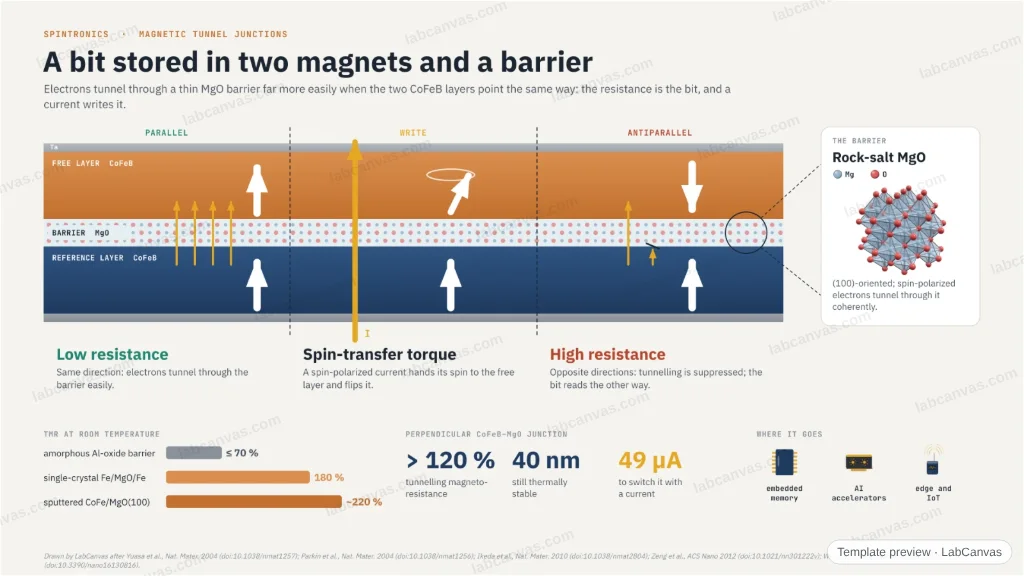
The layers of a CoFeB/MgO magnetic tunnel junction run across the figure as bands: with parallel magnetizations electrons tunnel easily (low resistance), a spin-polarized current writes the bit by spin-transfer torque, and antiparallel magnetizations block tunnelling (high resistance). A live 3D rock-salt lattice shows the MgO barrier; below, the room-temperature tunnelling magnetoresistance that crystalline MgO unlocked, the perpendicular junction’s numbers and where MRAM is used.
Updated 9 cited papers342 editable layers
At a glance
- Category
- Graphical abstracts
- Method
- Graphical abstract
- Starting materials
- Sputtered Ta/CoFeB/MgO/CoFeB/Ta stacks
- Product
- A non-volatile memory cell read by its tunnelling resistance and written by spin-transfer torque
- Key result
- TMR up to 180 % (Yuasa et al. 2004) and ~220 % (Parkin et al. 2004) at room temperature vs ≤ 70 % for Al-oxide; perpendicular CoFeB–MgO: > 120 %, stable at 40 nm, 49 µA switching (Ikeda et al. 2010)
- Figure
- 1920 × 1080 px (16:9), 342 editable layers, 3 generated objects
Step by step
- Two magnets and a barrierTwo ferromagnetic layers separated by a thin insulator; the resistance changes drastically between parallel and antiparallel magnetizations (Kohno et al. 2024; Yuan et al. 2026)
- ReadParallel: a low-resistance tunnelling path; antiparallel: high resistance (Yuan et al. 2026)
- WriteA spin-polarized current transfers spin angular momentum to the free layer (Zeng et al. 2012) and switches it; 49 µA in a perpendicular CoFeB–MgO junction (Ikeda et al. 2010)
- Crystalline MgOAmorphous Al-oxide barriers reach up to 70 % TMR at room temperature; Fe/MgO/Fe up to 180 % by coherent spin-polarized tunnelling (Yuasa et al. 2004); sputtered CoFe/MgO(100) ~220 % (Parkin et al. 2004)
- UsesEmbedded memories, edge and automotive electronics, AI accelerators (Wang et al. 2026; Yang et al. 2022)
Uses
- Graphical abstracts on spintronics and MRAM
- Talks on magnetic tunnel junctions and spin-transfer torque
- Teaching tunnelling magnetoresistance
Papers this template follows
- Yuasa et al., “Giant room-temperature magnetoresistance in single-crystal Fe/MgO/Fe magnetic tunnel junctions”, Nat. Mater. 2004. doi:10.1038/nmat1257primary
- Parkin et al., “Giant tunnelling magnetoresistance at room temperature with MgO (100) tunnel barriers”, Nat. Mater. 2004. doi:10.1038/nmat1256primary
- Ikeda et al., “A perpendicular-anisotropy CoFeB-MgO magnetic tunnel junction”, Nat. Mater. 2010. doi:10.1038/nmat2804primary
- Zeng et al., “High-power coherent microwave emission from magnetic tunnel junction nano-oscillators with perpendicular anisotropy”, ACS Nano 2012. doi:10.1021/nn301222vprimary
- Kohno et al., “Magnetic field observation in a magnetic tunnel junction by scanning transmission electron microscopy”, Microscopy 2024. doi:10.1093/jmicro/dfad063primary
- Yuan, Jian & Li, “Fe3GaTe2/Ga2Ge2Te2/Fe3GaTe2: a promising van der Waals magnetic tunnel junction with giant tunnel magnetoresistance”, J. Phys. Condens. Matter 2026. doi:10.1088/1361-648X/ae55effurther reading
- Chen, Mo & Mao, “Study of the magnetism of C-doped MgO based on first-principles calculations and the Ising model”, Phys. Chem. Chem. Phys. 2024. doi:10.1039/d3cp05383kfurther reading
- Wang, Li & Jiang, “MRAM: a versatile non-volatile memory for next-generation computing”, Nanomaterials 2026. doi:10.3390/nano16130816review
- Yang et al., “Two-dimensional materials prospects for non-volatile spintronic memories”, Nature 2022. doi:10.1038/s41586-022-04768-0review
Drawn by LabCanvas after Yuasa et al., Nat. Mater. 2004 (doi:10.1038/nmat1257); Parkin et al., Nat. Mater. 2004 (doi:10.1038/nmat1256); Ikeda et al., Nat. Mater. 2010 (doi:10.1038/nmat2804); Zeng et al., ACS Nano 2012 (doi:10.1021/nn301222v); Wang, Li & Jiang, Nanomaterials 2026 (doi:10.3390/nano16130816).
How templates are written and checked: editorial guidelines.
Questions
What does the “MRAM: a bit stored in the spins of a tunnel junction” template show?
The layers of a CoFeB/MgO magnetic tunnel junction run across the figure as bands: with parallel magnetizations electrons tunnel easily (low resistance), a spin-polarized current writes the bit by spin-transfer torque, and antiparallel magnetizations block tunnelling (high resistance). A live 3D rock-salt lattice shows the MgO barrier; below, the room-temperature tunnelling magnetoresistance that crystalline MgO unlocked, the perpendicular junction’s numbers and where MRAM is used.
What are the steps shown in “MRAM: a bit stored in the spins of a tunnel junction”?
1. Two magnets and a barrier: Two ferromagnetic layers separated by a thin insulator; the resistance changes drastically between parallel and antiparallel magnetizations (Kohno et al. 2024; Yuan et al. 2026). 2. Read: Parallel: a low-resistance tunnelling path; antiparallel: high resistance (Yuan et al. 2026). 3. Write: A spin-polarized current transfers spin angular momentum to the free layer (Zeng et al. 2012) and switches it; 49 µA in a perpendicular CoFeB–MgO junction (Ikeda et al. 2010). 4. Crystalline MgO: Amorphous Al-oxide barriers reach up to 70 % TMR at room temperature; Fe/MgO/Fe up to 180 % by coherent spin-polarized tunnelling (Yuasa et al. 2004); sputtered CoFe/MgO(100) ~220 % (Parkin et al. 2004). 5. Uses: Embedded memories, edge and automotive electronics, AI accelerators (Wang et al. 2026; Yang et al. 2022).
What are the starting materials and the product?
Starting materials: Sputtered Ta/CoFeB/MgO/CoFeB/Ta stacks. Product: A non-volatile memory cell read by its tunnelling resistance and written by spin-transfer torque.
Which papers is “MRAM: a bit stored in the spins of a tunnel junction” based on?
Yuasa et al., “Giant room-temperature magnetoresistance in single-crystal Fe/MgO/Fe magnetic tunnel junctions”, Nat. Mater. 2004 (doi:10.1038/nmat1257); Parkin et al., “Giant tunnelling magnetoresistance at room temperature with MgO (100) tunnel barriers”, Nat. Mater. 2004 (doi:10.1038/nmat1256); Ikeda et al., “A perpendicular-anisotropy CoFeB-MgO magnetic tunnel junction”, Nat. Mater. 2010 (doi:10.1038/nmat2804); Zeng et al., “High-power coherent microwave emission from magnetic tunnel junction nano-oscillators with perpendicular anisotropy”, ACS Nano 2012 (doi:10.1021/nn301222v); Kohno et al., “Magnetic field observation in a magnetic tunnel junction by scanning transmission electron microscopy”, Microscopy 2024 (doi:10.1093/jmicro/dfad063); Yuan, Jian & Li, “Fe3GaTe2/Ga2Ge2Te2/Fe3GaTe2: a promising van der Waals magnetic tunnel junction with giant tunnel magnetoresistance”, J. Phys. Condens. Matter 2026 (doi:10.1088/1361-648X/ae55ef); Chen, Mo & Mao, “Study of the magnetism of C-doped MgO based on first-principles calculations and the Ising model”, Phys. Chem. Chem. Phys. 2024 (doi:10.1039/d3cp05383k); Wang, Li & Jiang, “MRAM: a versatile non-volatile memory for next-generation computing”, Nanomaterials 2026 (doi:10.3390/nano16130816); Yang et al., “Two-dimensional materials prospects for non-volatile spintronic memories”, Nature 2022 (doi:10.1038/s41586-022-04768-0).
Can I edit the “MRAM: a bit stored in the spins of a tunnel junction” template?
Yes. Open it in the LabCanvas editor: all 342 layers are editable, including 3 generated objects (structures, plots, equipment) with their own settings. Change the text, colours and layout, then export PNG, TIFF, SVG or PDF.
Do I need an account to use this template?
Not to view it here. To open and edit it, sign in to LabCanvas or create a free account (the free plan keeps up to 3 designs). Downloading the figure is part of LabCanvas Pro (US$19 a month or US$199 a year).