Graphical abstract template · Materials graphical abstracts · Graphical abstract
Nanozymes: nanoparticles that act like enzymes
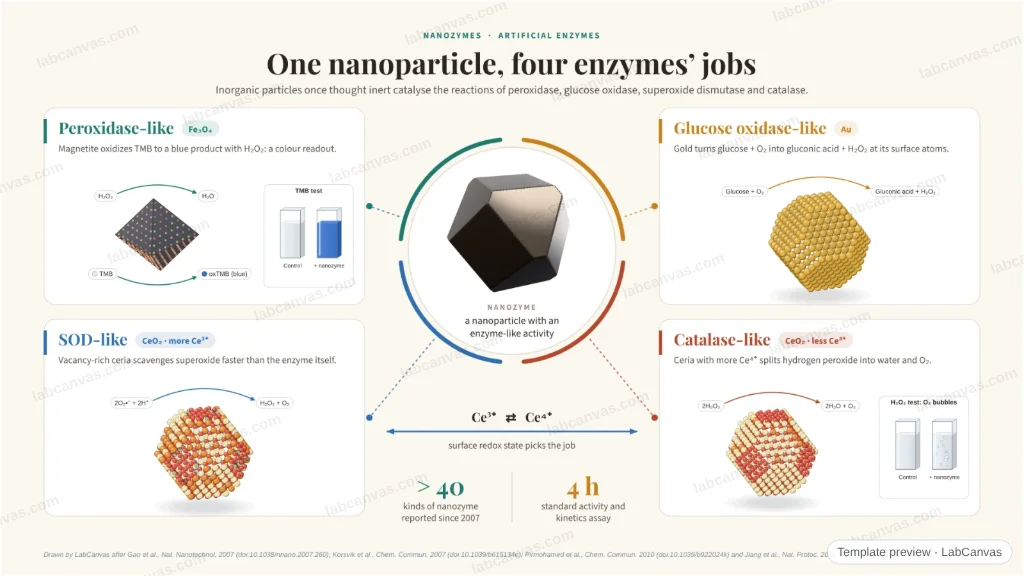
A radial graphical abstract: one nanoparticle at the hub and four enzyme-like activities around it, each on the material that showed it. Magnetite oxidizes substrates like a peroxidase, gold oxidizes glucose like glucose oxidase, and ceria scavenges superoxide or splits hydrogen peroxide depending on how much Ce³⁺ its surface carries.
Updated 9 cited papers58 editable layers
At a glance
- Category
- Materials graphical abstracts
- Method
- Graphical abstract
- Starting materials
- Inorganic nanoparticles once thought inert: magnetite, gold and ceria
- Product
- Nanozymes with peroxidase-, glucose oxidase-, superoxide dismutase- and catalase-like activity
- Key result
- More than 40 types of nanozymes since 2007, and a 4 h standard assay for peroxidase nanozymes (Jiang et al. 2018); ceria’s SOD-like rate constant exceeds the enzyme’s (Korsvik et al. 2007)
- Figure
- 1920 × 1080 px (16:9), 58 editable layers, 4 generated objects
Step by step
- Peroxidase-like · Fe₃O₄Magnetite nanoparticles have an intrinsic peroxidase-like activity (Gao et al. 2007); an Fe₃O₄ nanozyme oxidizes TMB to a blue product in the presence of H₂O₂ (Chit et al. 2026)
- Glucose oxidase-like · goldGold nanoparticles act as glucose-oxidase-like nanozymes, self-limited but true catalysts, with only their surface atoms as active sites (Zandieh & Liu 2021); they oxidize glucose into gluconic acid and H₂O₂ (Li et al. 2022)
- Superoxide dismutase-like · CeO₂ (more Ce³⁺)Vacancy-engineered ceria mimics SOD with a rate constant above the enzyme’s (Korsvik et al. 2007); superoxide scavenging is best with more surface Ce³⁺ (Pirmohamed et al. 2010)
- Catalase-like · CeO₂ (less Ce³⁺)Ceria with less surface Ce³⁺ breaks hydrogen peroxide down to O₂, the opposite trend to its SOD-like activity (Pirmohamed et al. 2010)
Uses
- Graphical abstracts on nanozymes and artificial enzymes
- Talks on nanozyme-based biosensing and immunoassays
- Teaching enzyme-like activity of inorganic nanoparticles
Papers this template follows
- Gao et al., “Intrinsic peroxidase-like activity of ferromagnetic nanoparticles”, Nat. Nanotechnol. 2007. doi:10.1038/nnano.2007.260method origin
- Korsvik, Patil, Seal & Self, “Superoxide dismutase mimetic properties exhibited by vacancy engineered ceria nanoparticles”, Chem. Commun. 2007. doi:10.1039/b615134eprimary
- Pirmohamed et al., “Nanoceria exhibit redox state-dependent catalase mimetic activity”, Chem. Commun. 2010. doi:10.1039/b922024kprimary
- Chit et al., “Ultrasensitive ppt-level detection of perfluorooctanoic acid (PFOA) via a hybrid nanozyme, Fe3O4@MWCNTs, with enhanced peroxidase-like activity”, Anal. Chem. 2026. doi:10.1021/acs.analchem.6c02884primary
- Jiang et al., “Standardized assays for determining the catalytic activity and kinetics of peroxidase-like nanozymes”, Nat. Protoc. 2018. doi:10.1038/s41596-018-0001-1method origin
- Li et al., “Injectable hydrogel based on defect-rich multi-nanozymes for diabetic wound healing via an oxygen self-supplying cascade reaction”, Small 2022. doi:10.1002/smll.202200165primary
- Zandieh & Liu, “Nanozyme catalytic turnover and self-limited reactions”, ACS Nano 2021. doi:10.1021/acsnano.1c07520review
- Wei & Wang, “Nanomaterials with enzyme-like characteristics (nanozymes): next-generation artificial enzymes”, Chem. Soc. Rev. 2013. doi:10.1039/c3cs35486ereview
- Wu et al., “Nanomaterials with enzyme-like characteristics (nanozymes): next-generation artificial enzymes (II)”, Chem. Soc. Rev. 2019. doi:10.1039/c8cs00457areview
Drawn by LabCanvas after Gao et al., Nat. Nanotechnol. 2007 (doi:10.1038/nnano.2007.260); Korsvik et al., Chem. Commun. 2007 (doi:10.1039/b615134e); Pirmohamed et al., Chem. Commun. 2010 (doi:10.1039/b922024k) and Jiang et al., Nat. Protoc. 2018 (doi:10.1038/s41596-018-0001-1).
How templates are written and checked: editorial guidelines.
Questions
What does the “Nanozymes: nanoparticles that act like enzymes” template show?
A radial graphical abstract: one nanoparticle at the hub and four enzyme-like activities around it, each on the material that showed it. Magnetite oxidizes substrates like a peroxidase, gold oxidizes glucose like glucose oxidase, and ceria scavenges superoxide or splits hydrogen peroxide depending on how much Ce³⁺ its surface carries.
What are the steps shown in “Nanozymes: nanoparticles that act like enzymes”?
1. Peroxidase-like · Fe₃O₄: Magnetite nanoparticles have an intrinsic peroxidase-like activity (Gao et al. 2007); an Fe₃O₄ nanozyme oxidizes TMB to a blue product in the presence of H₂O₂ (Chit et al. 2026). 2. Glucose oxidase-like · gold: Gold nanoparticles act as glucose-oxidase-like nanozymes, self-limited but true catalysts, with only their surface atoms as active sites (Zandieh & Liu 2021); they oxidize glucose into gluconic acid and H₂O₂ (Li et al. 2022). 3. Superoxide dismutase-like · CeO₂ (more Ce³⁺): Vacancy-engineered ceria mimics SOD with a rate constant above the enzyme’s (Korsvik et al. 2007); superoxide scavenging is best with more surface Ce³⁺ (Pirmohamed et al. 2010). 4. Catalase-like · CeO₂ (less Ce³⁺): Ceria with less surface Ce³⁺ breaks hydrogen peroxide down to O₂, the opposite trend to its SOD-like activity (Pirmohamed et al. 2010).
What are the starting materials and the product?
Starting materials: Inorganic nanoparticles once thought inert: magnetite, gold and ceria. Product: Nanozymes with peroxidase-, glucose oxidase-, superoxide dismutase- and catalase-like activity.
Which papers is “Nanozymes: nanoparticles that act like enzymes” based on?
Gao et al., “Intrinsic peroxidase-like activity of ferromagnetic nanoparticles”, Nat. Nanotechnol. 2007 (doi:10.1038/nnano.2007.260); Korsvik, Patil, Seal & Self, “Superoxide dismutase mimetic properties exhibited by vacancy engineered ceria nanoparticles”, Chem. Commun. 2007 (doi:10.1039/b615134e); Pirmohamed et al., “Nanoceria exhibit redox state-dependent catalase mimetic activity”, Chem. Commun. 2010 (doi:10.1039/b922024k); Chit et al., “Ultrasensitive ppt-level detection of perfluorooctanoic acid (PFOA) via a hybrid nanozyme, Fe3O4@MWCNTs, with enhanced peroxidase-like activity”, Anal. Chem. 2026 (doi:10.1021/acs.analchem.6c02884); Jiang et al., “Standardized assays for determining the catalytic activity and kinetics of peroxidase-like nanozymes”, Nat. Protoc. 2018 (doi:10.1038/s41596-018-0001-1); Li et al., “Injectable hydrogel based on defect-rich multi-nanozymes for diabetic wound healing via an oxygen self-supplying cascade reaction”, Small 2022 (doi:10.1002/smll.202200165); Zandieh & Liu, “Nanozyme catalytic turnover and self-limited reactions”, ACS Nano 2021 (doi:10.1021/acsnano.1c07520); Wei & Wang, “Nanomaterials with enzyme-like characteristics (nanozymes): next-generation artificial enzymes”, Chem. Soc. Rev. 2013 (doi:10.1039/c3cs35486e); Wu et al., “Nanomaterials with enzyme-like characteristics (nanozymes): next-generation artificial enzymes (II)”, Chem. Soc. Rev. 2019 (doi:10.1039/c8cs00457a).
Can I edit the “Nanozymes: nanoparticles that act like enzymes” template?
Yes. Open it in the LabCanvas editor: all 58 layers are editable, including 4 generated objects (structures, plots, equipment) with their own settings. Change the text, colours and layout, then export PNG, TIFF, SVG or PDF.
Do I need an account to use this template?
Not to view it here. To open and edit it, sign in to LabCanvas or create a free account (the free plan keeps up to 3 designs). Downloading the figure is part of LabCanvas Pro (US$19 a month or US$199 a year).