Graphical abstract template · Graphical abstracts · Graphical abstract
Organic solar cells: non-fullerene acceptors climb past the fullerene ceiling
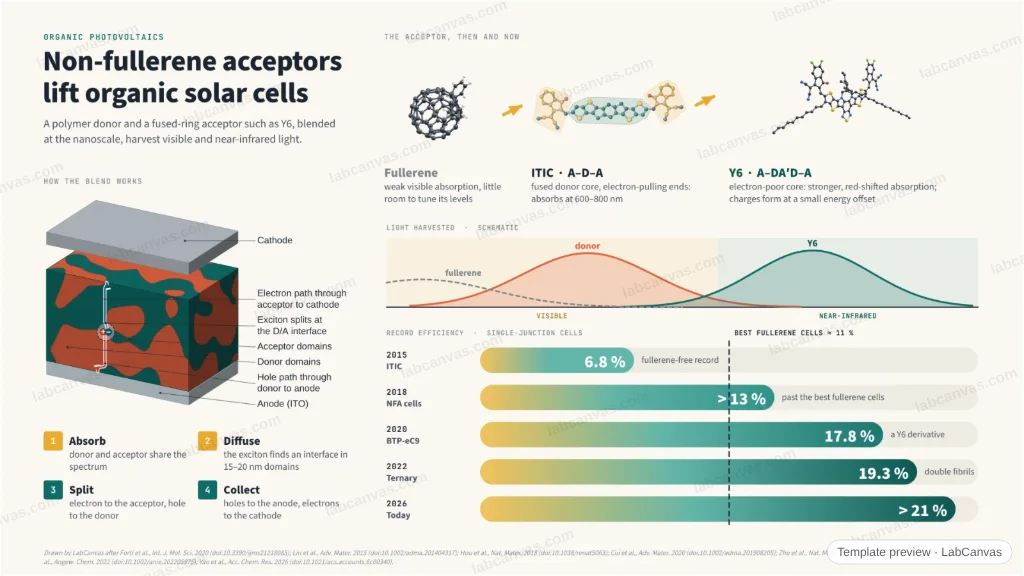
A ledger of record efficiencies for organic solar cells: fullerene acceptors stalled near 11%, while fused-ring non-fullerene acceptors (ITIC, then the crescent-shaped Y6 and its derivatives) climbed past 21%. A bulk-heterojunction film on the left shows how the donor–acceptor blend turns light into current, and the acceptors and the light they harvest line up above the ledger.
Updated 9 cited papers82 editable layers
At a glance
- Category
- Graphical abstracts
- Method
- Graphical abstract
- Starting materials
- A conjugated polymer donor and a fused-ring non-fullerene acceptor such as Y6
- Product
- A bulk-heterojunction organic solar cell above 21% efficiency
- Key result
- PCE 6.8% (ITIC; Lin et al. 2015), > 13% (Hou et al. 2018), 17.8% (Cui et al. 2020), 19.3% (Zhu et al. 2022), > 21% (Yao et al. 2026); best fullerene cells 11% and 15–20 nm domains (Forti et al. 2020)
- Figure
- 1920 × 1080 px (16:9), 82 editable layers, 2 generated objects
Step by step
- AbsorbDonor and acceptor absorb complementary parts of the visible and near-infrared spectrum (Forti et al. 2020); Y-series acceptors absorb strongly in the near-infrared (Khlaifia et al. 2025)
- DiffuseThe exciton must reach a donor–acceptor interface: the ideal blend is a bicontinuous network of 15–20 nm domains in a ~100 nm film (Forti et al. 2020)
- SplitAt the D/A interface the exciton dissociates: the electron goes to the acceptor, the hole stays on the donor (Forti et al. 2020)
- CollectHoles travel through the donor to the anode, electrons through the acceptor to the cathode (Forti et al. 2020)
- Climb past the fullerene ceilingFullerene cells peaked near 11% (Forti et al. 2020); ITIC 6.8% (Lin et al. 2015), > 13% by 2018 (Hou et al. 2018), 17.8% with BTP-eC9 (Cui et al. 2020), 19.3% (Zhu et al. 2022), > 21% (Yao et al. 2026)
Uses
- Graphical abstracts on organic photovoltaics and non-fullerene acceptors
- Talks on Y6 and fused-ring electron acceptors
- Teaching how a bulk heterojunction works
Papers this template follows
- Forti et al., “Recent advances in non-fullerene acceptors of the IDIC/ITIC families for bulk-heterojunction organic solar cells”, Int. J. Mol. Sci. 2020. doi:10.3390/ijms21218085review
- Lin et al., “An electron acceptor challenging fullerenes for efficient polymer solar cells”, Adv. Mater. 2015. doi:10.1002/adma.201404317primary
- Hou, Inganäs, Friend & Gao, “Organic solar cells based on non-fullerene acceptors”, Nat. Mater. 2018. doi:10.1038/nmat5063review
- Cui et al., “Single-junction organic photovoltaic cells with approaching 18% efficiency”, Adv. Mater. 2020. doi:10.1002/adma.201908205primary
- Zhu et al., “Single-junction organic solar cells with over 19% efficiency enabled by a refined double-fibril network morphology”, Nat. Mater. 2022. doi:10.1038/s41563-022-01244-yprimary
- Yao, Wan & Chen, “High-performance CH-series non-fullerene acceptors for organic photovoltaics”, Acc. Chem. Res. 2026. doi:10.1021/acs.accounts.6c00340further reading
- Guo, Han & Yi, “The intrinsic role of the fusion mode and electron-deficient core in fused-ring electron acceptors for organic photovoltaics”, Angew. Chem. Int. Ed. 2022. doi:10.1002/anie.202205975primary
- Shoaee et al., “What we have learnt from PM6:Y6”, Adv. Mater. 2023. doi:10.1002/adma.202302005review
- Khlaifia et al., “Epoch-making design strategies for high-efficiency fused-ring A-DA'D-A type non-fullerene acceptors in organic solar cells”, Macromol. Rapid Commun. 2025. doi:10.1002/marc.202500691review
Drawn by LabCanvas after Forti et al., Int. J. Mol. Sci. 2020 (doi:10.3390/ijms21218085); Lin et al., Adv. Mater. 2015 (doi:10.1002/adma.201404317); Hou et al., Nat. Mater. 2018 (doi:10.1038/nmat5063); Cui et al., Adv. Mater. 2020 (doi:10.1002/adma.201908205); Zhu et al., Nat. Mater. 2022 (doi:10.1038/s41563-022-01244-y); Guo et al., Angew. Chem. 2022 (doi:10.1002/anie.202205975); Yao et al., Acc. Chem. Res. 2026 (doi:10.1021/acs.accounts.6c00340).
How templates are written and checked: editorial guidelines.
Questions
What does the “Organic solar cells: non-fullerene acceptors climb past the fullerene ceiling” template show?
A ledger of record efficiencies for organic solar cells: fullerene acceptors stalled near 11%, while fused-ring non-fullerene acceptors (ITIC, then the crescent-shaped Y6 and its derivatives) climbed past 21%. A bulk-heterojunction film on the left shows how the donor–acceptor blend turns light into current, and the acceptors and the light they harvest line up above the ledger.
What are the steps shown in “Organic solar cells: non-fullerene acceptors climb past the fullerene ceiling”?
1. Absorb: Donor and acceptor absorb complementary parts of the visible and near-infrared spectrum (Forti et al. 2020); Y-series acceptors absorb strongly in the near-infrared (Khlaifia et al. 2025). 2. Diffuse: The exciton must reach a donor–acceptor interface: the ideal blend is a bicontinuous network of 15–20 nm domains in a ~100 nm film (Forti et al. 2020). 3. Split: At the D/A interface the exciton dissociates: the electron goes to the acceptor, the hole stays on the donor (Forti et al. 2020). 4. Collect: Holes travel through the donor to the anode, electrons through the acceptor to the cathode (Forti et al. 2020). 5. Climb past the fullerene ceiling: Fullerene cells peaked near 11% (Forti et al. 2020); ITIC 6.8% (Lin et al. 2015), > 13% by 2018 (Hou et al. 2018), 17.8% with BTP-eC9 (Cui et al. 2020), 19.3% (Zhu et al. 2022), > 21% (Yao et al. 2026).
What are the starting materials and the product?
Starting materials: A conjugated polymer donor and a fused-ring non-fullerene acceptor such as Y6. Product: A bulk-heterojunction organic solar cell above 21% efficiency.
Which papers is “Organic solar cells: non-fullerene acceptors climb past the fullerene ceiling” based on?
Forti et al., “Recent advances in non-fullerene acceptors of the IDIC/ITIC families for bulk-heterojunction organic solar cells”, Int. J. Mol. Sci. 2020 (doi:10.3390/ijms21218085); Lin et al., “An electron acceptor challenging fullerenes for efficient polymer solar cells”, Adv. Mater. 2015 (doi:10.1002/adma.201404317); Hou, Inganäs, Friend & Gao, “Organic solar cells based on non-fullerene acceptors”, Nat. Mater. 2018 (doi:10.1038/nmat5063); Cui et al., “Single-junction organic photovoltaic cells with approaching 18% efficiency”, Adv. Mater. 2020 (doi:10.1002/adma.201908205); Zhu et al., “Single-junction organic solar cells with over 19% efficiency enabled by a refined double-fibril network morphology”, Nat. Mater. 2022 (doi:10.1038/s41563-022-01244-y); Yao, Wan & Chen, “High-performance CH-series non-fullerene acceptors for organic photovoltaics”, Acc. Chem. Res. 2026 (doi:10.1021/acs.accounts.6c00340); Guo, Han & Yi, “The intrinsic role of the fusion mode and electron-deficient core in fused-ring electron acceptors for organic photovoltaics”, Angew. Chem. Int. Ed. 2022 (doi:10.1002/anie.202205975); Shoaee et al., “What we have learnt from PM6:Y6”, Adv. Mater. 2023 (doi:10.1002/adma.202302005); Khlaifia et al., “Epoch-making design strategies for high-efficiency fused-ring A-DA'D-A type non-fullerene acceptors in organic solar cells”, Macromol. Rapid Commun. 2025 (doi:10.1002/marc.202500691).
Can I edit the “Organic solar cells: non-fullerene acceptors climb past the fullerene ceiling” template?
Yes. Open it in the LabCanvas editor: all 82 layers are editable, including 2 generated objects (structures, plots, equipment) with their own settings. Change the text, colours and layout, then export PNG, TIFF, SVG or PDF.
Do I need an account to use this template?
Not to view it here. To open and edit it, sign in to LabCanvas or create a free account (the free plan keeps up to 3 designs). Downloading the figure is part of LabCanvas Pro (US$19 a month or US$199 a year).





