Graphical abstract template · Graphical abstracts · Graphical abstract
Phase-change memory: writing bits as glass or crystal
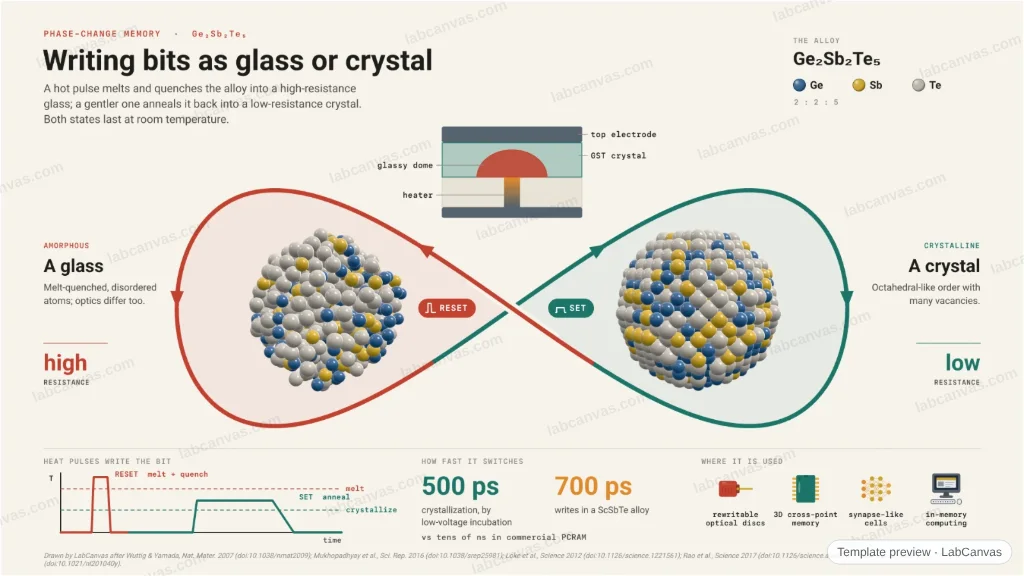
An infinity loop for phase-change memory: a heat pulse melts and quenches Ge–Sb–Te into a high-resistance glass (RESET), a gentler one anneals it back into a low-resistance crystal (SET), and both states last at room temperature. Write pulses, record switching speeds and the uses, from rewritable discs to brain-inspired computing, run along the bottom.
Updated 12 cited papers86 editable layers
At a glance
- Category
- Graphical abstracts
- Method
- Graphical abstract
- Starting materials
- Ge₂Sb₂Te₅ (GST), a chalcogenide phase-change alloy
- Product
- A non-volatile memory cell that stores a bit as a glass (high resistance) or a crystal (low resistance)
- Key result
- 500 ps crystallization with incubation (Loke et al. 2012); 700 ps writing in ScSbTe vs tens of ns for commercial PCRAM (Rao et al. 2017)
- Figure
- 1920 × 1080 px (16:9), 86 editable layers, 4 generated objects
Step by step
- Two statesPhase-change alloys switch rapidly and reversibly between amorphous and crystalline phases with very different electrical and optical properties (Lencer et al. 2011); the crystal has an octahedral-like arrangement with many vacancies (Wuttig & Yamada 2007)
- RESET: melt and quenchA high-power heat pulse melts the crystal and quenches it into the high-resistance amorphous state (Ning et al. 2022; Hatayama et al. 2018), over the heater of a mushroom cell (Zheng et al. 2025)
- SET: annealA gentler pulse anneals the glass back into the low-resistance crystal; melt, quench and anneal cycles repeat, and both states are long lived at ambient temperature (Mukhopadhyay et al. 2016)
- SpeedCommercial PCRAM writes in tens of nanoseconds, limited by stochastic nucleation (Rao et al. 2017); incubation gave 500 ps crystallization (Loke et al. 2012) and ScSbTe writes in 700 ps (Rao et al. 2017)
- UsesRewritable optical discs (Wuttig & Yamada 2007), 3D cross-point memory with threshold-switch selectors (Zhao et al. 2024), synapse-like cells (Kuzum et al. 2012; Ding et al. 2019) and in-memory computing (Syed et al. 2025)
Uses
- Graphical abstracts on phase-change materials and PCRAM
- Talks on non-volatile and storage-class memory
- Teaching melt-quench amorphization and crystallization
Papers this template follows
- Wuttig & Yamada, “Phase-change materials for rewriteable data storage”, Nat. Mater. 2007. doi:10.1038/nmat2009review
- Lencer, Salinga & Wuttig, “Design rules for phase-change materials in data storage applications”, Adv. Mater. 2011. doi:10.1002/adma.201004255review
- Mukhopadhyay et al., “Competing covalent and ionic bonding in Ge-Sb-Te phase change materials”, Sci. Rep. 2016. doi:10.1038/srep25981primary
- Loke et al., “Breaking the speed limits of phase-change memory”, Science 2012. doi:10.1126/science.1221561primary
- Rao et al., “Reducing the stochasticity of crystal nucleation to enable subnanosecond memory writing”, Science 2017. doi:10.1126/science.aao3212primary
- Hatayama et al., “Inverse resistance change Cr2Ge2Te6-based PCRAM enabling ultralow-energy amorphization”, ACS Appl. Mater. Interfaces 2018. doi:10.1021/acsami.7b16755primary
- Ning et al., “Low energy switching of phase change materials using a 2D thermal boundary layer”, ACS Appl. Mater. Interfaces 2022. doi:10.1021/acsami.2c12936further reading
- Zheng et al., “Extended switching endurance of phase change memory through nano-confined cell structure”, Nat. Commun. 2025. doi:10.1038/s41467-025-60644-1further reading
- Zhao et al., “Chalcogenide ovonic threshold switching selector”, Nano-Micro Lett. 2024. doi:10.1007/s40820-023-01289-xfurther reading
- Kuzum, Jeyasingh, Lee & Wong, “Nanoelectronic programmable synapses based on phase change materials for brain-inspired computing”, Nano Lett. 2012. doi:10.1021/nl201040yprimary
- Ding et al., “Phase-change heterostructure enables ultralow noise and drift for memory operation”, Science 2019. doi:10.1126/science.aay0291primary
- Syed, Le Gallo & Sebastian, “Phase-change memory for in-memory computing”, Chem. Rev. 2025. doi:10.1021/acs.chemrev.4c00670review
Drawn by LabCanvas after Wuttig & Yamada, Nat. Mater. 2007 (doi:10.1038/nmat2009); Mukhopadhyay et al., Sci. Rep. 2016 (doi:10.1038/srep25981); Loke et al., Science 2012 (doi:10.1126/science.1221561); Rao et al., Science 2017 (doi:10.1126/science.aao3212); Kuzum et al., Nano Lett. 2012 (doi:10.1021/nl201040y).
How templates are written and checked: editorial guidelines.
Questions
What does the “Phase-change memory: writing bits as glass or crystal” template show?
An infinity loop for phase-change memory: a heat pulse melts and quenches Ge–Sb–Te into a high-resistance glass (RESET), a gentler one anneals it back into a low-resistance crystal (SET), and both states last at room temperature. Write pulses, record switching speeds and the uses, from rewritable discs to brain-inspired computing, run along the bottom.
What are the steps shown in “Phase-change memory: writing bits as glass or crystal”?
1. Two states: Phase-change alloys switch rapidly and reversibly between amorphous and crystalline phases with very different electrical and optical properties (Lencer et al. 2011); the crystal has an octahedral-like arrangement with many vacancies (Wuttig & Yamada 2007). 2. RESET: melt and quench: A high-power heat pulse melts the crystal and quenches it into the high-resistance amorphous state (Ning et al. 2022; Hatayama et al. 2018), over the heater of a mushroom cell (Zheng et al. 2025). 3. SET: anneal: A gentler pulse anneals the glass back into the low-resistance crystal; melt, quench and anneal cycles repeat, and both states are long lived at ambient temperature (Mukhopadhyay et al. 2016). 4. Speed: Commercial PCRAM writes in tens of nanoseconds, limited by stochastic nucleation (Rao et al. 2017); incubation gave 500 ps crystallization (Loke et al. 2012) and ScSbTe writes in 700 ps (Rao et al. 2017). 5. Uses: Rewritable optical discs (Wuttig & Yamada 2007), 3D cross-point memory with threshold-switch selectors (Zhao et al. 2024), synapse-like cells (Kuzum et al. 2012; Ding et al. 2019) and in-memory computing (Syed et al. 2025).
What are the starting materials and the product?
Starting materials: Ge₂Sb₂Te₅ (GST), a chalcogenide phase-change alloy. Product: A non-volatile memory cell that stores a bit as a glass (high resistance) or a crystal (low resistance).
Which papers is “Phase-change memory: writing bits as glass or crystal” based on?
Wuttig & Yamada, “Phase-change materials for rewriteable data storage”, Nat. Mater. 2007 (doi:10.1038/nmat2009); Lencer, Salinga & Wuttig, “Design rules for phase-change materials in data storage applications”, Adv. Mater. 2011 (doi:10.1002/adma.201004255); Mukhopadhyay et al., “Competing covalent and ionic bonding in Ge-Sb-Te phase change materials”, Sci. Rep. 2016 (doi:10.1038/srep25981); Loke et al., “Breaking the speed limits of phase-change memory”, Science 2012 (doi:10.1126/science.1221561); Rao et al., “Reducing the stochasticity of crystal nucleation to enable subnanosecond memory writing”, Science 2017 (doi:10.1126/science.aao3212); Hatayama et al., “Inverse resistance change Cr2Ge2Te6-based PCRAM enabling ultralow-energy amorphization”, ACS Appl. Mater. Interfaces 2018 (doi:10.1021/acsami.7b16755); Ning et al., “Low energy switching of phase change materials using a 2D thermal boundary layer”, ACS Appl. Mater. Interfaces 2022 (doi:10.1021/acsami.2c12936); Zheng et al., “Extended switching endurance of phase change memory through nano-confined cell structure”, Nat. Commun. 2025 (doi:10.1038/s41467-025-60644-1); Zhao et al., “Chalcogenide ovonic threshold switching selector”, Nano-Micro Lett. 2024 (doi:10.1007/s40820-023-01289-x); Kuzum, Jeyasingh, Lee & Wong, “Nanoelectronic programmable synapses based on phase change materials for brain-inspired computing”, Nano Lett. 2012 (doi:10.1021/nl201040y); Ding et al., “Phase-change heterostructure enables ultralow noise and drift for memory operation”, Science 2019 (doi:10.1126/science.aay0291); Syed, Le Gallo & Sebastian, “Phase-change memory for in-memory computing”, Chem. Rev. 2025 (doi:10.1021/acs.chemrev.4c00670).
Can I edit the “Phase-change memory: writing bits as glass or crystal” template?
Yes. Open it in the LabCanvas editor: all 86 layers are editable, including 4 generated objects (structures, plots, equipment) with their own settings. Change the text, colours and layout, then export PNG, TIFF, SVG or PDF.
Do I need an account to use this template?
Not to view it here. To open and edit it, sign in to LabCanvas or create a free account (the free plan keeps up to 3 designs). Downloading the figure is part of LabCanvas Pro (US$19 a month or US$199 a year).