Graphical abstract template · Graphical abstracts · Graphical abstract
Photocatalyst sheets: from one SrTiO₃ particle to a 100 m² hydrogen farm
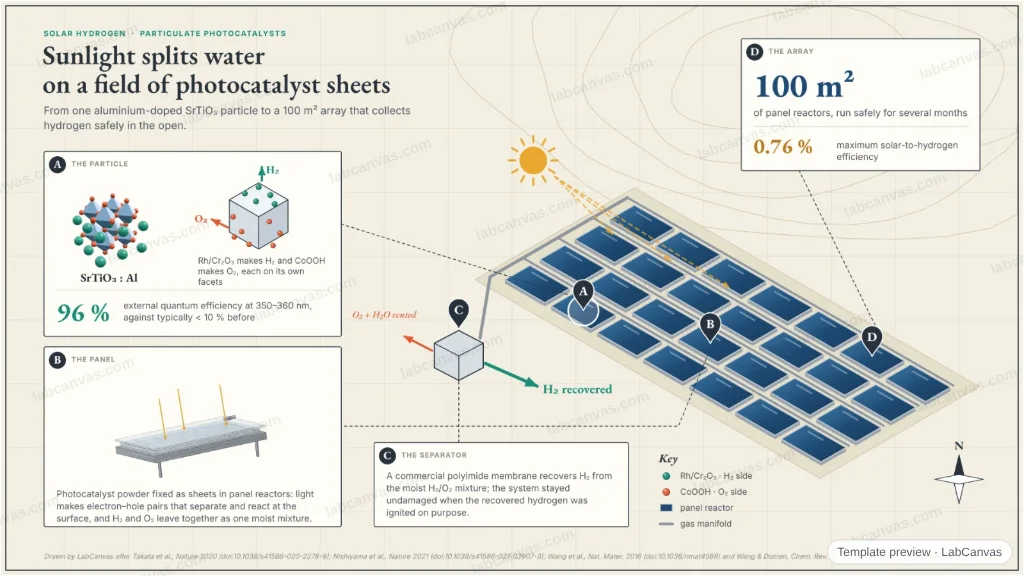
A survey-map graphical abstract of particulate photocatalysts for overall water splitting: an aerial view of a 100 m² array of panel reactors, with map pins leading to the aluminium-doped SrTiO₃ particle (cocatalysts for hydrogen and oxygen on different facets, 96% external quantum efficiency in the UV), the photocatalyst-sheet panel, and the polyimide membrane that recovers hydrogen safely from the mixed gas.
Updated 4 cited papers221 editable layers
At a glance
- Category
- Graphical abstracts
- Method
- Graphical abstract
- Starting materials
- Aluminium-doped SrTiO₃ powder with Rh/Cr₂O₃ and CoOOH cocatalysts
- Product
- Hydrogen recovered from water and sunlight on a 100 m² panel array
- Key result
- EQE up to 96% at 350–360 nm (Takata et al. 2020); STH 0.76% on 100 m² (Nishiyama et al. 2021); STH 1.1% for Z-scheme sheets (Wang et al. 2016)
- Figure
- 1920 × 1080 px (16:9), 221 editable layers, 1 generated objects
Step by step
- A · The particleAl-doped SrTiO₃ with Rh/Cr₂O₃ for H₂ and CoOOH for O₂ on different facets: external quantum efficiency up to 96% at 350–360 nm, against typically < 10% before (Takata et al. 2020)
- B · The panelPowder fixed as sheets in panel reactors; light makes electron–hole pairs that separate and react at the surface (Wang & Domen 2020); the H₂/O₂ product leaves as one moist mixture (Nishiyama et al. 2021); sheets of two photocatalysts on gold reached 1.1% STH (Wang et al. 2016)
- C · The separatorA commercial polyimide membrane recovers H₂ from the moist H₂/O₂ mixture; the system survived intentional ignition of the recovered hydrogen (Nishiyama et al. 2021)
- D · The array100 m² of panel reactors ran safely for several months, with a maximum STH of 0.76% (Nishiyama et al. 2021)
Uses
- Graphical abstracts on photocatalytic water splitting and solar hydrogen
- Talks on scaling up particulate photocatalysts
- Teaching cocatalysts and charge separation
Papers this template follows
- Takata et al., “Photocatalytic water splitting with a quantum efficiency of almost unity”, Nature 2020. doi:10.1038/s41586-020-2278-9primary
- Nishiyama et al., “Photocatalytic solar hydrogen production from water on a 100-m² scale”, Nature 2021. doi:10.1038/s41586-021-03907-3primary
- Wang et al., “Scalable water splitting on particulate photocatalyst sheets with a solar-to-hydrogen energy conversion efficiency exceeding 1%”, Nat. Mater. 2016. doi:10.1038/nmat4589primary
- Wang & Domen, “Particulate photocatalysts for light-driven water splitting: mechanisms, challenges, and design strategies”, Chem. Rev. 2020. doi:10.1021/acs.chemrev.9b00201review
Drawn by LabCanvas after Takata et al., Nature 2020 (doi:10.1038/s41586-020-2278-9); Nishiyama et al., Nature 2021 (doi:10.1038/s41586-021-03907-3); Wang et al., Nat. Mater. 2016 (doi:10.1038/nmat4589) and Wang & Domen, Chem. Rev. 2020 (doi:10.1021/acs.chemrev.9b00201).
How templates are written and checked: editorial guidelines.
Questions
What does the “Photocatalyst sheets: from one SrTiO₃ particle to a 100 m² hydrogen farm” template show?
A survey-map graphical abstract of particulate photocatalysts for overall water splitting: an aerial view of a 100 m² array of panel reactors, with map pins leading to the aluminium-doped SrTiO₃ particle (cocatalysts for hydrogen and oxygen on different facets, 96% external quantum efficiency in the UV), the photocatalyst-sheet panel, and the polyimide membrane that recovers hydrogen safely from the mixed gas.
What are the steps shown in “Photocatalyst sheets: from one SrTiO₃ particle to a 100 m² hydrogen farm”?
1. A · The particle: Al-doped SrTiO₃ with Rh/Cr₂O₃ for H₂ and CoOOH for O₂ on different facets: external quantum efficiency up to 96% at 350–360 nm, against typically < 10% before (Takata et al. 2020). 2. B · The panel: Powder fixed as sheets in panel reactors; light makes electron–hole pairs that separate and react at the surface (Wang & Domen 2020); the H₂/O₂ product leaves as one moist mixture (Nishiyama et al. 2021); sheets of two photocatalysts on gold reached 1.1% STH (Wang et al. 2016). 3. C · The separator: A commercial polyimide membrane recovers H₂ from the moist H₂/O₂ mixture; the system survived intentional ignition of the recovered hydrogen (Nishiyama et al. 2021). 4. D · The array: 100 m² of panel reactors ran safely for several months, with a maximum STH of 0.76% (Nishiyama et al. 2021).
What are the starting materials and the product?
Starting materials: Aluminium-doped SrTiO₃ powder with Rh/Cr₂O₃ and CoOOH cocatalysts. Product: Hydrogen recovered from water and sunlight on a 100 m² panel array.
Which papers is “Photocatalyst sheets: from one SrTiO₃ particle to a 100 m² hydrogen farm” based on?
Takata et al., “Photocatalytic water splitting with a quantum efficiency of almost unity”, Nature 2020 (doi:10.1038/s41586-020-2278-9); Nishiyama et al., “Photocatalytic solar hydrogen production from water on a 100-m² scale”, Nature 2021 (doi:10.1038/s41586-021-03907-3); Wang et al., “Scalable water splitting on particulate photocatalyst sheets with a solar-to-hydrogen energy conversion efficiency exceeding 1%”, Nat. Mater. 2016 (doi:10.1038/nmat4589); Wang & Domen, “Particulate photocatalysts for light-driven water splitting: mechanisms, challenges, and design strategies”, Chem. Rev. 2020 (doi:10.1021/acs.chemrev.9b00201).
Can I edit the “Photocatalyst sheets: from one SrTiO₃ particle to a 100 m² hydrogen farm” template?
Yes. Open it in the LabCanvas editor: all 221 layers are editable, including 1 generated objects (structures, plots, equipment) with their own settings. Change the text, colours and layout, then export PNG, TIFF, SVG or PDF.
Do I need an account to use this template?
Not to view it here. To open and edit it, sign in to LabCanvas or create a free account (the free plan keeps up to 3 designs). Downloading the figure is part of LabCanvas Pro (US$19 a month or US$199 a year).