Graphical abstract template · Materials graphical abstracts · Graphical abstract
Redox flow batteries: energy in the tanks, power in the stack
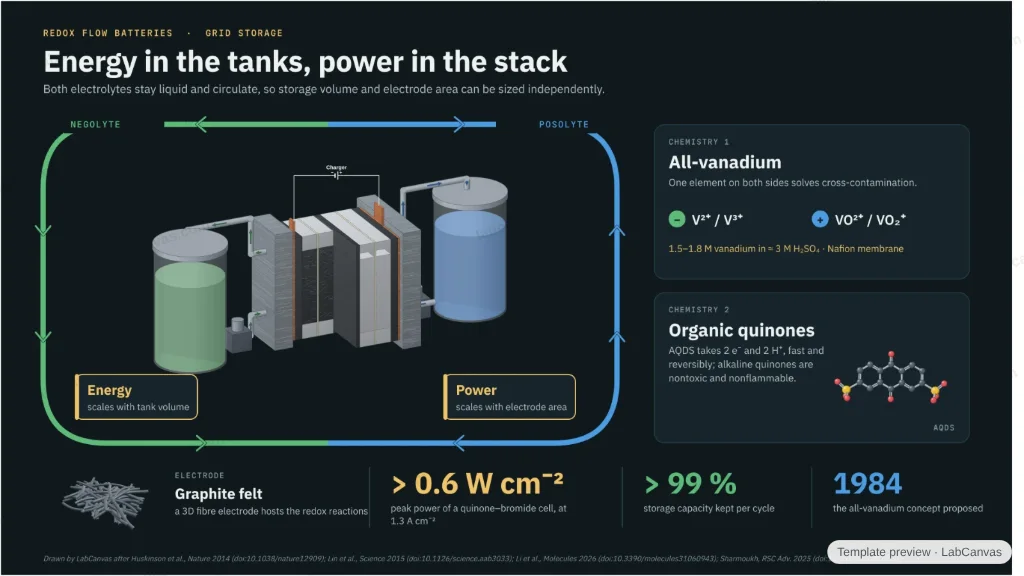
A redox flow battery cut open inside a circulating loop of its two electrolytes, tagged with the idea that defines it: energy scales with the tanks and power with the stack. The all-vanadium chemistry and a metal-free quinone are compared on the right, with a carbon-felt electrode and the key performance numbers along the bottom.
Updated 4 cited papers66 editable layers
At a glance
- Category
- Materials graphical abstracts
- Method
- Graphical abstract
- Starting materials
- Two liquid electrolytes in external tanks
- Product
- Grid-scale storage whose energy and power scale independently
- Key result
- Quinone–bromide cell: peak power above 0.6 W cm⁻² at 1.3 A cm⁻², over 99% capacity retained per cycle (Huskinson et al. 2014); vanadium 1.5–1.8 M in about 3 M sulfuric acid; concept proposed in 1984 (Li et al. 2026)
- Figure
- 1920 × 1080 px (16:9), 66 editable layers, 2 generated objects
Step by step
- Tanks hold the energyThe electroactive species stay in fluid form, so energy scales with the storage volume (Huskinson et al. 2014)
- The stack sets the powerPower scales with the electrode area of the stack, independently of the tanks (Huskinson et al. 2014; Li et al. 2026)
- All-vanadiumV²⁺/V³⁺ and VO²⁺/VO₂⁺ in sulfuric acid; one element on both sides avoids cross-contamination; Nafion membranes predominate (Li et al. 2026)
- Metal-free quinonesAQDS takes two electrons and two protons rapidly and reversibly; alkaline quinone batteries use Earth-abundant, nontoxic, nonflammable molecules (Huskinson et al. 2014; Lin et al. 2015)
- ElectrodesGraphite felt and other 3D electrodes host the reactions (Sharmoukh 2025)
Uses
- Graphical abstracts on flow batteries and grid storage
- Talks comparing vanadium and organic flow chemistries
- Teaching how flow batteries decouple energy and power
Papers this template follows
- Huskinson et al., “A metal-free organic-inorganic aqueous flow battery”, Nature 2014. doi:10.1038/nature12909primary
- Lin et al., “Alkaline quinone flow battery”, Science 2015. doi:10.1126/science.aab3033primary
- Li et al., “Research on the current development status of redox flow batteries”, Molecules 2026. doi:10.3390/molecules31060943review
- Sharmoukh, “Redox flow batteries as energy storage systems: materials, viability, and industrial applications”, RSC Adv. 2025. doi:10.1039/d5ra00296freview
Drawn by LabCanvas after Huskinson et al., Nature 2014 (doi:10.1038/nature12909); Lin et al., Science 2015 (doi:10.1126/science.aab3033); Li et al., Molecules 2026 (doi:10.3390/molecules31060943); Sharmoukh, RSC Adv. 2025 (doi:10.1039/d5ra00296f).
How templates are written and checked: editorial guidelines.
Questions
What does the “Redox flow batteries: energy in the tanks, power in the stack” template show?
A redox flow battery cut open inside a circulating loop of its two electrolytes, tagged with the idea that defines it: energy scales with the tanks and power with the stack. The all-vanadium chemistry and a metal-free quinone are compared on the right, with a carbon-felt electrode and the key performance numbers along the bottom.
What are the steps shown in “Redox flow batteries: energy in the tanks, power in the stack”?
1. Tanks hold the energy: The electroactive species stay in fluid form, so energy scales with the storage volume (Huskinson et al. 2014). 2. The stack sets the power: Power scales with the electrode area of the stack, independently of the tanks (Huskinson et al. 2014; Li et al. 2026). 3. All-vanadium: V²⁺/V³⁺ and VO²⁺/VO₂⁺ in sulfuric acid; one element on both sides avoids cross-contamination; Nafion membranes predominate (Li et al. 2026). 4. Metal-free quinones: AQDS takes two electrons and two protons rapidly and reversibly; alkaline quinone batteries use Earth-abundant, nontoxic, nonflammable molecules (Huskinson et al. 2014; Lin et al. 2015). 5. Electrodes: Graphite felt and other 3D electrodes host the reactions (Sharmoukh 2025).
What are the starting materials and the product?
Starting materials: Two liquid electrolytes in external tanks. Product: Grid-scale storage whose energy and power scale independently.
Which papers is “Redox flow batteries: energy in the tanks, power in the stack” based on?
Huskinson et al., “A metal-free organic-inorganic aqueous flow battery”, Nature 2014 (doi:10.1038/nature12909); Lin et al., “Alkaline quinone flow battery”, Science 2015 (doi:10.1126/science.aab3033); Li et al., “Research on the current development status of redox flow batteries”, Molecules 2026 (doi:10.3390/molecules31060943); Sharmoukh, “Redox flow batteries as energy storage systems: materials, viability, and industrial applications”, RSC Adv. 2025 (doi:10.1039/d5ra00296f).
Can I edit the “Redox flow batteries: energy in the tanks, power in the stack” template?
Yes. Open it in the LabCanvas editor: all 66 layers are editable, including 2 generated objects (structures, plots, equipment) with their own settings. Change the text, colours and layout, then export PNG, TIFF, SVG or PDF.
Do I need an account to use this template?
Not to view it here. To open and edit it, sign in to LabCanvas or create a free account (the free plan keeps up to 3 designs). Downloading the figure is part of LabCanvas Pro (US$19 a month or US$199 a year).





