Graphical abstract template · Materials graphical abstracts · Graphical abstract
Self-healing polymers: four ways to close a crack
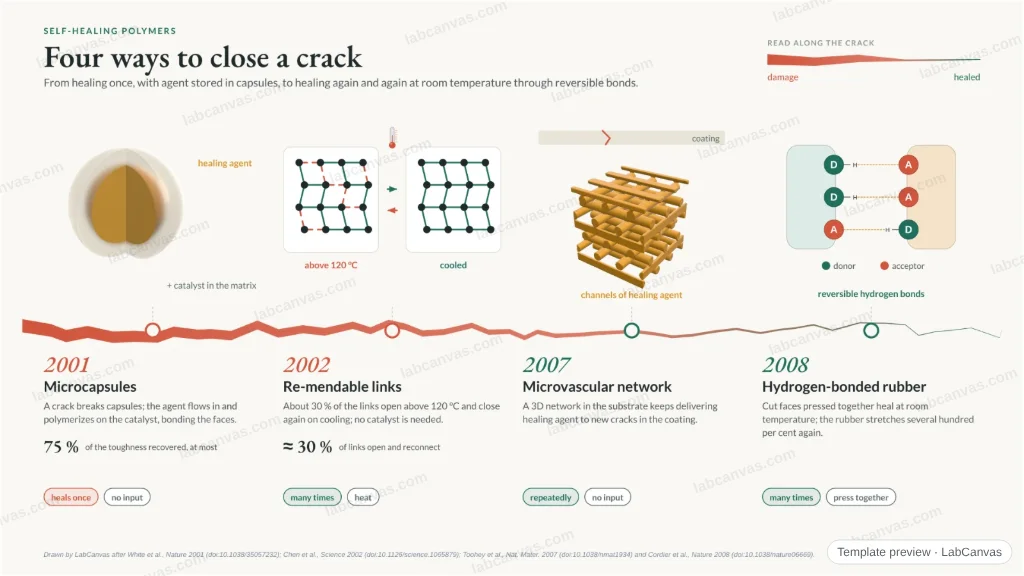
A timeline drawn along one crack that closes from left to right. Microcapsules of healing agent mend a crack once, thermally re-mendable links mend it many times with heat, a microvascular network delivers agent again and again, and a hydrogen-bonded rubber heals at room temperature when the cut faces are pressed together.
Updated 5 cited papers159 editable layers
At a glance
- Category
- Materials graphical abstracts
- Method
- Graphical abstract
- Starting materials
- A cracked polymer or polymer composite
- Product
- A polymer whose crack faces bond again, once (extrinsic, capsules) or many times (vascular, reversible covalent or hydrogen-bonded)
- Key result
- Up to 75% toughness recovery (White et al. 2001); ~30% of linkages open above 120 °C (Chen et al. 2002); extensibility up to several hundred per cent after healing (Cordier et al. 2008)
- Figure
- 1920 × 1080 px (16:9), 159 editable layers, 2 generated objects
Step by step
- 2001 · microcapsulesA crack breaks capsules of healing agent; an embedded catalyst polymerizes it and bonds the faces; up to 75% of the toughness comes back (White et al. 2001), but only once at a given site (Toohey et al. 2007)
- 2002 · re-mendable linksAbove 120 °C about 30% of the linkages disconnect and they reconnect on cooling, so a fracture can be mended many times without a catalyst (Chen et al. 2002)
- 2007 · microvascular networkA 3D microvascular network in the substrate delivers healing agent to cracks in an epoxy coating, which heal repeatedly (Toohey et al. 2007)
- 2008 · hydrogen-bonded rubberMolecules from fatty acids and urea form chains and cross-links through hydrogen bonds; cut pieces pressed together heal at room temperature, again and again, and stretch several hundred per cent (Cordier et al. 2008)
Uses
- Graphical abstracts on self-healing polymers and composites
- Talks comparing extrinsic and intrinsic healing
- Teaching dynamic bonds and damage repair
Papers this template follows
- White et al., “Autonomic healing of polymer composites”, Nature 2001. doi:10.1038/35057232method origin
- Chen et al., “A thermally re-mendable cross-linked polymeric material”, Science 2002. doi:10.1126/science.1065879primary
- Toohey, Sottos, Lewis, Moore & White, “Self-healing materials with microvascular networks”, Nat. Mater. 2007. doi:10.1038/nmat1934primary
- Cordier, Tournilhac, Soulié-Ziakovic & Leibler, “Self-healing and thermoreversible rubber from supramolecular assembly”, Nature 2008. doi:10.1038/nature06669primary
- Khan, “Self-healing dental biomaterials: bioinspired pathways to sustainable dentistry”, Biomater. Investig. Dent. 2025. doi:10.2340/biid.v12.45229review
Drawn by LabCanvas after White et al., Nature 2001 (doi:10.1038/35057232); Chen et al., Science 2002 (doi:10.1126/science.1065879); Toohey et al., Nat. Mater. 2007 (doi:10.1038/nmat1934) and Cordier et al., Nature 2008 (doi:10.1038/nature06669).
How templates are written and checked: editorial guidelines.
Questions
What does the “Self-healing polymers: four ways to close a crack” template show?
A timeline drawn along one crack that closes from left to right. Microcapsules of healing agent mend a crack once, thermally re-mendable links mend it many times with heat, a microvascular network delivers agent again and again, and a hydrogen-bonded rubber heals at room temperature when the cut faces are pressed together.
What are the steps shown in “Self-healing polymers: four ways to close a crack”?
1. 2001 · microcapsules: A crack breaks capsules of healing agent; an embedded catalyst polymerizes it and bonds the faces; up to 75% of the toughness comes back (White et al. 2001), but only once at a given site (Toohey et al. 2007). 2. 2002 · re-mendable links: Above 120 °C about 30% of the linkages disconnect and they reconnect on cooling, so a fracture can be mended many times without a catalyst (Chen et al. 2002). 3. 2007 · microvascular network: A 3D microvascular network in the substrate delivers healing agent to cracks in an epoxy coating, which heal repeatedly (Toohey et al. 2007). 4. 2008 · hydrogen-bonded rubber: Molecules from fatty acids and urea form chains and cross-links through hydrogen bonds; cut pieces pressed together heal at room temperature, again and again, and stretch several hundred per cent (Cordier et al. 2008).
What are the starting materials and the product?
Starting materials: A cracked polymer or polymer composite. Product: A polymer whose crack faces bond again, once (extrinsic, capsules) or many times (vascular, reversible covalent or hydrogen-bonded).
Which papers is “Self-healing polymers: four ways to close a crack” based on?
White et al., “Autonomic healing of polymer composites”, Nature 2001 (doi:10.1038/35057232); Chen et al., “A thermally re-mendable cross-linked polymeric material”, Science 2002 (doi:10.1126/science.1065879); Toohey, Sottos, Lewis, Moore & White, “Self-healing materials with microvascular networks”, Nat. Mater. 2007 (doi:10.1038/nmat1934); Cordier, Tournilhac, Soulié-Ziakovic & Leibler, “Self-healing and thermoreversible rubber from supramolecular assembly”, Nature 2008 (doi:10.1038/nature06669); Khan, “Self-healing dental biomaterials: bioinspired pathways to sustainable dentistry”, Biomater. Investig. Dent. 2025 (doi:10.2340/biid.v12.45229).
Can I edit the “Self-healing polymers: four ways to close a crack” template?
Yes. Open it in the LabCanvas editor: all 159 layers are editable, including 2 generated objects (structures, plots, equipment) with their own settings. Change the text, colours and layout, then export PNG, TIFF, SVG or PDF.
Do I need an account to use this template?
Not to view it here. To open and edit it, sign in to LabCanvas or create a free account (the free plan keeps up to 3 designs). Downloading the figure is part of LabCanvas Pro (US$19 a month or US$199 a year).