Graphical abstract template · Graphical abstracts · Graphical abstract
Shape-memory alloys: NiTi switches between austenite and martensite
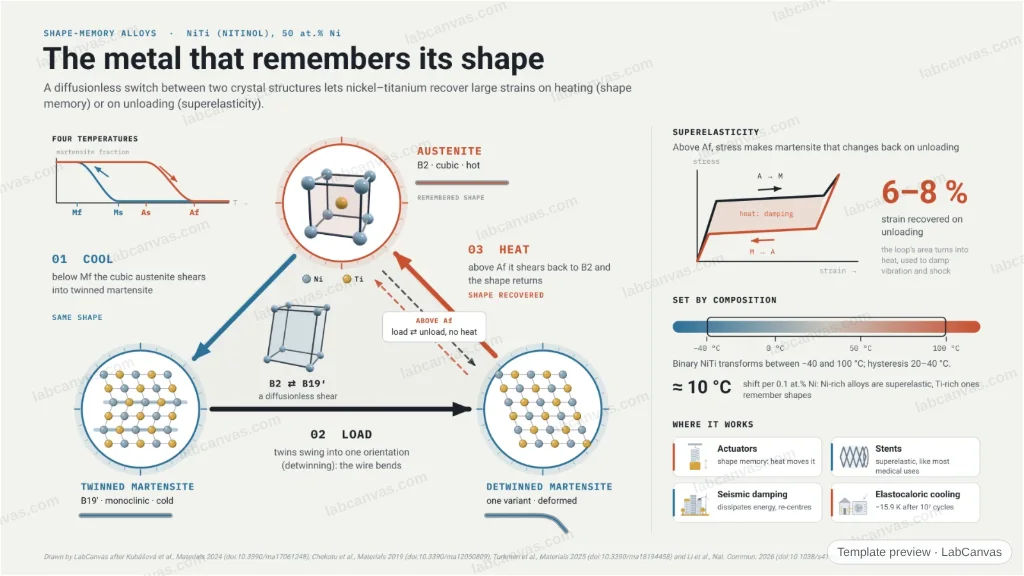
A triangle cycle for nickel–titanium: cooled, the cubic austenite turns into twinned martensite without changing shape; loaded, the twins reorient and the wire bends; heated above Af, the alloy returns to austenite and to its remembered shape. Above Af, stress alone does the same round trip (superelasticity), with 6–8 % recoverable strain, transformation temperatures set by composition and uses from actuators to elastocaloric cooling.
Updated 4 cited papers353 editable layers
At a glance
- Category
- Graphical abstracts
- Method
- Graphical abstract
- Starting materials
- Near-equiatomic nickel–titanium (50 at.% Ni)
- Product
- A wire that bends when cold and recovers its shape on heating, or springs back on unloading above Af
- Key result
- Reversible strain 6–8 % (Kubášová et al. 2024); transformation between −40 and 100 °C, hysteresis 20–40 °C, about 10 °C per 0.1 at.% Ni (Chekotu et al. 2019); −15.9 K elastocaloric effect after 10 million cycles (Li et al. 2026)
- Figure
- 1920 × 1080 px (16:9), 353 editable layers, 3 generated objects
Step by step
- Austenite (hot)Above Af NiTi is austenite, an ordered body-centred cubic B2 lattice (Chekotu et al. 2019; Kubášová et al. 2024)
- Cool: twinned martensiteBelow Ms the austenite turns into twinned, monoclinic B19′ martensite by a diffusionless shear, keeping its shape (Kubášová et al. 2024; Chekotu et al. 2019)
- Load: detwinningDeformation reorients the twins in one preferential direction; the shape changes without permanent damage (Chekotu et al. 2019)
- Heat: shape recoveredAbove As the martensite turns back into austenite, and above Af the original shape is fully recovered (Kubášová et al. 2024)
- SuperelasticityAbove Af, stress alone makes stress-induced martensite that reverts on unloading; 6–8 % reversible strain, and the hysteresis dissipates energy (Kubášová et al. 2024)
Uses
- Graphical abstracts on shape-memory alloys and Nitinol
- Talks on martensitic transformations, superelasticity and elastocaloric cooling
- Teaching the shape-memory effect
Papers this template follows
- Kubášová et al., “A Review on Additive Manufacturing Methods for NiTi Shape Memory Alloy Production”, Materials 2024. doi:10.3390/ma17061248review
- Chekotu, Groarke, O’Toole & Brabazon, “Advances in Selective Laser Melting of Nitinol Shape Memory Alloy Part Production”, Materials 2019. doi:10.3390/ma12050809review
- Turkmen, Issa, Awayssa & El-Hassan, “Incorporation of Nitinol (NiTi) Shape Memory Alloy (SMA) in Concrete: A Review”, Materials 2025. doi:10.3390/ma18194458review
- Li et al., “Fatigue resistant elastocaloric effect in TiNi via texture-precipitate synergy”, Nat. Commun. 2026. doi:10.1038/s41467-026-68835-0primary
Drawn by LabCanvas after Kubášová et al., Materials 2024 (doi:10.3390/ma17061248); Chekotu et al., Materials 2019 (doi:10.3390/ma12050809); Turkmen et al., Materials 2025 (doi:10.3390/ma18194458) and Li et al., Nat. Commun. 2026 (doi:10.1038/s41467-026-68835-0).
How templates are written and checked: editorial guidelines.
Questions
What does the “Shape-memory alloys: NiTi switches between austenite and martensite” template show?
A triangle cycle for nickel–titanium: cooled, the cubic austenite turns into twinned martensite without changing shape; loaded, the twins reorient and the wire bends; heated above Af, the alloy returns to austenite and to its remembered shape. Above Af, stress alone does the same round trip (superelasticity), with 6–8 % recoverable strain, transformation temperatures set by composition and uses from actuators to elastocaloric cooling.
What are the steps shown in “Shape-memory alloys: NiTi switches between austenite and martensite”?
1. Austenite (hot): Above Af NiTi is austenite, an ordered body-centred cubic B2 lattice (Chekotu et al. 2019; Kubášová et al. 2024). 2. Cool: twinned martensite: Below Ms the austenite turns into twinned, monoclinic B19′ martensite by a diffusionless shear, keeping its shape (Kubášová et al. 2024; Chekotu et al. 2019). 3. Load: detwinning: Deformation reorients the twins in one preferential direction; the shape changes without permanent damage (Chekotu et al. 2019). 4. Heat: shape recovered: Above As the martensite turns back into austenite, and above Af the original shape is fully recovered (Kubášová et al. 2024). 5. Superelasticity: Above Af, stress alone makes stress-induced martensite that reverts on unloading; 6–8 % reversible strain, and the hysteresis dissipates energy (Kubášová et al. 2024).
What are the starting materials and the product?
Starting materials: Near-equiatomic nickel–titanium (50 at.% Ni). Product: A wire that bends when cold and recovers its shape on heating, or springs back on unloading above Af.
Which papers is “Shape-memory alloys: NiTi switches between austenite and martensite” based on?
Kubášová et al., “A Review on Additive Manufacturing Methods for NiTi Shape Memory Alloy Production”, Materials 2024 (doi:10.3390/ma17061248); Chekotu, Groarke, O’Toole & Brabazon, “Advances in Selective Laser Melting of Nitinol Shape Memory Alloy Part Production”, Materials 2019 (doi:10.3390/ma12050809); Turkmen, Issa, Awayssa & El-Hassan, “Incorporation of Nitinol (NiTi) Shape Memory Alloy (SMA) in Concrete: A Review”, Materials 2025 (doi:10.3390/ma18194458); Li et al., “Fatigue resistant elastocaloric effect in TiNi via texture-precipitate synergy”, Nat. Commun. 2026 (doi:10.1038/s41467-026-68835-0).
Can I edit the “Shape-memory alloys: NiTi switches between austenite and martensite” template?
Yes. Open it in the LabCanvas editor: all 353 layers are editable, including 3 generated objects (structures, plots, equipment) with their own settings. Change the text, colours and layout, then export PNG, TIFF, SVG or PDF.
Do I need an account to use this template?
Not to view it here. To open and edit it, sign in to LabCanvas or create a free account (the free plan keeps up to 3 designs). Downloading the figure is part of LabCanvas Pro (US$19 a month or US$199 a year).