Graphical abstract template · Graphical abstracts · Graphical abstract
Solid oxide cells: one ceramic cell, run as a fuel cell or an electrolyzer
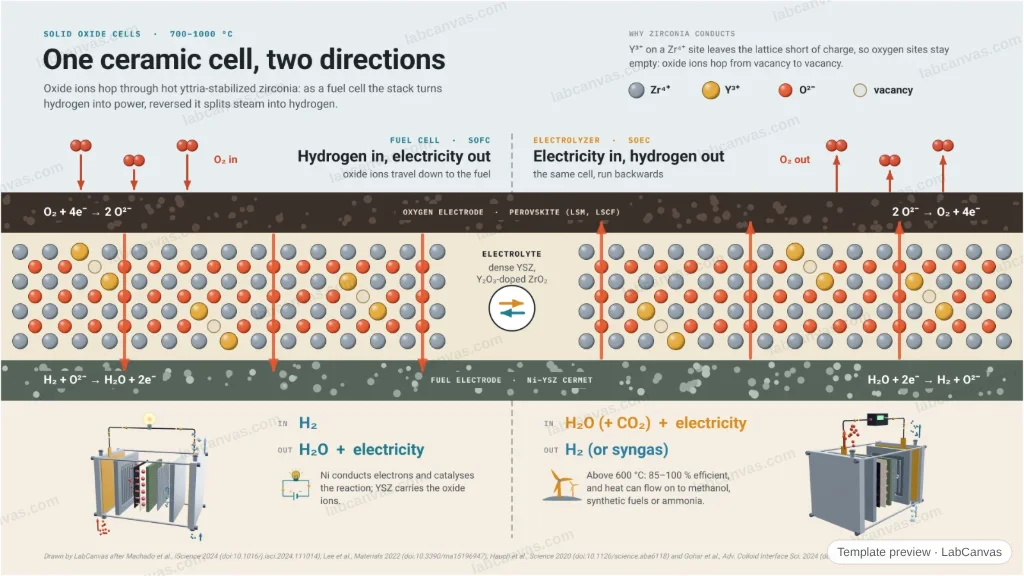
A cut through a solid oxide cell from edge to edge: porous perovskite oxygen electrode, dense yttria-stabilized zirconia electrolyte and Ni–YSZ fuel electrode. On the left the cell runs as a fuel cell, oxide ions moving down to burn hydrogen into water and electricity; on the right the same cell runs backwards as an electrolyzer, splitting steam into hydrogen. Oxygen vacancies made by yttrium doping let the oxide ions hop through the zirconia at 700–1000 °C.
Updated 4 cited papers588 editable layers
At a glance
- Category
- Graphical abstracts
- Method
- Graphical abstract
- Starting materials
- Steam (and CO₂) with electricity, or hydrogen with air
- Product
- Hydrogen or syngas from electrolysis; electricity and water from the fuel cell
- Key result
- YSZ at 700–1000 °C; SOECs above 600 °C with 85–100% efficiency (Machado et al. 2024); 8 mol% Y₂O₃ cubic YSZ (Lee et al. 2022)
- Figure
- 1920 × 1080 px (16:9), 588 editable layers, 2 generated objects
Step by step
- Oxygen electrodeA porous perovskite (LSM, LSCF): in fuel-cell mode O₂ takes electrons and becomes O²⁻; in electrolysis mode O²⁻ gives them up and leaves as O₂ (Machado et al. 2024)
- YSZ electrolyteY³⁺ on Zr⁴⁺ sites stabilizes cubic zirconia and creates oxygen vacancies that carry oxide ions (Lee et al. 2022); YSZ is the most used electrolyte, at 700–1000 °C (Machado et al. 2024)
- Fuel electrodeA porous Ni–YSZ cermet: nickel conducts electrons and catalyses the reaction, YSZ conducts oxide ions (Machado et al. 2024; Gohar et al. 2024)
- Fuel cell (SOFC)Oxide ions move to the fuel electrode and oxidize hydrogen to water, giving electricity (Machado et al. 2024)
- Electrolyzer (SOEC)The same materials run backwards: steam (and CO₂) is split at the fuel electrode and O₂ leaves at the oxygen electrode; above 600 °C, 85–100% efficient (Machado et al. 2024), with heat integration into methanol, synthetic fuel or ammonia synthesis (Hauch et al. 2020)
Uses
- Graphical abstracts on solid oxide fuel and electrolysis cells
- Talks on high-temperature electrolysis and reversible cells
- Teaching oxide-ion conduction in YSZ
Papers this template follows
- Machado et al., “Syngas enhancement for Fischer-Tropsch integration via solid oxide electrolyzer cell co-electrolysis with or without methane”, iScience 2024. doi:10.1016/j.isci.2024.111014review
- Lee et al., “Destabilization and ion conductivity of yttria-stabilized zirconia for solid oxide electrolyte by thermal aging”, Materials 2022. doi:10.3390/ma15196947primary
- Hauch et al., “Recent advances in solid oxide cell technology for electrolysis”, Science 2020. doi:10.1126/science.aba6118review
- Gohar et al., “Navigating the future of solid oxide fuel cell: comprehensive insights into fuel electrode related degradation mechanisms and mitigation strategies”, Adv. Colloid Interface Sci. 2024. doi:10.1016/j.cis.2024.103241review
Drawn by LabCanvas after Machado et al., iScience 2024 (doi:10.1016/j.isci.2024.111014); Lee et al., Materials 2022 (doi:10.3390/ma15196947); Hauch et al., Science 2020 (doi:10.1126/science.aba6118) and Gohar et al., Adv. Colloid Interface Sci. 2024 (doi:10.1016/j.cis.2024.103241).
How templates are written and checked: editorial guidelines.
Questions
What does the “Solid oxide cells: one ceramic cell, run as a fuel cell or an electrolyzer” template show?
A cut through a solid oxide cell from edge to edge: porous perovskite oxygen electrode, dense yttria-stabilized zirconia electrolyte and Ni–YSZ fuel electrode. On the left the cell runs as a fuel cell, oxide ions moving down to burn hydrogen into water and electricity; on the right the same cell runs backwards as an electrolyzer, splitting steam into hydrogen. Oxygen vacancies made by yttrium doping let the oxide ions hop through the zirconia at 700–1000 °C.
What are the steps shown in “Solid oxide cells: one ceramic cell, run as a fuel cell or an electrolyzer”?
1. Oxygen electrode: A porous perovskite (LSM, LSCF): in fuel-cell mode O₂ takes electrons and becomes O²⁻; in electrolysis mode O²⁻ gives them up and leaves as O₂ (Machado et al. 2024). 2. YSZ electrolyte: Y³⁺ on Zr⁴⁺ sites stabilizes cubic zirconia and creates oxygen vacancies that carry oxide ions (Lee et al. 2022); YSZ is the most used electrolyte, at 700–1000 °C (Machado et al. 2024). 3. Fuel electrode: A porous Ni–YSZ cermet: nickel conducts electrons and catalyses the reaction, YSZ conducts oxide ions (Machado et al. 2024; Gohar et al. 2024). 4. Fuel cell (SOFC): Oxide ions move to the fuel electrode and oxidize hydrogen to water, giving electricity (Machado et al. 2024). 5. Electrolyzer (SOEC): The same materials run backwards: steam (and CO₂) is split at the fuel electrode and O₂ leaves at the oxygen electrode; above 600 °C, 85–100% efficient (Machado et al. 2024), with heat integration into methanol, synthetic fuel or ammonia synthesis (Hauch et al. 2020).
What are the starting materials and the product?
Starting materials: Steam (and CO₂) with electricity, or hydrogen with air. Product: Hydrogen or syngas from electrolysis; electricity and water from the fuel cell.
Which papers is “Solid oxide cells: one ceramic cell, run as a fuel cell or an electrolyzer” based on?
Machado et al., “Syngas enhancement for Fischer-Tropsch integration via solid oxide electrolyzer cell co-electrolysis with or without methane”, iScience 2024 (doi:10.1016/j.isci.2024.111014); Lee et al., “Destabilization and ion conductivity of yttria-stabilized zirconia for solid oxide electrolyte by thermal aging”, Materials 2022 (doi:10.3390/ma15196947); Hauch et al., “Recent advances in solid oxide cell technology for electrolysis”, Science 2020 (doi:10.1126/science.aba6118); Gohar et al., “Navigating the future of solid oxide fuel cell: comprehensive insights into fuel electrode related degradation mechanisms and mitigation strategies”, Adv. Colloid Interface Sci. 2024 (doi:10.1016/j.cis.2024.103241).
Can I edit the “Solid oxide cells: one ceramic cell, run as a fuel cell or an electrolyzer” template?
Yes. Open it in the LabCanvas editor: all 588 layers are editable, including 2 generated objects (structures, plots, equipment) with their own settings. Change the text, colours and layout, then export PNG, TIFF, SVG or PDF.
Do I need an account to use this template?
Not to view it here. To open and edit it, sign in to LabCanvas or create a free account (the free plan keeps up to 3 designs). Downloading the figure is part of LabCanvas Pro (US$19 a month or US$199 a year).