Graphical abstract template · Graphical abstracts · Graphical abstract
Structural colour: photonic crystals colour without dyes
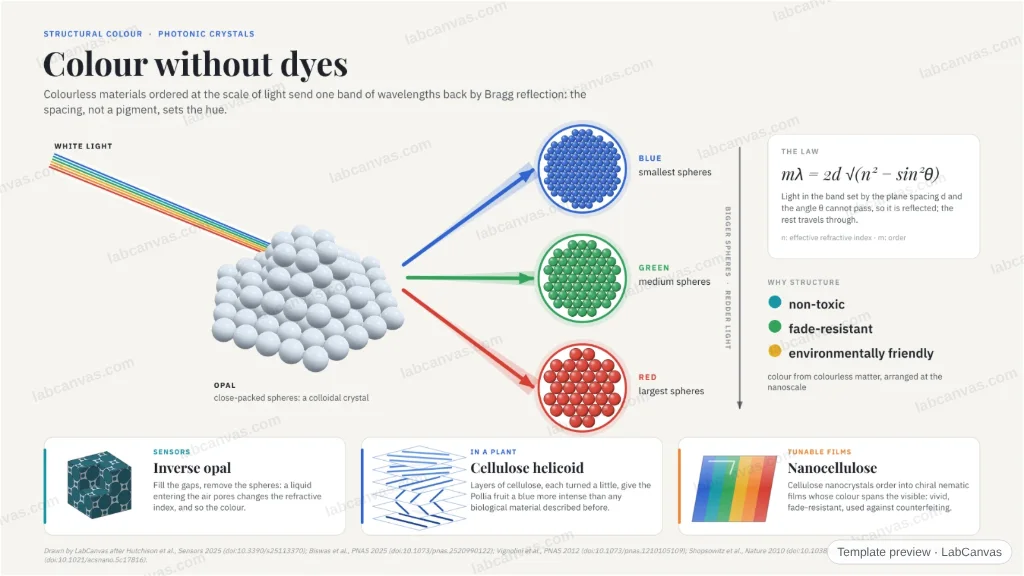
A fan of light: white light falls on an opal of close-packed spheres and one colour comes back, set by the spacing of the spheres through Bragg reflection, blue for small spheres and red for large ones. Cards show where the idea goes next: inverse opals that change colour when their pores fill, the helicoidal cellulose behind the blue Pollia fruit, and nanocellulose films tuned across the visible.
Updated 5 cited papers280 editable layers
At a glance
- Category
- Graphical abstracts
- Method
- Graphical abstract
- Starting materials
- Colourless spheres, pores or cellulose rods ordered at the scale of light
- Product
- Colour reflected by structure alone, without dyes or pigments
- Key result
- Bragg–Snell law and red/blue shifts with spacing (Hutchison et al. 2025); structural colour non-toxic and fade-resistant (Biswas et al. 2025); peak tunable across the visible into the near-IR (Shopsowitz et al. 2010)
- Figure
- 1920 × 1080 px (16:9), 280 editable layers, 1 generated objects
Step by step
- White light inLight in the photonic band gap of a colloidal crystal cannot pass and is reflected; in the visible this is structural colour, as in the opal gemstone (Hutchison et al. 2025)
- The spacing picks the colourmλ = 2d √(n_eff² − sin²θ): smaller spheres or closer planes shift the reflection to blue, larger ones to red (Hutchison et al. 2025)
- Inverse opal sensorsFill the gaps, remove the spheres: a liquid in the air pores changes n_eff and the colour, readable by eye (Hutchison et al. 2025)
- Cellulose helicoidsHelicoidally stacked cellulose in the Pollia fruit reflects a blue more intense than any previously described biological material, circularly polarized (Vignolini et al. 2012); nanocellulose films are tuned across the visible (Shopsowitz et al. 2010)
Uses
- Graphical abstracts on structural colour and photonic crystals
- Talks on bioinspired optics, colorimetric sensors and anti-counterfeiting
- Teaching Bragg reflection in colloidal crystals
Papers this template follows
- Hutchison, Kingshott & Yu, “Oxide and Hydrogel Inverse Opals and Their Applications as Physical, Chemical and Biological Sensors”, Sensors 2025. doi:10.3390/s25113370review
- Biswas et al., “Dynamic control of phase for tunable structural colors”, PNAS 2025. doi:10.1073/pnas.2520990122primary
- Vignolini et al., “Pointillist structural color in Pollia fruit”, PNAS 2012. doi:10.1073/pnas.1210105109primary
- Shopsowitz, Qi, Hamad & MacLachlan, “Free-standing mesoporous silica films with tunable chiral nematic structures”, Nature 2010. doi:10.1038/nature09540primary
- Qiu, Lu & Xiong, “Bioinspired Nanofluidic-Assisted Printing Cellulose Nanocrystal Photonic Patterns”, ACS Nano 2026. doi:10.1021/acsnano.5c17816further reading
Drawn by LabCanvas after Hutchison et al., Sensors 2025 (doi:10.3390/s25113370); Biswas et al., PNAS 2025 (doi:10.1073/pnas.2520990122); Vignolini et al., PNAS 2012 (doi:10.1073/pnas.1210105109); Shopsowitz et al., Nature 2010 (doi:10.1038/nature09540) and Qiu et al., ACS Nano 2026 (doi:10.1021/acsnano.5c17816).
How templates are written and checked: editorial guidelines.
Questions
What does the “Structural colour: photonic crystals colour without dyes” template show?
A fan of light: white light falls on an opal of close-packed spheres and one colour comes back, set by the spacing of the spheres through Bragg reflection, blue for small spheres and red for large ones. Cards show where the idea goes next: inverse opals that change colour when their pores fill, the helicoidal cellulose behind the blue Pollia fruit, and nanocellulose films tuned across the visible.
What are the steps shown in “Structural colour: photonic crystals colour without dyes”?
1. White light in: Light in the photonic band gap of a colloidal crystal cannot pass and is reflected; in the visible this is structural colour, as in the opal gemstone (Hutchison et al. 2025). 2. The spacing picks the colour: mλ = 2d √(n_eff² − sin²θ): smaller spheres or closer planes shift the reflection to blue, larger ones to red (Hutchison et al. 2025). 3. Inverse opal sensors: Fill the gaps, remove the spheres: a liquid in the air pores changes n_eff and the colour, readable by eye (Hutchison et al. 2025). 4. Cellulose helicoids: Helicoidally stacked cellulose in the Pollia fruit reflects a blue more intense than any previously described biological material, circularly polarized (Vignolini et al. 2012); nanocellulose films are tuned across the visible (Shopsowitz et al. 2010).
What are the starting materials and the product?
Starting materials: Colourless spheres, pores or cellulose rods ordered at the scale of light. Product: Colour reflected by structure alone, without dyes or pigments.
Which papers is “Structural colour: photonic crystals colour without dyes” based on?
Hutchison, Kingshott & Yu, “Oxide and Hydrogel Inverse Opals and Their Applications as Physical, Chemical and Biological Sensors”, Sensors 2025 (doi:10.3390/s25113370); Biswas et al., “Dynamic control of phase for tunable structural colors”, PNAS 2025 (doi:10.1073/pnas.2520990122); Vignolini et al., “Pointillist structural color in Pollia fruit”, PNAS 2012 (doi:10.1073/pnas.1210105109); Shopsowitz, Qi, Hamad & MacLachlan, “Free-standing mesoporous silica films with tunable chiral nematic structures”, Nature 2010 (doi:10.1038/nature09540); Qiu, Lu & Xiong, “Bioinspired Nanofluidic-Assisted Printing Cellulose Nanocrystal Photonic Patterns”, ACS Nano 2026 (doi:10.1021/acsnano.5c17816).
Can I edit the “Structural colour: photonic crystals colour without dyes” template?
Yes. Open it in the LabCanvas editor: all 280 layers are editable, including 1 generated objects (structures, plots, equipment) with their own settings. Change the text, colours and layout, then export PNG, TIFF, SVG or PDF.
Do I need an account to use this template?
Not to view it here. To open and edit it, sign in to LabCanvas or create a free account (the free plan keeps up to 3 designs). Downloading the figure is part of LabCanvas Pro (US$19 a month or US$199 a year).