Graphical abstract template · Graphical abstracts · Graphical abstract
Superhydrophobic surfaces: the lotus effect, read on a protractor
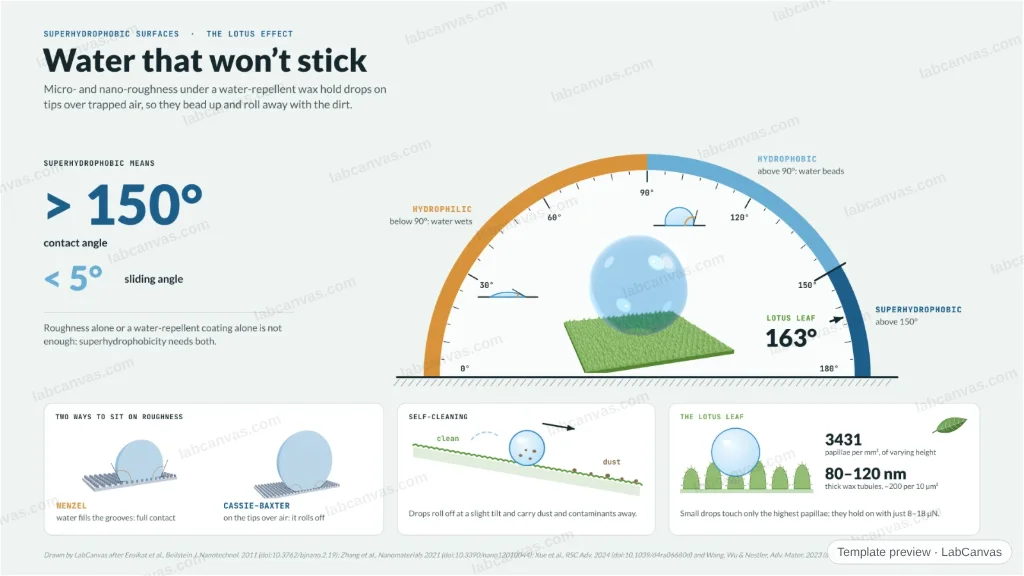
A contact-angle protractor from 0° to 180°: water spreads below 90°, beads above it, and beyond 150° (with drops sliding off below 5°) the surface is superhydrophobic, like the lotus leaf at 163°. Underneath, the two ways a drop sits on roughness (Wenzel, filling the grooves; Cassie–Baxter, resting on air), drops rolling off with the dirt, and the lotus leaf’s papillae and wax tubules in numbers.
Updated 4 cited papers128 editable layers
At a glance
- Category
- Graphical abstracts
- Method
- Graphical abstract
- Starting materials
- A surface with micro- and nano-scale roughness and low surface energy
- Product
- A superhydrophobic, self-cleaning surface: contact angle above 150°, drops roll off
- Key result
- Above 150° and sliding below 5° (Zhang et al. 2021); lotus leaf 163°, 3431 papillae per mm², wax tubules 80–120 nm thick, adhesion 8–18 µN (Ensikat et al. 2011)
- Figure
- 1920 × 1080 px (16:9), 128 editable layers, 1 generated objects
Step by step
- The scaleHydrophilic below 90°, hydrophobic above 90°, superhydrophobic above 150° with a sliding angle below 5° (Zhang et al. 2021)
- Wenzel or Cassie–BaxterIn the Wenzel state water fills the grooves; in the Cassie–Baxter state the drop rests over air, touches less, beads more and rolls off; roughness and low surface energy are both needed (Zhang et al. 2021; Ensikat et al. 2011)
- The lotus leaf3431 papillae per mm² coated with wax tubules 80–120 nm thick; 163° contact angle and 8–18 µN drop adhesion (Ensikat et al. 2011)
- Self-cleaningDrops roll off and carry dust and contaminants away (Xue et al. 2024)
Uses
- Graphical abstracts on superhydrophobic and self-cleaning surfaces
- Talks on wetting, the lotus effect and bioinspired coatings
- Teaching contact angles and the Wenzel and Cassie–Baxter states
Papers this template follows
- Ensikat, Ditsche-Kuru, Neinhuis & Barthlott, “Superhydrophobicity in perfection: the outstanding properties of the lotus leaf”, Beilstein J. Nanotechnol. 2011. doi:10.3762/bjnano.2.19primary
- Zhang et al., “A Review of Recent Advances in Superhydrophobic Surfaces and Their Applications in Drag Reduction and Heat Transfer”, Nanomaterials 2021. doi:10.3390/nano12010044review
- Xue et al., “A comprehensive review on self-cleaning glass surfaces: durability, mechanisms, and functional applications”, RSC Adv. 2024. doi:10.1039/d4ra06680dreview
- Wang, Wu & Nestler, “Wetting Effect on Patterned Substrates”, Adv. Mater. 2023. doi:10.1002/adma.202210745review
Drawn by LabCanvas after Ensikat et al., Beilstein J. Nanotechnol. 2011 (doi:10.3762/bjnano.2.19); Zhang et al., Nanomaterials 2021 (doi:10.3390/nano12010044); Xue et al., RSC Adv. 2024 (doi:10.1039/d4ra06680d) and Wang, Wu & Nestler, Adv. Mater. 2023 (doi:10.1002/adma.202210745).
How templates are written and checked: editorial guidelines.
Questions
What does the “Superhydrophobic surfaces: the lotus effect, read on a protractor” template show?
A contact-angle protractor from 0° to 180°: water spreads below 90°, beads above it, and beyond 150° (with drops sliding off below 5°) the surface is superhydrophobic, like the lotus leaf at 163°. Underneath, the two ways a drop sits on roughness (Wenzel, filling the grooves; Cassie–Baxter, resting on air), drops rolling off with the dirt, and the lotus leaf’s papillae and wax tubules in numbers.
What are the steps shown in “Superhydrophobic surfaces: the lotus effect, read on a protractor”?
1. The scale: Hydrophilic below 90°, hydrophobic above 90°, superhydrophobic above 150° with a sliding angle below 5° (Zhang et al. 2021). 2. Wenzel or Cassie–Baxter: In the Wenzel state water fills the grooves; in the Cassie–Baxter state the drop rests over air, touches less, beads more and rolls off; roughness and low surface energy are both needed (Zhang et al. 2021; Ensikat et al. 2011). 3. The lotus leaf: 3431 papillae per mm² coated with wax tubules 80–120 nm thick; 163° contact angle and 8–18 µN drop adhesion (Ensikat et al. 2011). 4. Self-cleaning: Drops roll off and carry dust and contaminants away (Xue et al. 2024).
What are the starting materials and the product?
Starting materials: A surface with micro- and nano-scale roughness and low surface energy. Product: A superhydrophobic, self-cleaning surface: contact angle above 150°, drops roll off.
Which papers is “Superhydrophobic surfaces: the lotus effect, read on a protractor” based on?
Ensikat, Ditsche-Kuru, Neinhuis & Barthlott, “Superhydrophobicity in perfection: the outstanding properties of the lotus leaf”, Beilstein J. Nanotechnol. 2011 (doi:10.3762/bjnano.2.19); Zhang et al., “A Review of Recent Advances in Superhydrophobic Surfaces and Their Applications in Drag Reduction and Heat Transfer”, Nanomaterials 2021 (doi:10.3390/nano12010044); Xue et al., “A comprehensive review on self-cleaning glass surfaces: durability, mechanisms, and functional applications”, RSC Adv. 2024 (doi:10.1039/d4ra06680d); Wang, Wu & Nestler, “Wetting Effect on Patterned Substrates”, Adv. Mater. 2023 (doi:10.1002/adma.202210745).
Can I edit the “Superhydrophobic surfaces: the lotus effect, read on a protractor” template?
Yes. Open it in the LabCanvas editor: all 128 layers are editable, including 1 generated objects (structures, plots, equipment) with their own settings. Change the text, colours and layout, then export PNG, TIFF, SVG or PDF.
Do I need an account to use this template?
Not to view it here. To open and edit it, sign in to LabCanvas or create a free account (the free plan keeps up to 3 designs). Downloading the figure is part of LabCanvas Pro (US$19 a month or US$199 a year).