Graphical abstract template · Graphical abstracts · Graphical abstract
Transparent wood: take out the lignin, fill in a matching polymer
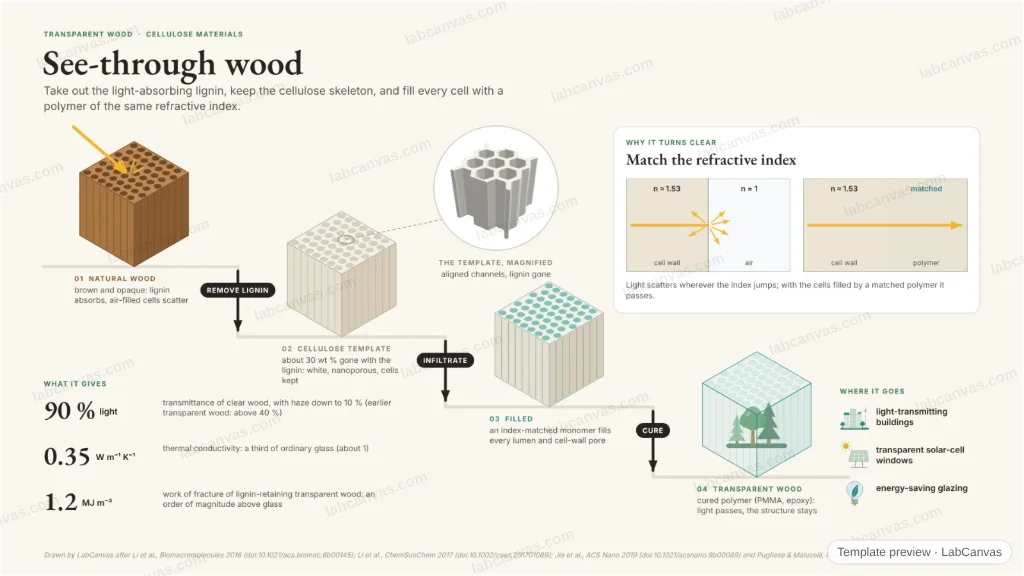
A staircase of four wood blocks: natural wood, the white cellulose template left when the light-absorbing lignin is removed, the template filled with a polymer whose refractive index matches the cell walls, and transparent wood that passes up to 90 % of the light. Above the steps, why it turns clear; below them, what it brings: low haze, a third of glass’s thermal conductivity and far more work of fracture, for light-transmitting buildings and solar-cell windows.
Updated 4 cited papers99 editable layers
At a glance
- Category
- Graphical abstracts
- Method
- Graphical abstract
- Starting materials
- A block of natural wood (balsa is among the most used)
- Product
- Transparent wood: a cellulose template filled with an index-matched polymer
- Key result
- Transmittance 85 %, haze 71 % (Li et al. 2016); 90 % and 10 % (Jia et al. 2019); 0.35 W m⁻¹ K⁻¹ against ~1 for glass (Jia et al. 2019); work of fracture 1.2 MJ m⁻³, an order of magnitude above glass (Li et al. 2017)
- Figure
- 1920 × 1080 px (16:9), 99 editable layers, 4 generated objects
Step by step
- Natural woodLignin absorbs light, and the cell walls (refractive index about 1.53) scatter it at the air-filled cells (index 1) (Li et al. 2016; Pugliese & Malucelli 2025)
- Remove ligninDelignification takes out around 30 wt % of the wood and leaves a white, nanoporous cellulose template with the cell structure kept (Li et al. 2017; Li et al. 2016)
- InfiltrateA refractive-index-matched prepolymerized monomer (MMA) fills the lumens and the nanopores of the cell walls (Li et al. 2016)
- Transparent woodUp to 85 % transmittance at 71 % haze (Li et al. 2016); clear wood reaches 90 % with 10 % haze and conducts heat at a third of glass’s rate (Jia et al. 2019)
Uses
- Graphical abstracts on transparent wood and cellulose materials
- Talks on bio-based optical materials and energy-saving buildings
- Teaching refractive-index matching
Papers this template follows
- Li, Fu, Yu, Yan & Berglund, “Optically Transparent Wood from a Nanoporous Cellulosic Template: Combining Functional and Structural Performance”, Biomacromolecules 2016. doi:10.1021/acs.biomac.6b00145method origin
- Li et al., “Lignin-Retaining Transparent Wood”, ChemSusChem 2017. doi:10.1002/cssc.201701089primary
- Jia et al., “Clear Wood toward High-Performance Building Materials”, ACS Nano 2019. doi:10.1021/acsnano.9b00089primary
- Pugliese & Malucelli, “Toward the Optimization of the Optical Behavior of Transparent Wood: Current State of the Art and Perspectives”, Polymers 2025. doi:10.3390/polym17243276review
Drawn by LabCanvas after Li et al., Biomacromolecules 2016 (doi:10.1021/acs.biomac.6b00145); Li et al., ChemSusChem 2017 (doi:10.1002/cssc.201701089); Jia et al., ACS Nano 2019 (doi:10.1021/acsnano.9b00089) and Pugliese & Malucelli, Polymers 2025 (doi:10.3390/polym17243276).
How templates are written and checked: editorial guidelines.
Questions
What does the “Transparent wood: take out the lignin, fill in a matching polymer” template show?
A staircase of four wood blocks: natural wood, the white cellulose template left when the light-absorbing lignin is removed, the template filled with a polymer whose refractive index matches the cell walls, and transparent wood that passes up to 90 % of the light. Above the steps, why it turns clear; below them, what it brings: low haze, a third of glass’s thermal conductivity and far more work of fracture, for light-transmitting buildings and solar-cell windows.
What are the steps shown in “Transparent wood: take out the lignin, fill in a matching polymer”?
1. Natural wood: Lignin absorbs light, and the cell walls (refractive index about 1.53) scatter it at the air-filled cells (index 1) (Li et al. 2016; Pugliese & Malucelli 2025). 2. Remove lignin: Delignification takes out around 30 wt % of the wood and leaves a white, nanoporous cellulose template with the cell structure kept (Li et al. 2017; Li et al. 2016). 3. Infiltrate: A refractive-index-matched prepolymerized monomer (MMA) fills the lumens and the nanopores of the cell walls (Li et al. 2016). 4. Transparent wood: Up to 85 % transmittance at 71 % haze (Li et al. 2016); clear wood reaches 90 % with 10 % haze and conducts heat at a third of glass’s rate (Jia et al. 2019).
What are the starting materials and the product?
Starting materials: A block of natural wood (balsa is among the most used). Product: Transparent wood: a cellulose template filled with an index-matched polymer.
Which papers is “Transparent wood: take out the lignin, fill in a matching polymer” based on?
Li, Fu, Yu, Yan & Berglund, “Optically Transparent Wood from a Nanoporous Cellulosic Template: Combining Functional and Structural Performance”, Biomacromolecules 2016 (doi:10.1021/acs.biomac.6b00145); Li et al., “Lignin-Retaining Transparent Wood”, ChemSusChem 2017 (doi:10.1002/cssc.201701089); Jia et al., “Clear Wood toward High-Performance Building Materials”, ACS Nano 2019 (doi:10.1021/acsnano.9b00089); Pugliese & Malucelli, “Toward the Optimization of the Optical Behavior of Transparent Wood: Current State of the Art and Perspectives”, Polymers 2025 (doi:10.3390/polym17243276).
Can I edit the “Transparent wood: take out the lignin, fill in a matching polymer” template?
Yes. Open it in the LabCanvas editor: all 99 layers are editable, including 4 generated objects (structures, plots, equipment) with their own settings. Change the text, colours and layout, then export PNG, TIFF, SVG or PDF.
Do I need an account to use this template?
Not to view it here. To open and edit it, sign in to LabCanvas or create a free account (the free plan keeps up to 3 designs). Downloading the figure is part of LabCanvas Pro (US$19 a month or US$199 a year).