Graphical abstract template · Materials graphical abstracts · Graphical abstract
Triboelectric nanogenerators: turning everyday motion into electricity
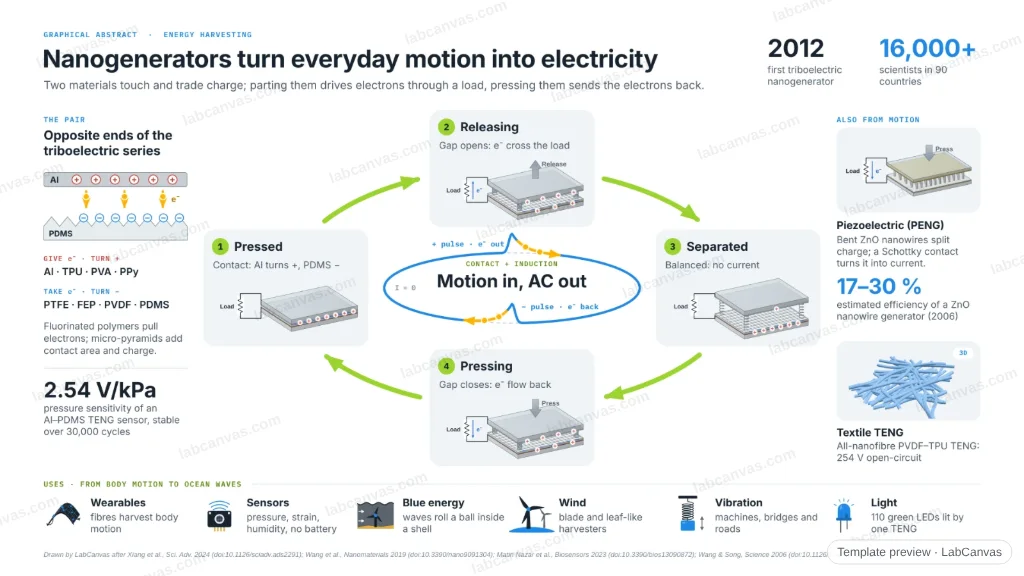
The triboelectric nanogenerator (TENG) drawn as a four-stage cycle: two materials touch and charge, pulling them apart drives electrons through a load, they rest balanced, and pressing them together sends the electrons back, so every press and release gives a pair of opposite current pulses. Around the cycle sit the material pair, the piezoelectric ZnO-nanowire cousin, a nanofibre textile harvester as a live 3D model and a row of uses, from wearables and self-powered sensors to wind and ocean waves.
Updated 5 cited papers129 editable layers
At a glance
- Category
- Materials graphical abstracts
- Method
- Graphical abstract
- Starting materials
- Two materials from opposite ends of the triboelectric series (aluminium and micro-pyramid PDMS) on electrodes, wired to a load
- Product
- Alternating current from repeated contact and separation
- Key result
- TENG invented by Wang’s group in 2012 and studied by more than 16,000 scientists in 90 countries (Xiang et al. 2024); ZnO nanowire generator efficiency estimated at 17–30 % (Wang & Song 2006); an Al/micro-pyramid PDMS TENG lit 110 green LEDs and sensed pressure at 2.54 V/kPa over 30,000 cycles (Wang et al. 2019); an all-nanofibre PVDF–TPU TENG reached 254 V (reviewed by Matin Nazar et al. 2023)
- Figure
- 1920 × 1080 px (16:9), 129 editable layers, 11 generated objects
Step by step
- PressedIn contact the two layers take equal and opposite charges: aluminium gives up electrons (+), PDMS takes them (−)
- ReleasingAs the layers part, the potential difference drives electrons through the external load to balance the static charges
- SeparatedFully apart, the electrodes reach electrostatic equilibrium and no current flows
- PressingPressing the layers together inverts the potential and the electrons flow back: the output alternates
Uses
- Wearable energy harvesting
- Self-powered sensors
- Ocean-wave (blue) energy
- Wind energy
- Vibration and structural monitoring
- Powering LEDs and small electronics
Papers this template follows
- Xiang, Peng, Yang, Wang & Cao, “Triboelectric nanogenerator for high-entropy energy, self-powered sensors, and popular education”, Sci. Adv. 2024. doi:10.1126/sciadv.ads2291review
- Wang et al., “Flexible and Wearable PDMS-Based Triboelectric Nanogenerator for Self-Powered Tactile Sensing”, Nanomaterials 2019. doi:10.3390/nano9091304primary
- Matin Nazar et al., “Skin-Contact Triboelectric Nanogenerator for Energy Harvesting and Motion Sensing: Principles, Challenges, and Perspectives”, Biosensors 2023. doi:10.3390/bios13090872review
- Lu, Mi, Wu, Cao & Wang, “From Triboelectric Nanogenerator to Polymer-Based Biosensor: A Review”, Biosensors 2022. doi:10.3390/bios12050323further reading
- Wang & Song, “Piezoelectric nanogenerators based on zinc oxide nanowire arrays”, Science 2006. doi:10.1126/science.1124005method origin
Drawn by LabCanvas after Xiang et al., Sci. Adv. 2024 (doi:10.1126/sciadv.ads2291); Wang et al., Nanomaterials 2019 (doi:10.3390/nano9091304); Matin Nazar et al., Biosensors 2023 (doi:10.3390/bios13090872); Wang & Song, Science 2006 (doi:10.1126/science.1124005).
How templates are written and checked: editorial guidelines.
Questions
What does the “Triboelectric nanogenerators: turning everyday motion into electricity” template show?
The triboelectric nanogenerator (TENG) drawn as a four-stage cycle: two materials touch and charge, pulling them apart drives electrons through a load, they rest balanced, and pressing them together sends the electrons back, so every press and release gives a pair of opposite current pulses. Around the cycle sit the material pair, the piezoelectric ZnO-nanowire cousin, a nanofibre textile harvester as a live 3D model and a row of uses, from wearables and self-powered sensors to wind and ocean waves.
What are the steps shown in “Triboelectric nanogenerators: turning everyday motion into electricity”?
1. Pressed: In contact the two layers take equal and opposite charges: aluminium gives up electrons (+), PDMS takes them (−). 2. Releasing: As the layers part, the potential difference drives electrons through the external load to balance the static charges. 3. Separated: Fully apart, the electrodes reach electrostatic equilibrium and no current flows. 4. Pressing: Pressing the layers together inverts the potential and the electrons flow back: the output alternates.
What are the starting materials and the product?
Starting materials: Two materials from opposite ends of the triboelectric series (aluminium and micro-pyramid PDMS) on electrodes, wired to a load. Product: Alternating current from repeated contact and separation.
Which papers is “Triboelectric nanogenerators: turning everyday motion into electricity” based on?
Xiang, Peng, Yang, Wang & Cao, “Triboelectric nanogenerator for high-entropy energy, self-powered sensors, and popular education”, Sci. Adv. 2024 (doi:10.1126/sciadv.ads2291); Wang et al., “Flexible and Wearable PDMS-Based Triboelectric Nanogenerator for Self-Powered Tactile Sensing”, Nanomaterials 2019 (doi:10.3390/nano9091304); Matin Nazar et al., “Skin-Contact Triboelectric Nanogenerator for Energy Harvesting and Motion Sensing: Principles, Challenges, and Perspectives”, Biosensors 2023 (doi:10.3390/bios13090872); Lu, Mi, Wu, Cao & Wang, “From Triboelectric Nanogenerator to Polymer-Based Biosensor: A Review”, Biosensors 2022 (doi:10.3390/bios12050323); Wang & Song, “Piezoelectric nanogenerators based on zinc oxide nanowire arrays”, Science 2006 (doi:10.1126/science.1124005).
Can I edit the “Triboelectric nanogenerators: turning everyday motion into electricity” template?
Yes. Open it in the LabCanvas editor: all 129 layers are editable, including 11 generated objects (structures, plots, equipment) with their own settings. Change the text, colours and layout, then export PNG, TIFF, SVG or PDF.
Do I need an account to use this template?
Not to view it here. To open and edit it, sign in to LabCanvas or create a free account (the free plan keeps up to 3 designs). Downloading the figure is part of LabCanvas Pro (US$19 a month or US$199 a year).