Graphical abstract template · Graphical abstracts · Graphical abstract
Two-dimensional magnets: magnetism, one layer at a time
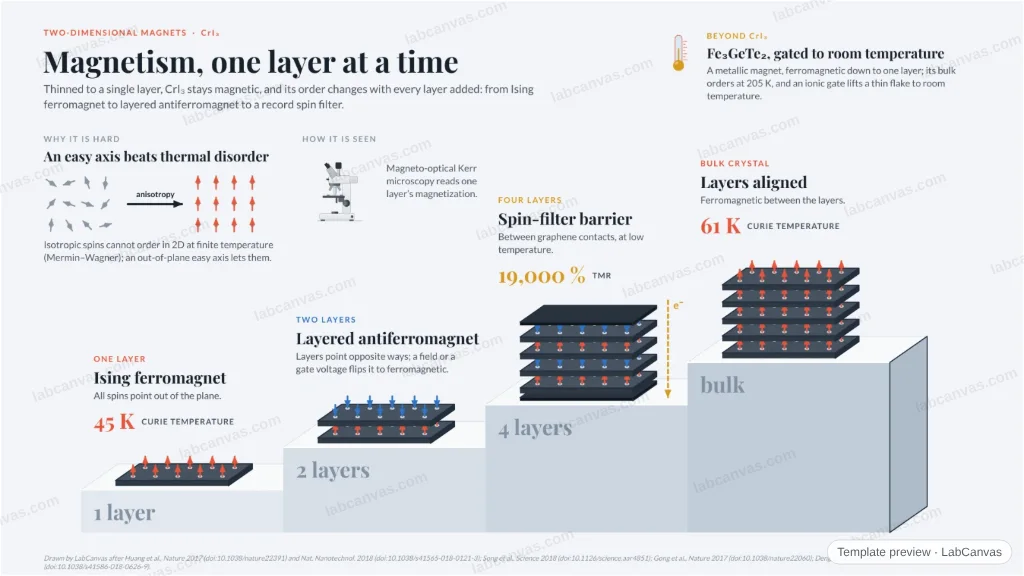
A staircase of CrI₃ stacks: a single layer is an Ising ferromagnet, two layers make a layered antiferromagnet that a gate can flip, four layers between graphene filter spins with a record tunnelling magnetoresistance, and the bulk is a ferromagnet again. Around it: why one layer needs an easy axis to order, how Kerr microscopy sees it, and metallic Fe₃GeTe₂ gated to room temperature.
Updated 5 cited papers384 editable layers
At a glance
- Category
- Graphical abstracts
- Method
- Graphical abstract
- Starting materials
- Layered van der Waals magnets (CrI₃, Cr₂Ge₂Te₆, Fe₃GeTe₂) thinned to a few atomic layers
- Product
- Magnetic order that changes layer by layer, and devices built from it
- Key result
- Tc 45 K (monolayer) vs 61 K (bulk CrI₃) (Huang et al. 2017); TMR up to 19,000 % with four-layer CrI₃ barriers (Song et al. 2018); Fe₃GeTe₂ bulk Tc 205 K, gated to room temperature (Deng et al. 2018)
- Figure
- 1920 × 1080 px (16:9), 384 editable layers, 2 generated objects
Step by step
- Why it is hardThe Mermin–Wagner theorem forbids order of isotropic spins in 2D at finite temperature; magnetic anisotropy lifts the ban (Huang et al. 2017; Gong et al. 2017)
- One layerKerr microscopy shows monolayer CrI₃ is an Ising ferromagnet with out-of-plane spins, Curie temperature 45 K (Huang et al. 2017)
- Two layersBilayer CrI₃ is a layered antiferromagnet; a magnetic field or a gate voltage switches it to ferromagnetic (Huang et al. 2017; Huang et al. 2018)
- Four layersCrI₃ between graphene contacts is a spin-filter tunnel barrier: up to 19,000 % magnetoresistance with four layers at low temperature, from the layer-by-layer antiferromagnetic order (Song et al. 2018)
- Bulk and beyondBulk CrI₃ orders at 61 K with ferromagnetic interlayer coupling (Huang et al. 2017); metallic Fe₃GeTe₂ (bulk 205 K) stays ferromagnetic down to one layer and an ionic gate raises its Tc to room temperature (Deng et al. 2018)
Uses
- Graphical abstracts on 2D magnetism and van der Waals magnets
- Talks on spintronics and magnetic tunnel junctions from 2D materials
- Teaching the Mermin–Wagner theorem and magnetic anisotropy
Papers this template follows
- Huang et al., “Layer-dependent ferromagnetism in a van der Waals crystal down to the monolayer limit”, Nature 2017. doi:10.1038/nature22391primary
- Gong et al., “Discovery of intrinsic ferromagnetism in two-dimensional van der Waals crystals”, Nature 2017. doi:10.1038/nature22060primary
- Huang et al., “Electrical control of 2D magnetism in bilayer CrI3”, Nat. Nanotechnol. 2018. doi:10.1038/s41565-018-0121-3primary
- Song et al., “Giant tunneling magnetoresistance in spin-filter van der Waals heterostructures”, Science 2018. doi:10.1126/science.aar4851primary
- Deng et al., “Gate-tunable room-temperature ferromagnetism in two-dimensional Fe3GeTe2”, Nature 2018. doi:10.1038/s41586-018-0626-9primary
Drawn by LabCanvas after Huang et al., Nature 2017 (doi:10.1038/nature22391) and Nat. Nanotechnol. 2018 (doi:10.1038/s41565-018-0121-3); Song et al., Science 2018 (doi:10.1126/science.aar4851); Gong et al., Nature 2017 (doi:10.1038/nature22060); Deng et al., Nature 2018 (doi:10.1038/s41586-018-0626-9).
How templates are written and checked: editorial guidelines.
Questions
What does the “Two-dimensional magnets: magnetism, one layer at a time” template show?
A staircase of CrI₃ stacks: a single layer is an Ising ferromagnet, two layers make a layered antiferromagnet that a gate can flip, four layers between graphene filter spins with a record tunnelling magnetoresistance, and the bulk is a ferromagnet again. Around it: why one layer needs an easy axis to order, how Kerr microscopy sees it, and metallic Fe₃GeTe₂ gated to room temperature.
What are the steps shown in “Two-dimensional magnets: magnetism, one layer at a time”?
1. Why it is hard: The Mermin–Wagner theorem forbids order of isotropic spins in 2D at finite temperature; magnetic anisotropy lifts the ban (Huang et al. 2017; Gong et al. 2017). 2. One layer: Kerr microscopy shows monolayer CrI₃ is an Ising ferromagnet with out-of-plane spins, Curie temperature 45 K (Huang et al. 2017). 3. Two layers: Bilayer CrI₃ is a layered antiferromagnet; a magnetic field or a gate voltage switches it to ferromagnetic (Huang et al. 2017; Huang et al. 2018). 4. Four layers: CrI₃ between graphene contacts is a spin-filter tunnel barrier: up to 19,000 % magnetoresistance with four layers at low temperature, from the layer-by-layer antiferromagnetic order (Song et al. 2018). 5. Bulk and beyond: Bulk CrI₃ orders at 61 K with ferromagnetic interlayer coupling (Huang et al. 2017); metallic Fe₃GeTe₂ (bulk 205 K) stays ferromagnetic down to one layer and an ionic gate raises its Tc to room temperature (Deng et al. 2018).
What are the starting materials and the product?
Starting materials: Layered van der Waals magnets (CrI₃, Cr₂Ge₂Te₆, Fe₃GeTe₂) thinned to a few atomic layers. Product: Magnetic order that changes layer by layer, and devices built from it.
Which papers is “Two-dimensional magnets: magnetism, one layer at a time” based on?
Huang et al., “Layer-dependent ferromagnetism in a van der Waals crystal down to the monolayer limit”, Nature 2017 (doi:10.1038/nature22391); Gong et al., “Discovery of intrinsic ferromagnetism in two-dimensional van der Waals crystals”, Nature 2017 (doi:10.1038/nature22060); Huang et al., “Electrical control of 2D magnetism in bilayer CrI3”, Nat. Nanotechnol. 2018 (doi:10.1038/s41565-018-0121-3); Song et al., “Giant tunneling magnetoresistance in spin-filter van der Waals heterostructures”, Science 2018 (doi:10.1126/science.aar4851); Deng et al., “Gate-tunable room-temperature ferromagnetism in two-dimensional Fe3GeTe2”, Nature 2018 (doi:10.1038/s41586-018-0626-9).
Can I edit the “Two-dimensional magnets: magnetism, one layer at a time” template?
Yes. Open it in the LabCanvas editor: all 384 layers are editable, including 2 generated objects (structures, plots, equipment) with their own settings. Change the text, colours and layout, then export PNG, TIFF, SVG or PDF.
Do I need an account to use this template?
Not to view it here. To open and edit it, sign in to LabCanvas or create a free account (the free plan keeps up to 3 designs). Downloading the figure is part of LabCanvas Pro (US$19 a month or US$199 a year).





