Graphical abstract template · Graphical abstracts · Graphical abstract
Upconversion nanoparticles: two infrared photons in, one visible photon out
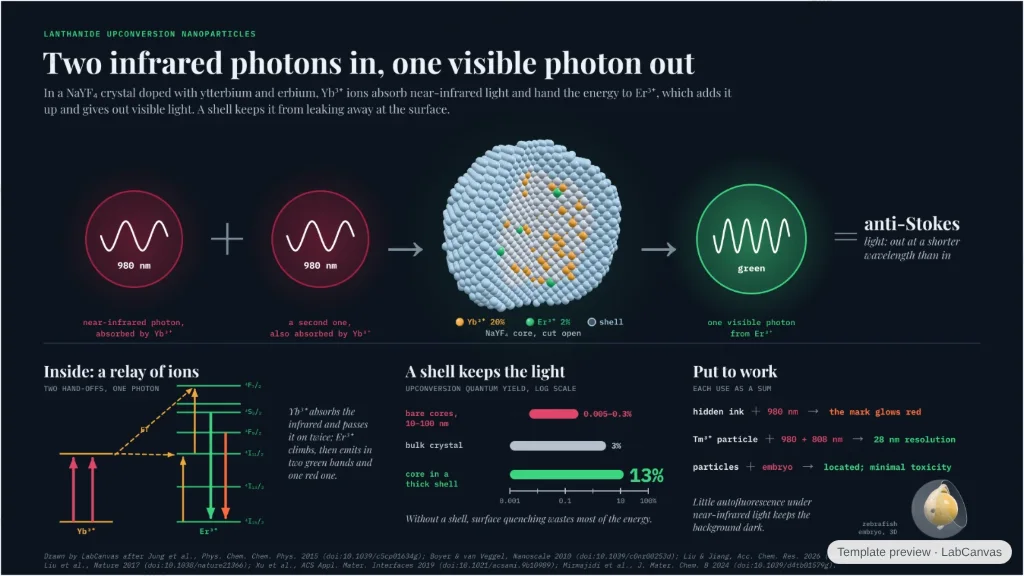
Lanthanide upconversion written as a sum: two near-infrared photons absorbed by ytterbium ions in a NaYF₄ core are relayed to erbium, which emits one visible photon. Under the sum, the energy ladder, how a shell lifts quantum yields from fractions of a percent towards 13%, and uses written as small equations: hidden inks, 28 nm nanoscopy and zebrafish embryos.
Updated 8 cited papers111 editable layers
At a glance
- Category
- Graphical abstracts
- Method
- Graphical abstract
- Starting materials
- NaYF₄ nanocrystals doped with Yb³⁺ (sensitizer) and Er³⁺ (activator), grown inside a shell
- Product
- Nanoparticles that turn 980 nm near-infrared light into visible green and red light
- Key result
- QY 0.005–0.3% (10–100 nm) vs 3% bulk (Boyer & van Veggel 2010); up to 13% core–ultrathick shell (Liu & Jiang 2026); 28 nm STED resolution (Liu et al. 2017)
- Figure
- 1920 × 1080 px (16:9), 111 editable layers
Step by step
- Two photons inYb³⁺ ions absorb near-infrared light (980 nm excitation) and pass the energy to Er³⁺ in two transfers (Jung et al. 2015)
- One photon outEr³⁺ emits in two green bands and one red band; the red mostly via ⁴I₁₁/₂ → ⁴I₁₃/₂ → ⁴F₉/₂ (Jung et al. 2015)
- A shell keeps the lightBare 10–100 nm particles: 0.005–0.3% quantum yield, bulk 3% (Boyer & van Veggel 2010); a core in an ultrathick shell: up to 13% (Liu & Jiang 2026)
- UsesInks read under 980 nm (Xu et al. 2019), STED nanoscopy at 28 nm (Liu et al. 2017), particles in zebrafish embryos with minimal toxicity (Mirmajidi et al. 2024); little autofluorescence background (Liu & Chen 2026)
Uses
- Graphical abstracts on lanthanide upconversion
- Talks on near-infrared-excited probes and anti-Stokes emission
- Teaching sensitizer–activator energy transfer
Papers this template follows
- Jung et al., “The preferred upconversion pathway for the red emission of lanthanide-doped upconverting nanoparticles, NaYF4:Yb3+,Er3+”, Phys. Chem. Chem. Phys. 2015. doi:10.1039/c5cp01634gprimary
- Boyer & van Veggel, “Absolute quantum yield measurements of colloidal NaYF4: Er3+, Yb3+ upconverting nanoparticles”, Nanoscale 2010. doi:10.1039/c0nr00253dprimary
- Liu & Jiang, “Brightening Upconversion Nanoparticles”, Acc. Chem. Res. 2026. doi:10.1021/acs.accounts.5c00910review
- Liu & Chen, “Photophysics-Guided Upconversion Nanosystems for Sensing”, Acc. Chem. Res. 2026. doi:10.1021/acs.accounts.5c00916review
- Liu et al., “Amplified stimulated emission in upconversion nanoparticles for super-resolution nanoscopy”, Nature 2017. doi:10.1038/nature21366primary
- Xu et al., “Dual-Mode, Color-Tunable, Lanthanide-Doped Core-Shell Nanoarchitectures for Anti-Counterfeiting Inks and Latent Fingerprint Recognition”, ACS Appl. Mater. Interfaces 2019. doi:10.1021/acsami.9b10989primary
- Mirmajidi et al., “Nano-bio interactions of Gum Arabic-stabilized lanthanide-based upconverting nanoparticles: in vitro and in vivo study”, J. Mater. Chem. B 2024. doi:10.1039/d4tb01579gprimary
- Wang et al., “Tuning upconversion through energy migration in core-shell nanoparticles”, Nat. Mater. 2011. doi:10.1038/nmat3149further reading
Drawn by LabCanvas after Jung et al., Phys. Chem. Chem. Phys. 2015 (doi:10.1039/c5cp01634g); Boyer & van Veggel, Nanoscale 2010 (doi:10.1039/c0nr00253d); Liu & Jiang, Acc. Chem. Res. 2026 (doi:10.1021/acs.accounts.5c00910); Liu et al., Nature 2017 (doi:10.1038/nature21366); Xu et al., ACS Appl. Mater. Interfaces 2019 (doi:10.1021/acsami.9b10989); Mirmajidi et al., J. Mater. Chem. B 2024 (doi:10.1039/d4tb01579g).
How templates are written and checked: editorial guidelines.
Questions
What does the “Upconversion nanoparticles: two infrared photons in, one visible photon out” template show?
Lanthanide upconversion written as a sum: two near-infrared photons absorbed by ytterbium ions in a NaYF₄ core are relayed to erbium, which emits one visible photon. Under the sum, the energy ladder, how a shell lifts quantum yields from fractions of a percent towards 13%, and uses written as small equations: hidden inks, 28 nm nanoscopy and zebrafish embryos.
What are the steps shown in “Upconversion nanoparticles: two infrared photons in, one visible photon out”?
1. Two photons in: Yb³⁺ ions absorb near-infrared light (980 nm excitation) and pass the energy to Er³⁺ in two transfers (Jung et al. 2015). 2. One photon out: Er³⁺ emits in two green bands and one red band; the red mostly via ⁴I₁₁/₂ → ⁴I₁₃/₂ → ⁴F₉/₂ (Jung et al. 2015). 3. A shell keeps the light: Bare 10–100 nm particles: 0.005–0.3% quantum yield, bulk 3% (Boyer & van Veggel 2010); a core in an ultrathick shell: up to 13% (Liu & Jiang 2026). 4. Uses: Inks read under 980 nm (Xu et al. 2019), STED nanoscopy at 28 nm (Liu et al. 2017), particles in zebrafish embryos with minimal toxicity (Mirmajidi et al. 2024); little autofluorescence background (Liu & Chen 2026).
What are the starting materials and the product?
Starting materials: NaYF₄ nanocrystals doped with Yb³⁺ (sensitizer) and Er³⁺ (activator), grown inside a shell. Product: Nanoparticles that turn 980 nm near-infrared light into visible green and red light.
Which papers is “Upconversion nanoparticles: two infrared photons in, one visible photon out” based on?
Jung et al., “The preferred upconversion pathway for the red emission of lanthanide-doped upconverting nanoparticles, NaYF4:Yb3+,Er3+”, Phys. Chem. Chem. Phys. 2015 (doi:10.1039/c5cp01634g); Boyer & van Veggel, “Absolute quantum yield measurements of colloidal NaYF4: Er3+, Yb3+ upconverting nanoparticles”, Nanoscale 2010 (doi:10.1039/c0nr00253d); Liu & Jiang, “Brightening Upconversion Nanoparticles”, Acc. Chem. Res. 2026 (doi:10.1021/acs.accounts.5c00910); Liu & Chen, “Photophysics-Guided Upconversion Nanosystems for Sensing”, Acc. Chem. Res. 2026 (doi:10.1021/acs.accounts.5c00916); Liu et al., “Amplified stimulated emission in upconversion nanoparticles for super-resolution nanoscopy”, Nature 2017 (doi:10.1038/nature21366); Xu et al., “Dual-Mode, Color-Tunable, Lanthanide-Doped Core-Shell Nanoarchitectures for Anti-Counterfeiting Inks and Latent Fingerprint Recognition”, ACS Appl. Mater. Interfaces 2019 (doi:10.1021/acsami.9b10989); Mirmajidi et al., “Nano-bio interactions of Gum Arabic-stabilized lanthanide-based upconverting nanoparticles: in vitro and in vivo study”, J. Mater. Chem. B 2024 (doi:10.1039/d4tb01579g); Wang et al., “Tuning upconversion through energy migration in core-shell nanoparticles”, Nat. Mater. 2011 (doi:10.1038/nmat3149).
Can I edit the “Upconversion nanoparticles: two infrared photons in, one visible photon out” template?
Yes. Open it in the LabCanvas editor: all 111 layers are editable. Change the text, colours and layout, then export PNG, TIFF, SVG or PDF.
Do I need an account to use this template?
Not to view it here. To open and edit it, sign in to LabCanvas or create a free account (the free plan keeps up to 3 designs). Downloading the figure is part of LabCanvas Pro (US$19 a month or US$199 a year).