Graphical abstract template · Nanomaterial applications · Energy storage
Nanomaterials for energy storage
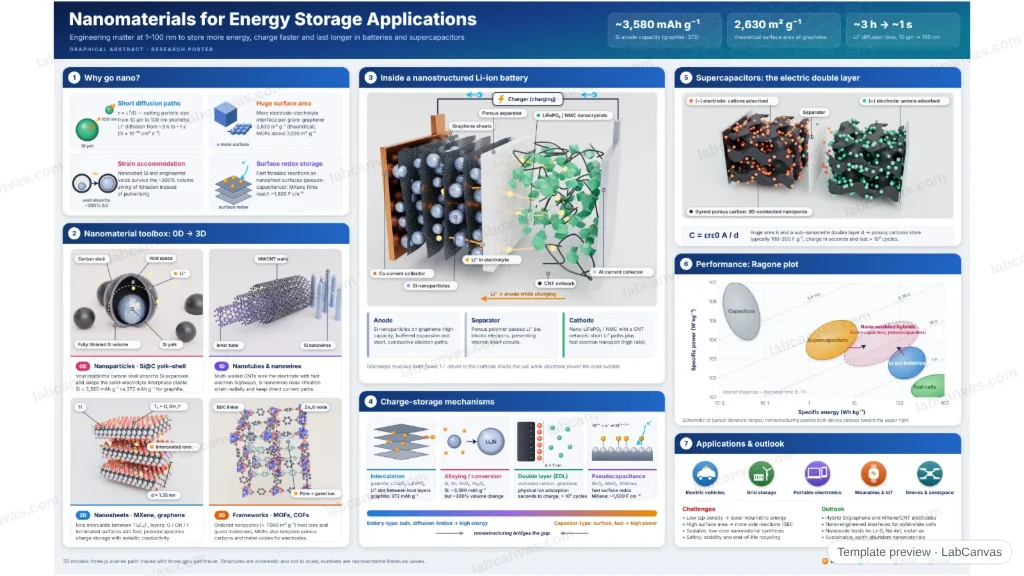
A poster-style graphical abstract on why nanostructuring helps batteries and supercapacitors: shorter Li⁺ diffusion paths, more surface, strain accommodation and surface redox, then a 0D to 3D toolbox (Si@C yolk–shell particles, CNTs and Si nanowires, MXene and graphene sheets, MOFs).
Updated 1 cited paper547 editable layers
At a glance
- Category
- Nanomaterial applications
- Method
- Energy storage
- Product
- Nanostructured electrodes for batteries and supercapacitors
- Figure
- 2400 × 1500 px (16:9), 547 editable layers
Strengths
- Diffusion time scales with L²: 10 µm → 100 nm cuts Li⁺ diffusion from hours to about a second
- Graphene: 2,630 m² g⁻¹ theoretical surface area
- Si: ~3,580 mAh g⁻¹ versus 372 mAh g⁻¹ for graphite
Uses
- Lithium-ion and sodium-ion batteries
- Supercapacitors and pseudocapacitors
- Conference posters and review graphical abstracts
Papers this template follows
- Aricò et al., “Nanostructured materials for advanced energy conversion and storage devices”, Nat. Mater. 2005. doi:10.1038/nmat1368review
Overview after Aricò et al., Nat. Mater. 2005 (doi:10.1038/nmat1368). Capacities, surface areas and diffusion times are typical literature values; particles, sheets and the cell are schematic, not to scale.
How templates are written and checked: editorial guidelines.
Questions
What does the “Nanomaterials for energy storage” template show?
A poster-style graphical abstract on why nanostructuring helps batteries and supercapacitors: shorter Li⁺ diffusion paths, more surface, strain accommodation and surface redox, then a 0D to 3D toolbox (Si@C yolk–shell particles, CNTs and Si nanowires, MXene and graphene sheets, MOFs).
Which papers is “Nanomaterials for energy storage” based on?
Aricò et al., “Nanostructured materials for advanced energy conversion and storage devices”, Nat. Mater. 2005 (doi:10.1038/nmat1368).
Can I edit the “Nanomaterials for energy storage” template?
Yes. Open it in the LabCanvas editor: all 547 layers are editable. Change the text, colours and layout, then export PNG, TIFF, SVG or PDF.
Do I need an account to use this template?
Not to view it here. To open and edit it, sign in to LabCanvas or create a free account (the free plan keeps one design of each kind). Downloading the figure is part of LabCanvas Pro (US$19 a month or US$199 a year).