How to make a 1 M NaCl solution (and any molar solution)
Weigh 58.44 g of NaCl, dissolve it in about 800 mL of water and make up to 1 L in a volumetric flask. Molar mass, hydrates, temperature and mistakes.
Contents
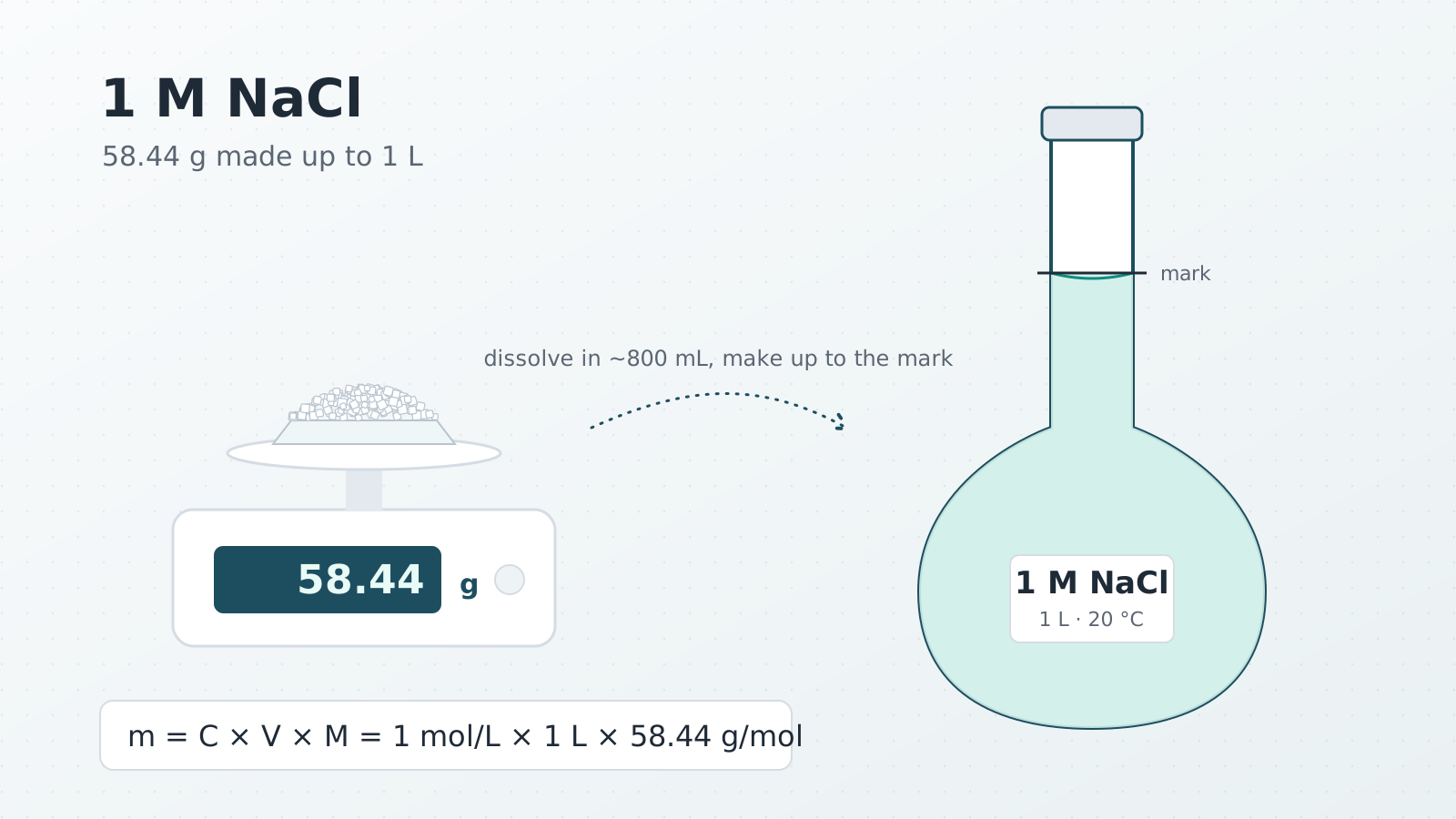
To make 1 L of a 1 M NaCl solution, weigh 58.44 g of sodium chloride (its molar mass is 58.44 g/mol), dissolve it in about 800 mL of distilled or deionised water, pour it into a 1 L volumetric flask, rinse the beaker into the flask, add water up to the mark and mix by inverting the stoppered flask. The same three numbers, concentration × volume × molar mass, give the mass for any molar solution: m = C × V × M.
Below: the mass of NaCl for other volumes, each step at the bench, why you make up to volume instead of adding a litre of water, how temperature, hydrates and purity change the numbers, and the mistakes that most often make a "1 M" solution something else. The molarity calculator does the arithmetic for any compound.
How much NaCl for a 1 M solution
| Final volume | NaCl to weigh |
|---|---|
| 1 L | 58.44 g |
| 500 mL | 29.22 g |
| 250 mL | 14.61 g |
| 100 mL | 5.844 g |
| 50 mL | 2.922 g |
| 10 mL | 584.4 mg |
Each mass is 1 mol/L × the volume × 58.44 g/mol. For other concentrations scale it: 5 M is 292.2 g per litre, 150 mM is 8.766 g per litre. Normal saline, 0.9 % w/v, is 9 g per litre, which is 154 mM.
Step 1: find the molar mass
Add up the standard atomic weights in the formula. For NaCl, sodium is 22.98976928 and chlorine 35.45, so
These are the IUPAC (CIAAW) 2021 standard atomic weights; NIST lists the same values for both elements. Chlorine's atomic weight varies a little between natural sources (NIST gives the interval 35.446 to 35.457), so 35.45 is the conventional value to calculate with; the difference is far below what a balance can see in a buffer. The label on the bottle usually gives the formula weight too. For any other compound, type its formula into the molar mass calculator, hydrates included.
Step 2: calculate the mass to weigh
with
In the molarity calculator, choose Mass to weigh, pick sodium chloride from the list (or type its molar mass), enter 1 M and 1 L, and it gives 58.44 g with a one-line recipe to copy. It also works backwards: the molarity you get from a mass you already weighed, or the volume to dissolve it to.
Step 3: weigh it
Tare a clean, dry weighing boat or beaker on the balance and add NaCl with a spatula until it reads 58.44 g. A balance that reads to 0.01 g is plenty for a litre; for small volumes, where the mass is a few hundred milligrams, use one that reads to 0.001 g or better, so the last digit is a small fraction of what you weigh. Close the bottle straight away.
Step 4: dissolve it in less water than the final volume
Put about 800 mL of distilled or deionised water in a beaker with a stir bar, add the salt and stir until no crystals are left. Do not start from a full litre: the dissolved salt takes up room, so 58.44 g added to 1 L of water gives a little more than a litre of solution, and a concentration slightly below 1 M. Some solutes warm or cool the water as they dissolve (sodium hydroxide gets hot, urea cools it noticeably); let the solution come back to room temperature before the next step.
Step 5: make up to volume in a volumetric flask
- Pour the solution into a 1 L volumetric flask through a funnel.
- Rinse the beaker, the stir bar and the funnel two or three times with a little water and add the rinses to the flask, so no salt is left behind.
- Add water until the level is just below the mark, then add the last few millilitres dropwise until the bottom of the meniscus sits on the line, with your eye level with it.
- Stopper the flask and invert it ten times or more. The water added last sits on top until it is mixed in.
A volumetric flask holds its stated volume at its reference temperature: 20 °C under ISO 1042, the standard for one-mark volumetric flasks (27 °C in countries that have adopted it). A graduated cylinder or the marks on a beaker or bottle are much less accurate; they will do for a rough wash solution, not for a stock you dilute into everything else.
Step 6: label and store it
Transfer the solution to a clean, labelled bottle: the name and concentration (1 M NaCl), the date and your initials. Sterilise it by autoclaving or filtering if your work needs a sterile stock.
Temperature changes the volume, so molarity is defined at a temperature
Molarity is moles per litre of solution, and liquids expand when warmed. Water has a density of 0.99821 g/mL at 20 °C and 0.99705 g/mL at 25 °C (Tanaka et al. 2001), so the same water takes up about 0.12 % more volume at 25 °C. A dilute solution made up to the mark at 20 °C therefore holds about 0.12 % less solute per litre once it has warmed to 25 °C. That is negligible for most buffers, but it matters for analytical standards, which are made up at the flask's calibration temperature and used close to it. When a concentration must not depend on temperature, use molality instead: moles per kilogram of solvent.
Any molar solution: the same three numbers
| Solution | Volume | Molar mass (g/mol) | Mass to weigh |
|---|---|---|---|
| 150 mM NaCl (saline) | 500 mL | 58.44 | 4.383 g |
| 5 M NaCl stock | 1 L | 58.44 | 292.2 g |
| 1 M Tris base | 100 mL | 121.14 | 12.11 g |
| 0.5 M EDTA (disodium dihydrate) | 1 L | 372.24 | 186.1 g |
| 1 M glucose | 250 mL | 180.16 | 45.04 g |
| 2 M KCl | 50 mL | 74.55 | 7.455 g |
| 1 M CaCl₂ from CaCl₂·2H₂O | 100 mL | 147.01 | 14.7 g |
| 1 M DTT | 10 mL | 154.24 | 1.542 g |
Every row is m = C × V × M with the molar mass of the form you weigh. The molarity calculator has these and 32 more reagents built in, and its page lists ready-made recipes for the usual stocks (Tris-HCl, EDTA, PBS, TAE and TBE).
Hydrates: use the molar mass of what is in the bottle
Many salts are sold as hydrates, with water built into the crystal, and that water is part of what you weigh. Calcium chloride is the classic case:
| Form | Formula | Molar mass (g/mol) | For 1 L of 1 M |
|---|---|---|---|
| Calcium chloride dihydrate | CaCl₂·2H₂O | 147.01 | 147.01 g |
| Calcium chloride, anhydrous | CaCl₂ | 110.98 | 110.98 g |
| Magnesium chloride hexahydrate | MgCl₂·6H₂O | 203.30 | 203.30 g |
| Magnesium chloride, anhydrous | MgCl₂ | 95.21 | 95.21 g |
The dihydrate's molar mass, in g/mol, is
Mix the forms up and the error is large: 110.98 g of the dihydrate in 1 L gives 0.755 M (25 % short), and 147.01 g of the anhydrous salt gives 1.325 M (32 % over). Read the formula on the label, not just the name. Anhydrous calcium chloride takes up water from the air, so weigh it quickly and keep the bottle closed.
Purity
The calculation assumes the solid is pure. If the label gives an assay below 100 %, divide by it: for NaCl of 99.5 % purity,
Molarity, molality and percent
| What it means | 1 M NaCl | 1 mol/kg NaCl | 5.844 % w/v NaCl |
|---|---|---|---|
| Per what | litre of solution | kilogram of water | 100 mL of solution |
| How to make it | 58.44 g made up to 1 L | 58.44 g in 1 kg of water | 58.44 g made up to 1 L |
| Changes with temperature | Slightly | No | Slightly |
Amount concentration (molarity) and molality are defined in the IUPAC Green Book. 1 M and 5.844 % w/v NaCl are the same solution written two ways; 1 mol/kg is a different, slightly more dilute one. The concentration converter converts between these units.
Common mistakes
- Dissolving in the full final volume. Make up to volume instead; see Step 4.
- Using the anhydrous molar mass for a hydrate, or the other way round.
- Mixing up mM and M, or mL and L. Each is a factor of 1000. Write the units next to every number.
- Not mixing after making up to the mark. The top of the flask stays dilute until the flask is inverted.
- Making up to volume while the solution is still warm or cold from dissolving, so the volume changes as it settles to room temperature.
- Weighing the wrong salt form, such as Tris-HCl (157.59 g/mol) for a recipe written for Tris base (121.14 g/mol).
From the 1 M stock to a working solution
A 1 M or 5 M stock is usually diluted before use, with C₁V₁ = C₂V₂: C1V1 = C2V2: the dilution formula with worked examples covers that step, and the dilution calculator gives the volumes. For buffers that need a set pH, the pH calculator gives the acid-to-base ratio.
References
- Prohaska T, Irrgeher J, Benefield J, Böhlke JK, Chesson LA, Coplen TB, et al. (2022). Standard atomic weights of the elements 2021 (IUPAC Technical Report). Pure and Applied Chemistry 94(5), 573–600. doi:10.1515/pac-2019-0603
- Coursey JS, Schwab DJ, Tsai JJ, Dragoset RA. Atomic Weights and Isotopic Compositions with Relative Atomic Masses. NIST Physical Measurement Laboratory. nist.gov
- Cohen ER, Cvitaš T, Frey JG, et al. (2007). Quantities, Units and Symbols in Physical Chemistry (IUPAC Green Book), 3rd edition. RSC Publishing. doi:10.1039/9781847557889
- ISO 1042:1998. Laboratory glassware: one-mark volumetric flasks. International Organization for Standardization.
- Tanaka M, Girard G, Davis R, Peuto A, Bignell N (2001). Recommended table for the density of water between 0 °C and 40 °C based on recent experimental reports. Metrologia 38(4), 301–309. doi:10.1088/0026-1394/38/4/3
Frequently asked questions
How many grams of NaCl do I need for a 1 M solution?
58.44 g per litre of final solution, because the molar mass of NaCl is 58.44 g/mol. For 100 mL weigh 5.844 g; for 500 mL, 29.22 g.
Do I add 58.44 g of NaCl to 1 L of water?
No. Dissolve it in less water, about 800 mL, then add water up to the 1 L mark of a volumetric flask. Added to a full litre of water, the salt makes slightly more than a litre of solution, so the concentration ends up a little below 1 M (the result is close to a 1 mol/kg, or 1 molal, solution instead).
What is the molar mass of NaCl?
58.44 g/mol: sodium 22.98976928 plus chlorine 35.45 (the IUPAC standard atomic weights, also listed by NIST).
How do I make 100 mL of 1 M NaCl?
Weigh 5.844 g of NaCl, dissolve it in about 80 mL of water, transfer it to a 100 mL volumetric flask, make up to the mark and mix by inverting.
How do I make 1 M CaCl₂ from calcium chloride dihydrate?
Use the molar mass of the dihydrate, CaCl₂·2H₂O, 147.01 g/mol: 147.01 g per litre, or 14.7 g per 100 mL. Anhydrous CaCl₂ is 110.98 g/mol; weighing that mass of the dihydrate would give only 0.755 M.
What is the difference between 1 M and 1 m?
1 M (molar) is 1 mol of solute per litre of solution; 1 m (molal, mol/kg) is 1 mol per kilogram of solvent. 1 M NaCl is 58.44 g made up to 1 L; 1 mol/kg NaCl is 58.44 g dissolved in 1 kg of water.
Does temperature change the molarity?
Slightly, because the volume changes. Water takes up about 0.12 % more volume at 25 °C than at 20 °C, and volumetric flasks are calibrated at 20 °C. Molality, per kilogram of solvent, does not depend on temperature.
Try it in LabCanvas
Every app is free to start in your browser. Create an account and begin.
Open the LabCanvas dashboardKeep reading
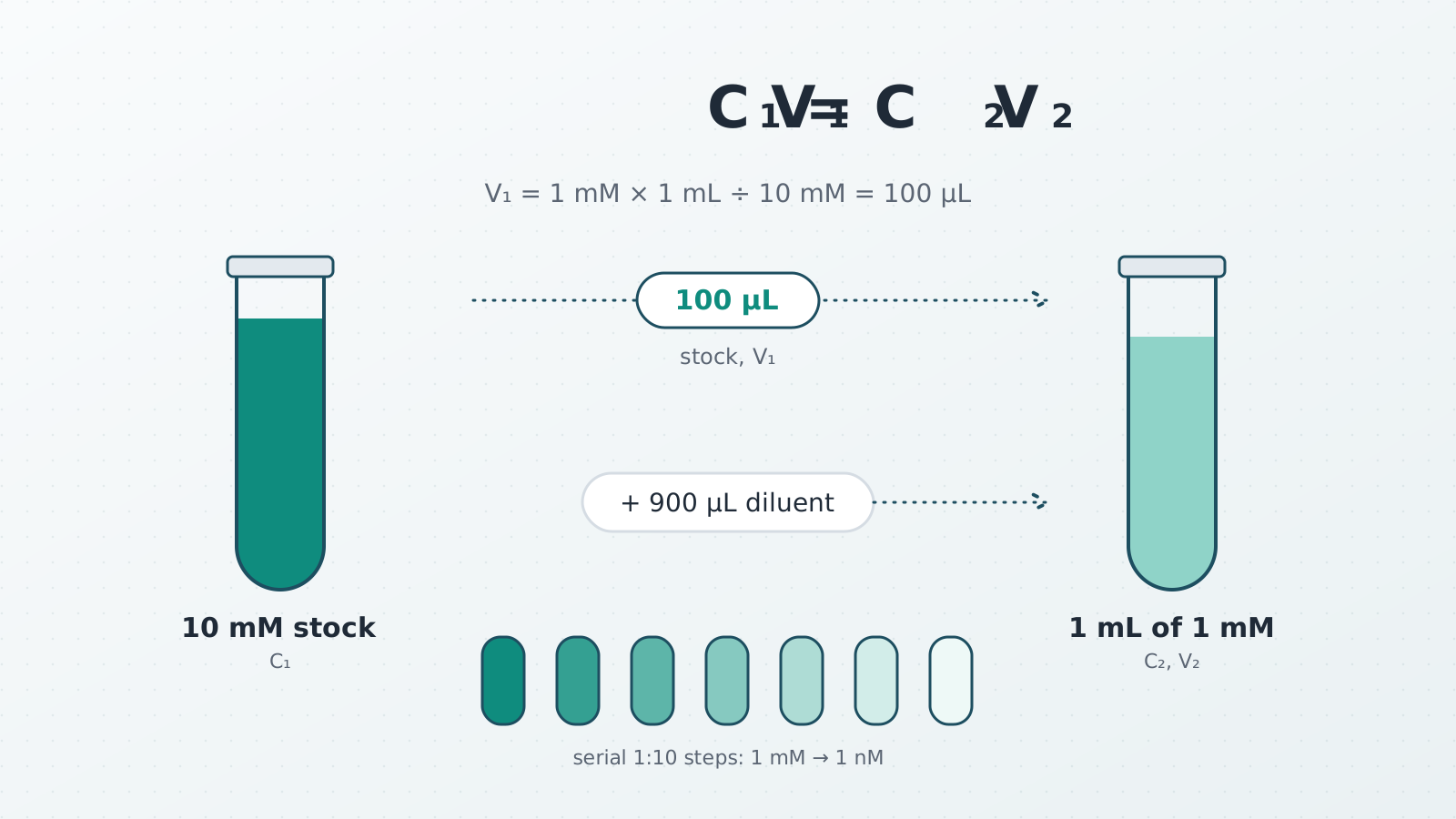
C1V1 = C2V2: the dilution formula with worked examples
C1V1 = C2V2 with worked examples: 10× buffer to 1×, a 1:1000 antibody, serial dilutions, consistent units, and when the dilution formula does not apply.
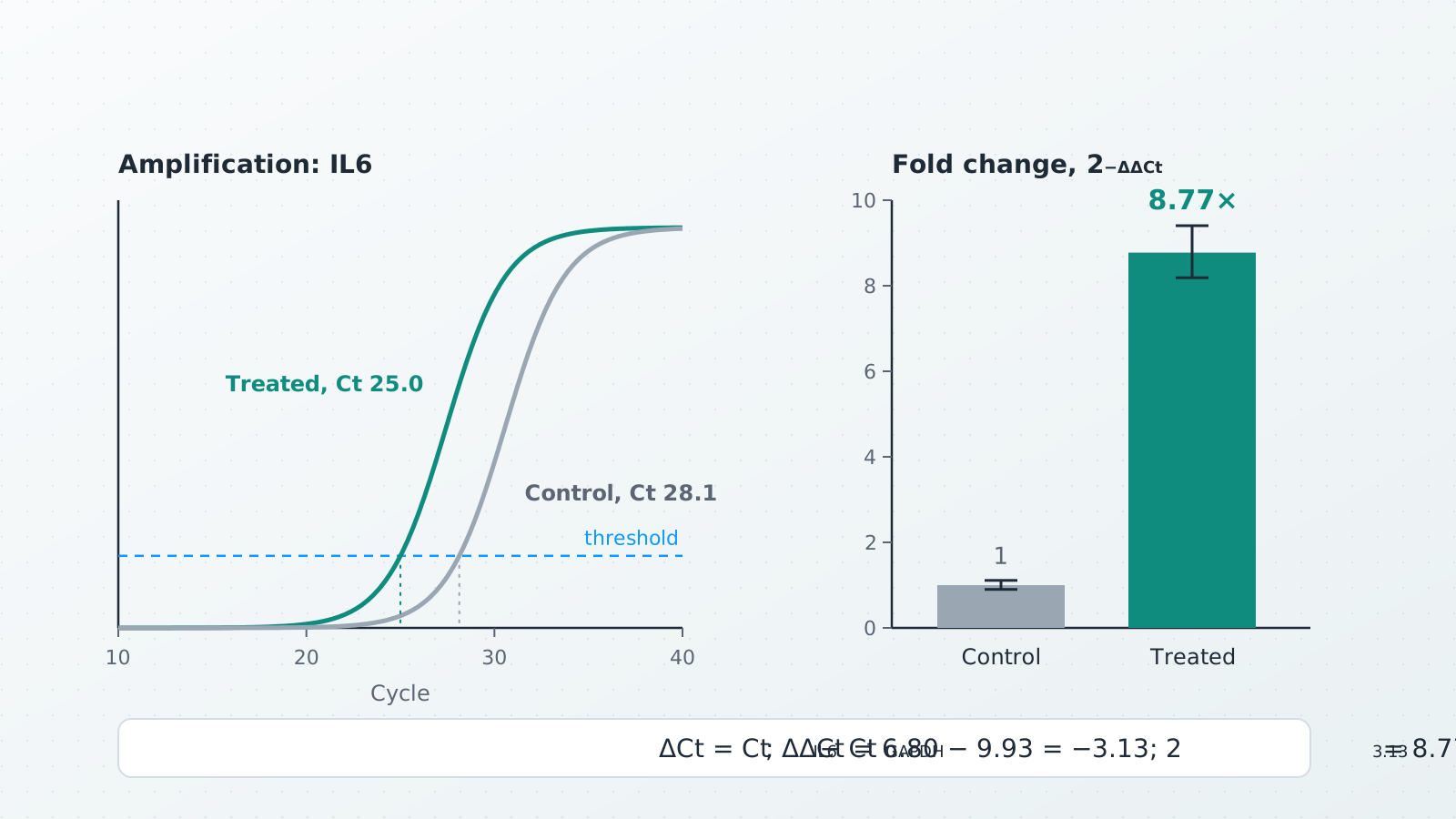
ΔΔCt method step by step (Livak and Schmittgen 2001)
The 2^−ΔΔCt method step by step: ΔCt, ΔΔCt and fold change with a worked example, the efficiency assumption, the Pfaffl correction and MIQE reference genes.
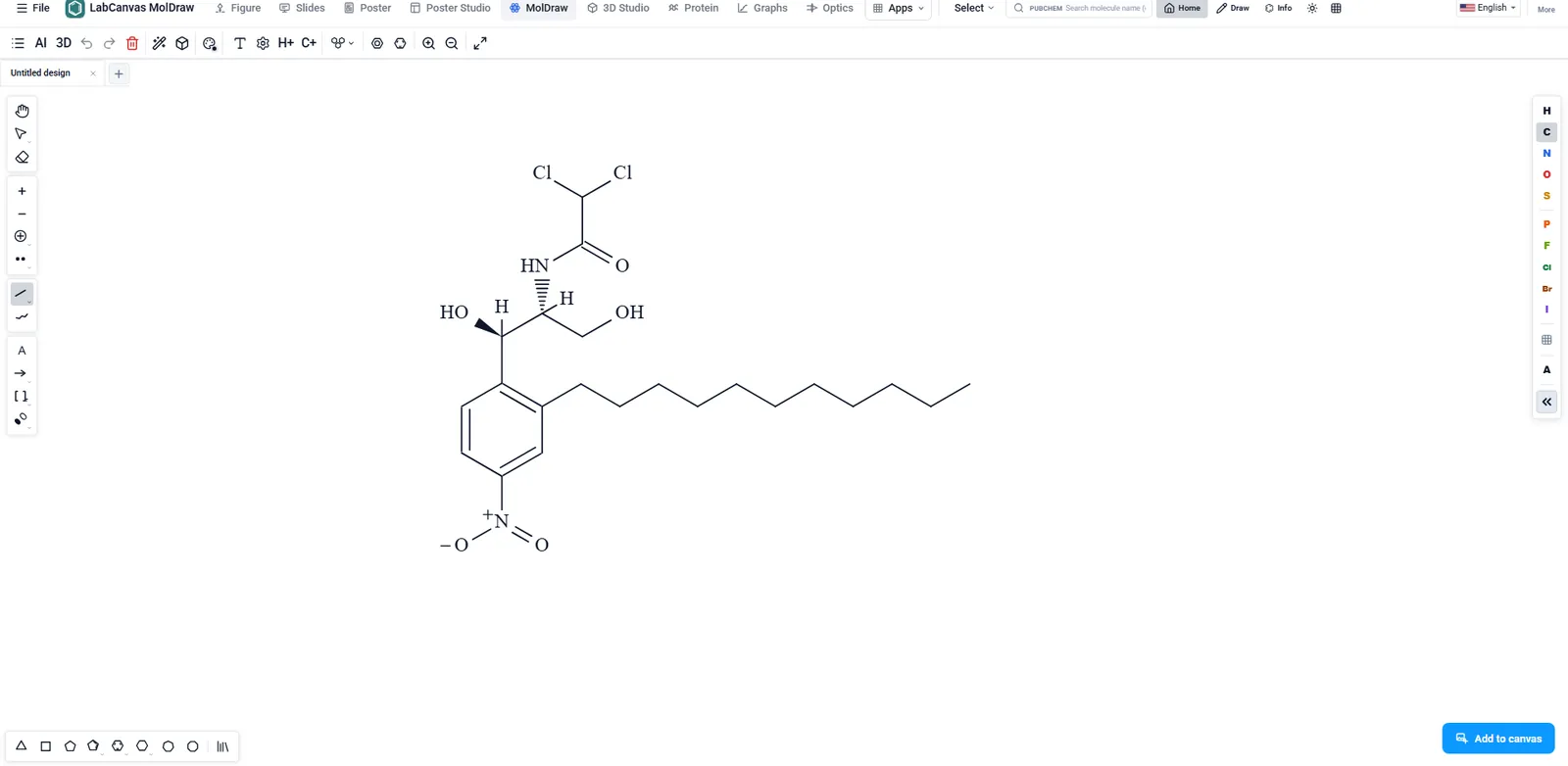
ChemDraw vs LabCanvas MolDraw: chemical structure drawing compared
ChemDraw or LabCanvas MolDraw? Drawing, names, NMR, file formats, price and platforms side by side, a reaction-scheme example, and when ChemDraw is better.