SrTiO₃ (strontium titanate): structure, properties and uses
Strontium titanate (SrTiO₃) is an oxide perovskite: at room temperature it is cubic with a = 3.905 Å, with Ti in corner-sharing TiO₆ octahedra and Sr in the cavities between them (Leroy et al. 2025; Bartel et al. 2019). Below about 105 K the octahedra rotate and the crystal turns tetragonal, and on further cooling it comes close to ferroelectricity but never gets there: quantum fluctuations keep it paraelectric down to the lowest temperatures (Leroy et al. 2025). It is a substrate for oxide films (Kawasaki et al. 1994), home of the high-mobility LaAlO₃/SrTiO₃ interface (Ohtomo & Hwang 2004), and in Al-doped form a photocatalyst that splits water with a quantum efficiency near unity (Takata et al. 2020).
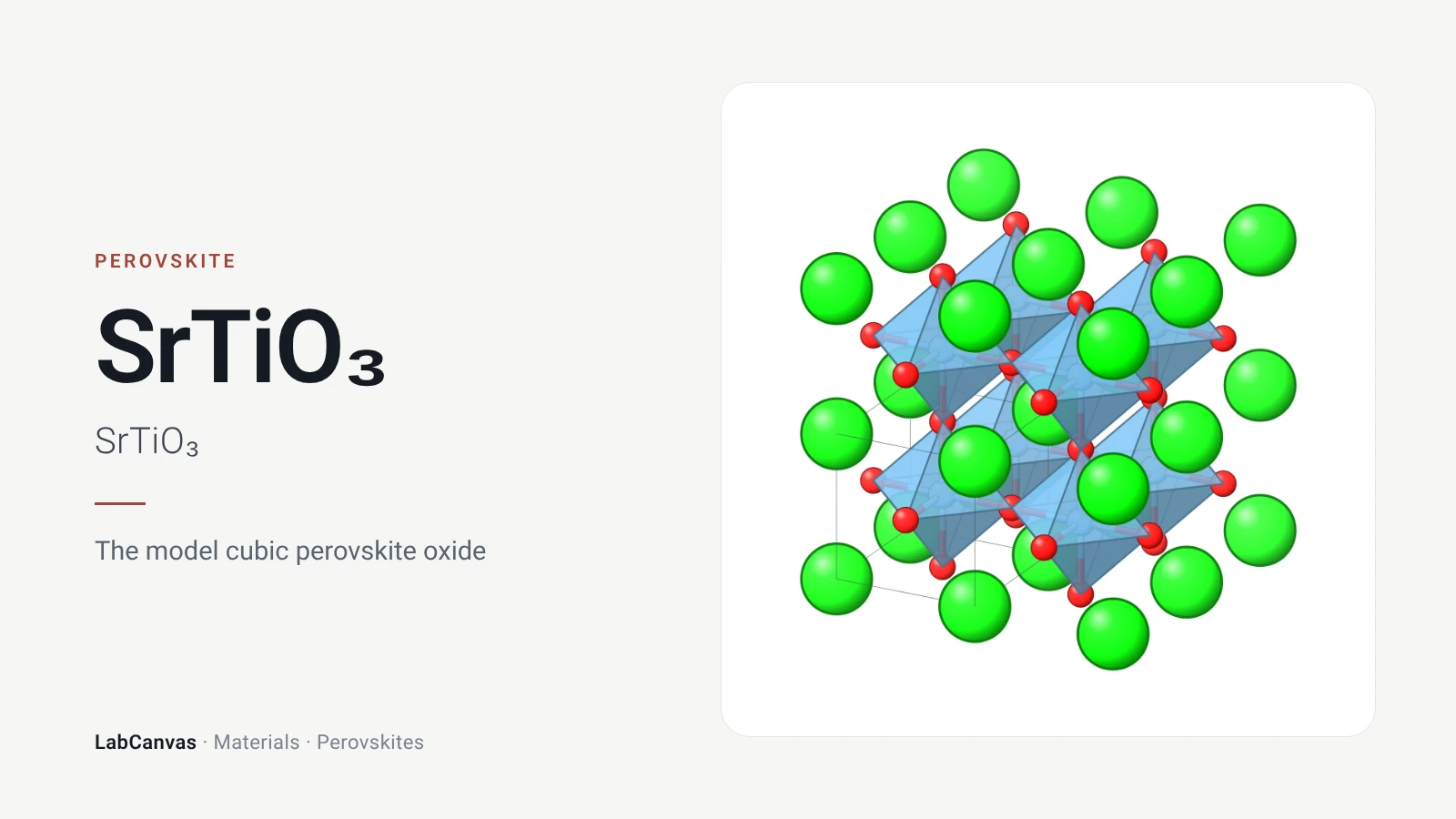
Contents
SrTiO₃ (strontium titanate) at a glance
| Formula | SrTiO₃ (Leroy et al. 2025) |
|---|---|
| Molar mass | 183.48 g mol⁻¹ (calculated from the formula) |
| Structure type | Perovskite: corner-sharing TiO₆ octahedra with Sr in the 12-coordinate cavities (Bartel et al. 2019) |
| Room-temperature structure | Cubic, unstrained, one formula unit per cell (Leroy et al. 2025) |
| Lattice constant | a = 3.905 Å (Leroy et al. 2025) |
| Bond lengths | Ti–O 1.953 Å, Sr–O 2.761 Å (calculated from a = 3.905 Å for the ideal cubic cell) |
| Density | About 5.12 g cm⁻³ (calculated from the formula and a = 3.905 Å, one formula unit per cell) |
| Structural transition | About 105 K, cubic → tetragonal; TiO₆ octahedra rotate out of phase (a⁰a⁰a⁰ → a⁰a⁰c⁻), doubling the primitive cell (Leroy et al. 2025) |
| Dielectric behaviour | Incipient ferroelectric; quantum fluctuations suppress ferroelectricity, so it stays paraelectric down to the lowest temperatures (Leroy et al. 2025) |
| Soft mode | Polar TO1 mode at about 2.6 THz at room temperature, softening on cooling (Leroy et al. 2025) |
| Strained films | Ferroelectric at room temperature under epitaxial strain; εᵣ nearly 7,000 at 10 GHz (Haeni et al. 2004) |
| Substrate surface | Atomically flat, TiO₂-terminated (100) surface with unit-cell steps after NH₄F–HF treatment (Kawasaki et al. 1994) |
| LaAlO₃/SrTiO₃ interface | Electron-doped interface conducting, mobility above 10,000 cm² V⁻¹ s⁻¹; hole-doped interface insulating (Ohtomo and Hwang 2004) |
| Photocatalysis | SrTiO₃:Al with Rh/Cr₂O₃ and CoOOH cocatalysts: overall water splitting, external quantum efficiency up to 96% at 350–360 nm (Takata et al. 2020) |
| Key reports | Haeni et al., Nature 430, 758 (2004); Ohtomo & Hwang, Nature 427, 423 (2004); Takata et al., Nature 581, 411 (2020) |
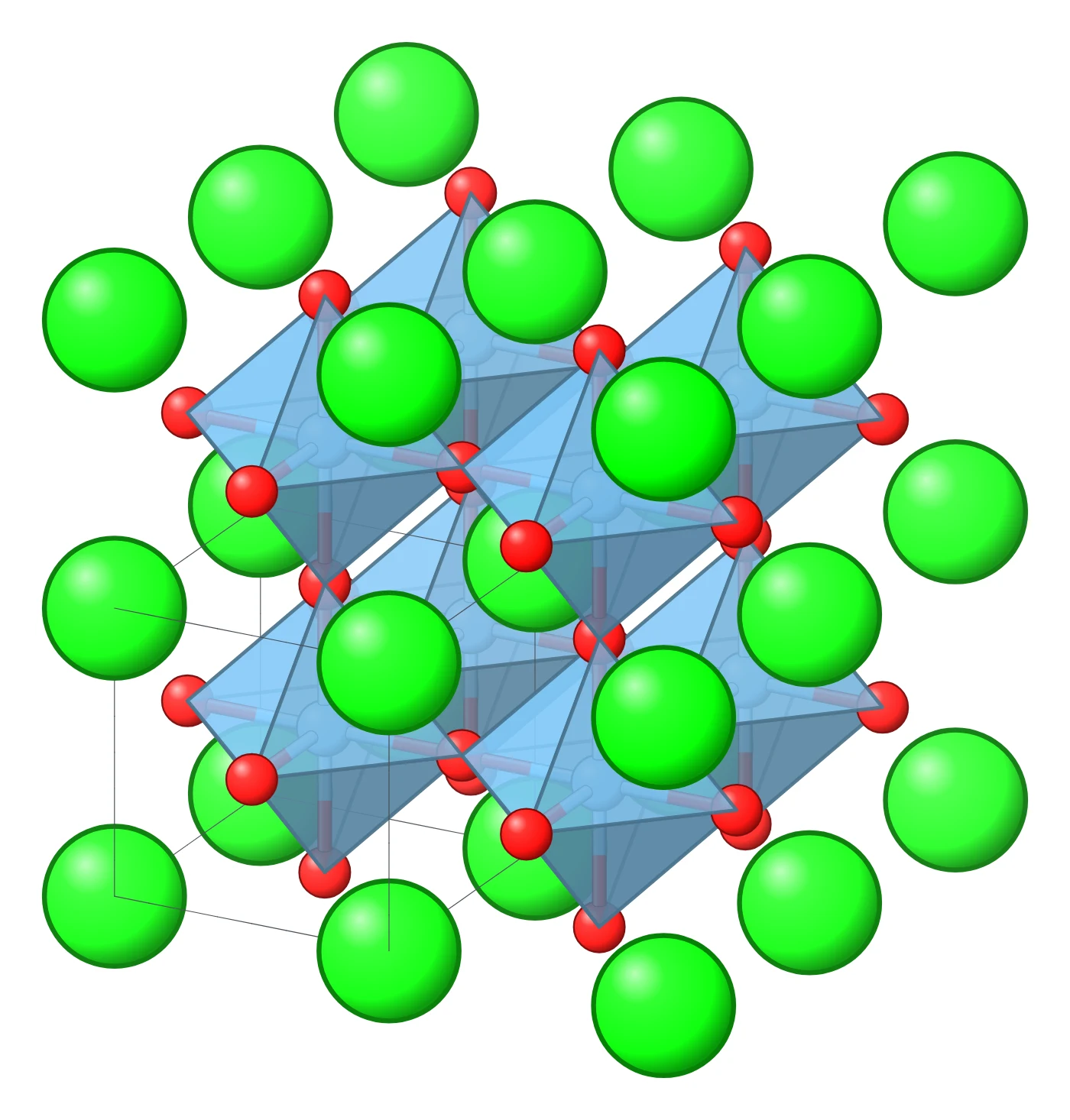
SrTiO₃ (strontium titanate) crystal structure (high-resolution SVG)
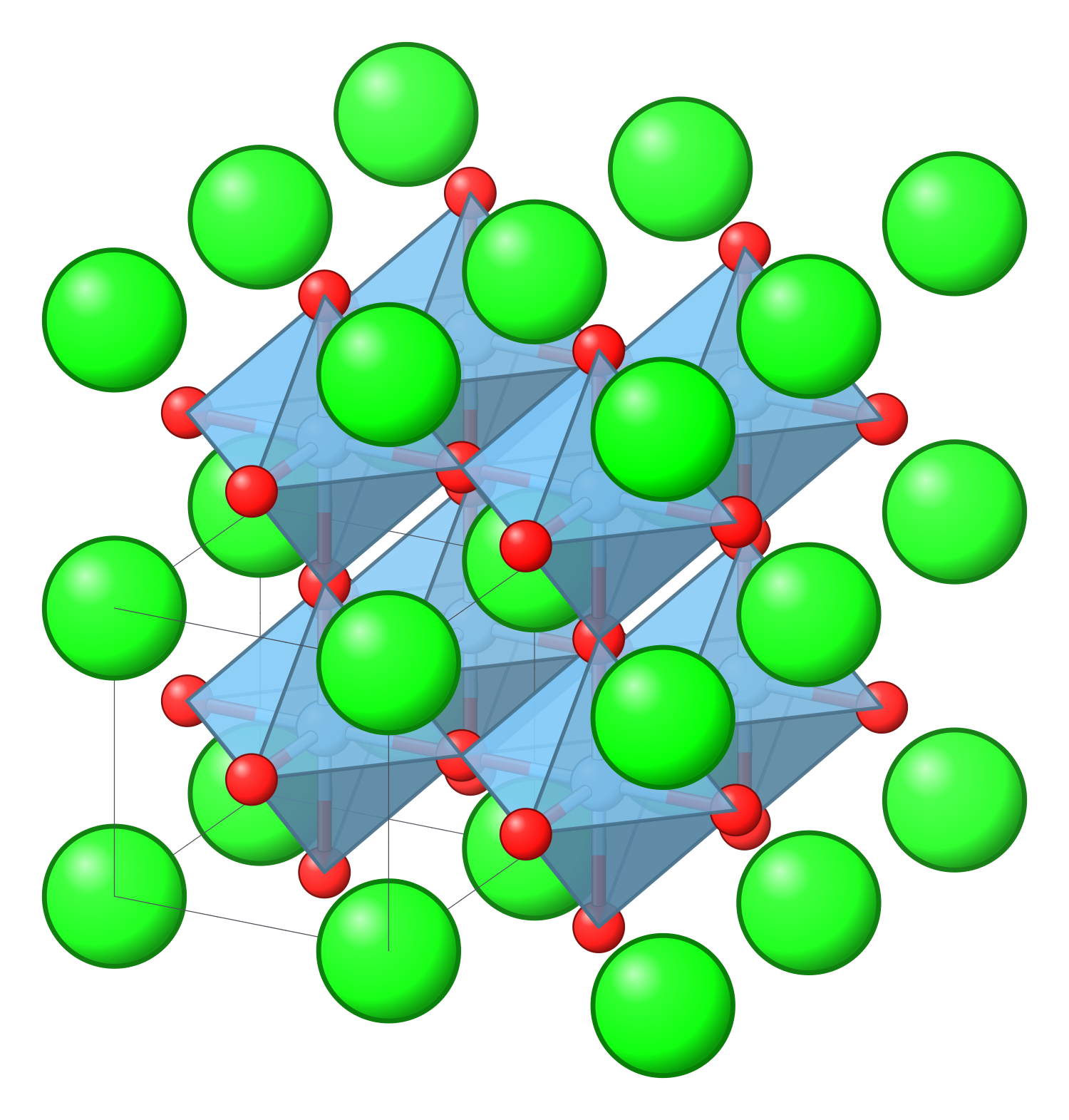
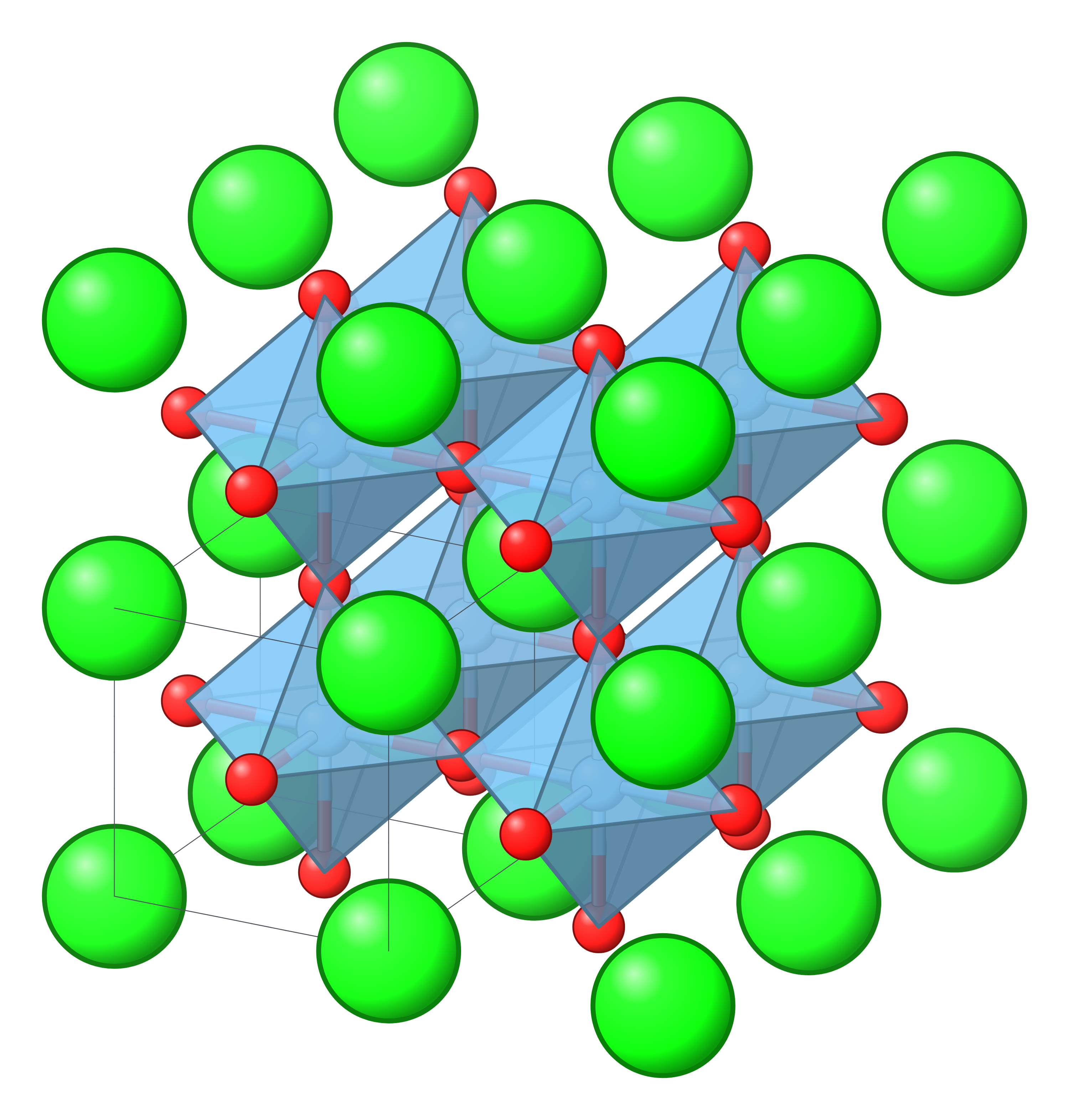
SrTiO₃ (strontium titanate) in 3D (interactive)
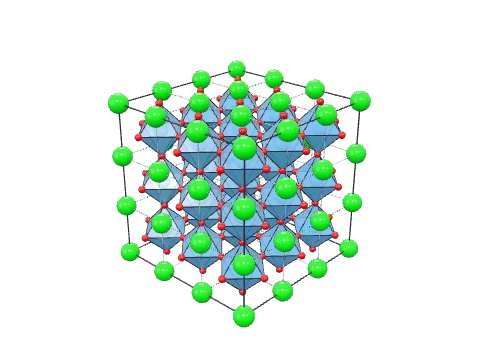
Loading the 3D model…
SrTiO₃ structure explained
SrTiO₃ is the textbook perovskite. Each titanium sits at the centre of an octahedron of six oxygen atoms, the TiO₆ octahedra share all their corners, and each strontium fills a cavity between eight octahedra with twelve oxygen neighbours (Bartel et al. 2019).
At room temperature the structure is the ideal cubic one, with a cell edge of 3.905 Å and one formula unit per cell (Leroy et al. 2025). In that cell Ti–O is half the edge, 1.953 Å, and Sr–O is a/√2, 2.761 Å (calculated from a); the calculated density is about 5.12 g cm⁻³.
The 105 K antiferrodistortive transition
On cooling to about 105 K, SrTiO₃ undergoes an antiferrodistortive (AFD) transition from cubic to tetragonal. It is driven by a rotation of the TiO₆ octahedra about one axis, in opposite senses in neighbouring octahedra, which doubles the primitive unit cell. In Glazer notation the cubic phase is a⁰a⁰a⁰ and the tetragonal phase a⁰a⁰c⁻ (Leroy et al. 2025).
The transition is a rotation of the octahedra, not a polar shift, and does not by itself make bulk SrTiO₃ ferroelectric (Leroy et al. 2025).
Quantum paraelectric behaviour
SrTiO₃ is an incipient ferroelectric. As it cools, its polar TO1 phonon (about 2.6 THz at room temperature) softens and the dielectric constant rises steeply, signalling that a ferroelectric phase is close (Leroy et al. 2025). Yet the transition never happens: quantum fluctuations suppress the ferroelectric order, so SrTiO₃ stays paraelectric down to the lowest temperatures (Leroy et al. 2025). A material that stays paraelectric for this reason is called a quantum paraelectric.
Because it is so close to the edge, small perturbations tip it over. Epitaxial strain from a suitable substrate raises the ferroelectric transition by hundreds of degrees and makes SrTiO₃ films ferroelectric at room temperature, with a permittivity of nearly 7,000 at 10 GHz (Haeni et al. 2004). Doping a very low concentration of carriers into SrTiO₃ makes it a dilute superconductor (Leroy et al. 2025).
SrTiO₃ as a substrate for oxide thin films
Kawasaki et al. showed in 1994 that treating the (100) surface with a pH-controlled NH₄F–HF solution leaves an atomically smooth, TiO₂-terminated surface with steps one unit cell high, on which SrTiO₃ grows layer by layer. The terminating layer can be switched to SrO by homoepitaxy, giving a well-defined starting surface for atomically controlled growth of perovskite films such as YBa₂Cu₃O₇₋δ (Kawasaki et al. 1994).
The LaAlO₃/SrTiO₃ interface and its 2D electron gas
LaAlO₃ and SrTiO₃ are both insulators. Ohtomo and Hwang grew LaAlO₃ on SrTiO₃ while controlling the terminating layer at the interface atom by atom. In the simple ionic picture the interface carries an extra half electron or half hole per two-dimensional unit cell, depending on its stacking. The hole-doped interface stays insulating, but the electron-doped interface conducts, with carrier mobilities above 10,000 cm² V⁻¹ s⁻¹ and magnetoresistance oscillations at low temperature that point to quantum transport (Ohtomo & Hwang 2004).
SrTiO₃:Al and photocatalytic water splitting
Particulate photocatalysts that split water into H₂ and O₂ in a 2:1 ratio usually reach quantum efficiencies below 10%. Takata et al. used aluminium-doped SrTiO₃ and photodeposited the hydrogen-evolution cocatalyst Rh/Cr₂O₃ and the oxygen-evolution cocatalyst CoOOH on different crystal facets, so that electrons and holes are carried to separate faces. The result was overall water splitting with an external quantum efficiency of up to 96% at 350–360 nm, equivalent to an internal quantum efficiency of almost unity (Takata et al. 2020).
Uses and research areas
- Substrate for oxide films. Atomically flat TiO₂-terminated surfaces for epitaxial growth (Kawasaki et al. 1994).
- Oxide interfaces. The LaAlO₃/SrTiO₃ electron gas (Ohtomo & Hwang 2004); SrTiO₃ is one of the most studied materials in oxide thin films and heterostructures (Leroy et al. 2025).
- Tunable dielectrics. Strained SrTiO₃ films with a large, field-dependent permittivity at microwave frequencies (Haeni et al. 2004).
- Photocatalysis. SrTiO₃:Al for overall water splitting (Takata et al. 2020).
- Fundamental physics. Quantum paraelectricity, soft modes and dilute superconductivity (Leroy et al. 2025).
How to draw the SrTiO₃ structure
For a paper, slide or poster, draw the cubic cell with a TiO₆ octahedron at the centre and Sr at the corners, or eight corner-sharing octahedra around one Sr; use the cell edge of 3.905 Å for scale. To show the low-temperature phase, rotate neighbouring octahedra in opposite senses about the c axis (a⁰a⁰c⁻). For an interface figure, stack LaAlO₃ layers on TiO₂-terminated SrTiO₃. In LabCanvas you can draw the perovskite cell in the figure editor, show the TiO₆ polyhedra, repeat the cell and export a high-resolution image.
SrTiO₃ compared with other perovskites
| Material | Formula | Family | Low-temperature behaviour | Known for | Key report |
|---|---|---|---|---|---|
| Strontium titanate | SrTiO₃ | Oxide | Octahedra rotate at ~105 K; stays paraelectric (quantum paraelectric) | Substrate; LaAlO₃/SrTiO₃ electron gas; SrTiO₃:Al photocatalyst | Ohtomo & Hwang, Nature 2004 |
| Barium titanate | BaTiO₃ | Oxide | Ferroelectric below a Curie point near 120 °C | Capacitors; lead-free piezoelectrics | Tan et al., Sci. Rep. 2015 |
| Caesium lead bromide | CsPbBr₃ | Halide | — | Bright nanocrystal emitters | Protesescu et al., Nano Lett. 2015 |
| Methylammonium lead iodide | CH₃NH₃PbI₃ | Hybrid halide | — | Perovskite solar cells | Kojima et al., JACS 2009 |
Related materials
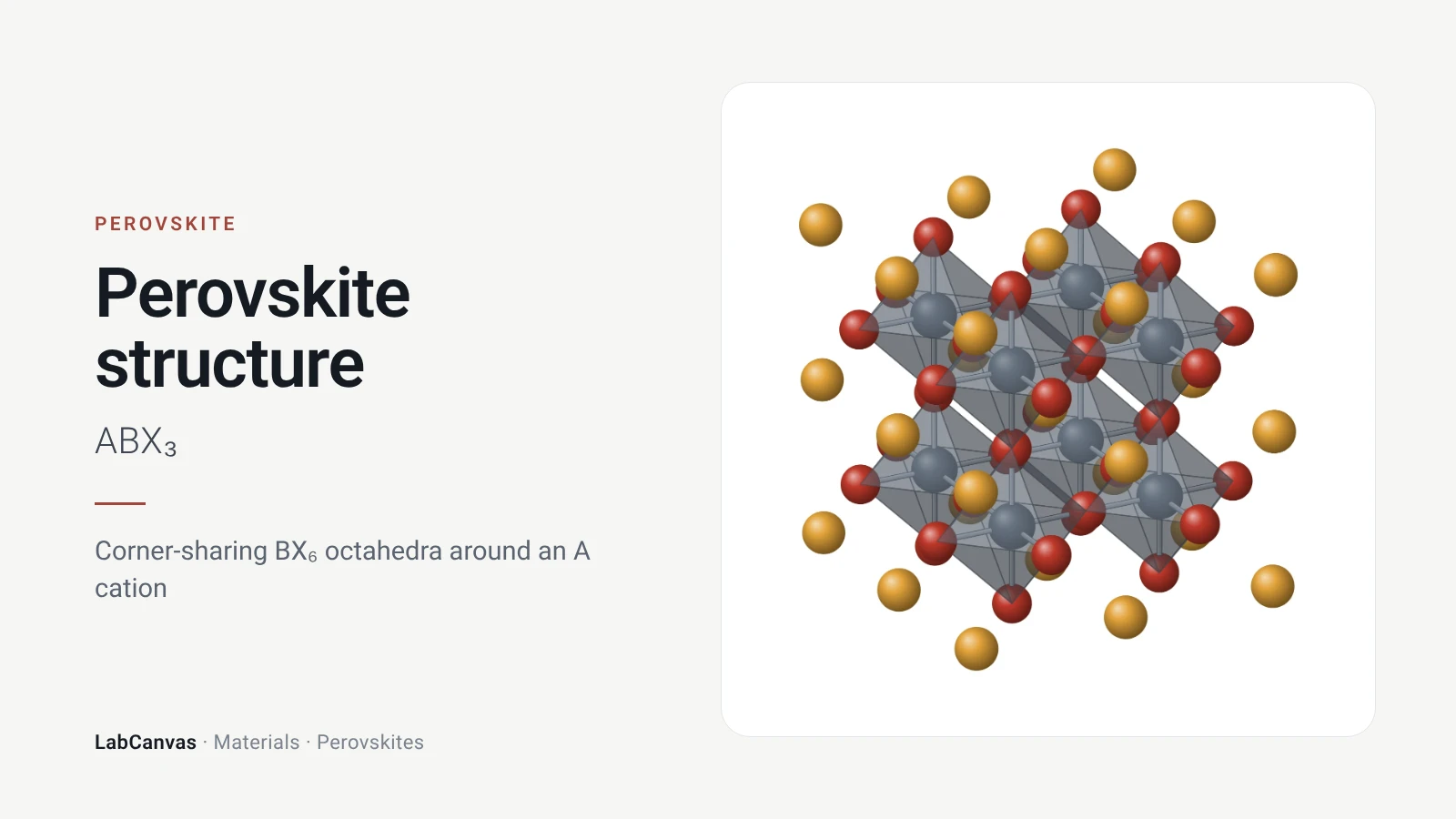
Perovskite structure
The perovskite structure explained: ABX₃ with corner-sharing BX₆ octahedra, the tolerance factor, octahedral tilts, and oxide vs halide perovskites.
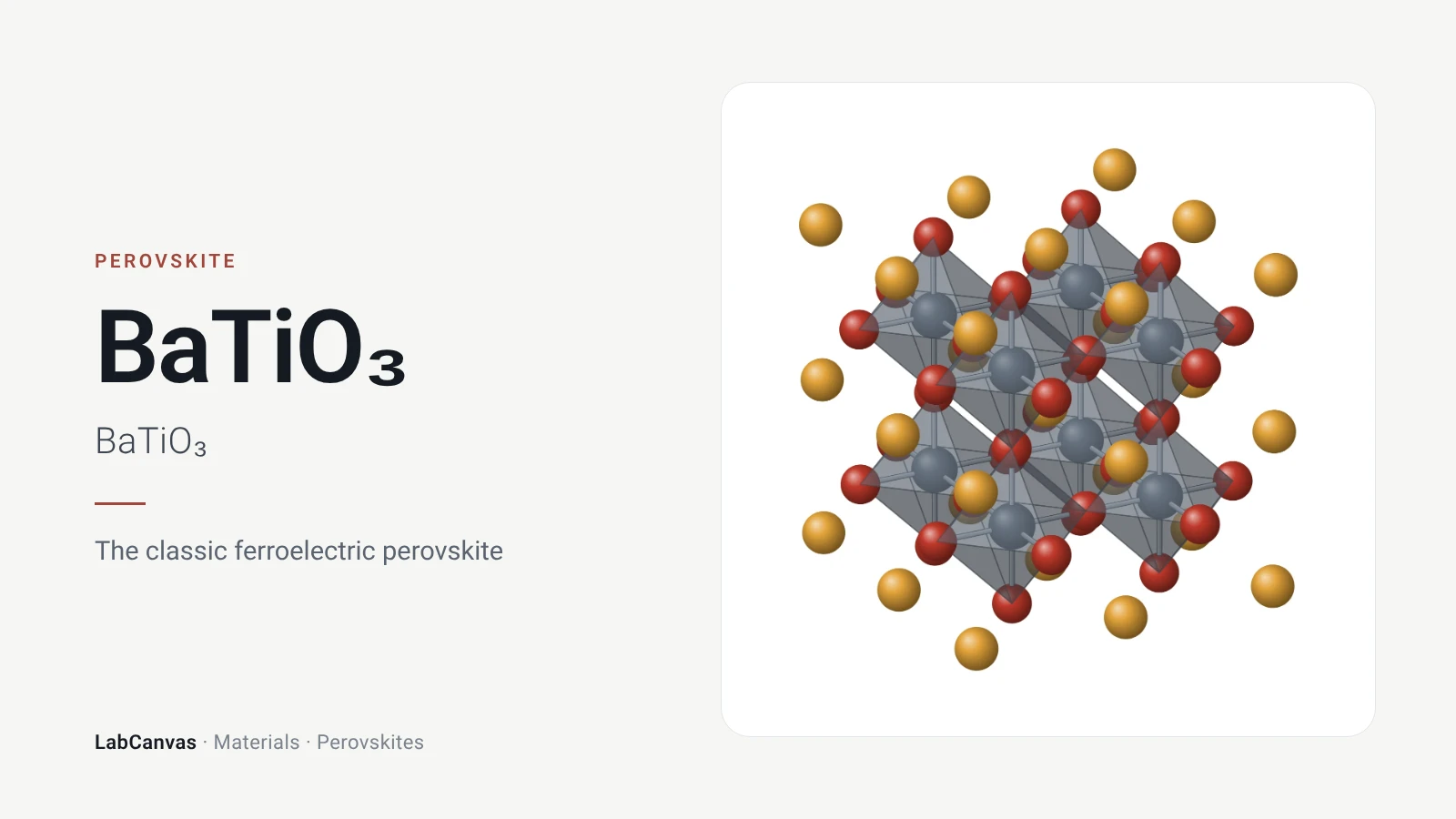
BaTiO₃ (barium titanate)
BaTiO₃, the classic ferroelectric perovskite: its ~120 °C Curie point, tetragonal, orthorhombic and rhombohedral phases, capacitors and piezoelectrics.
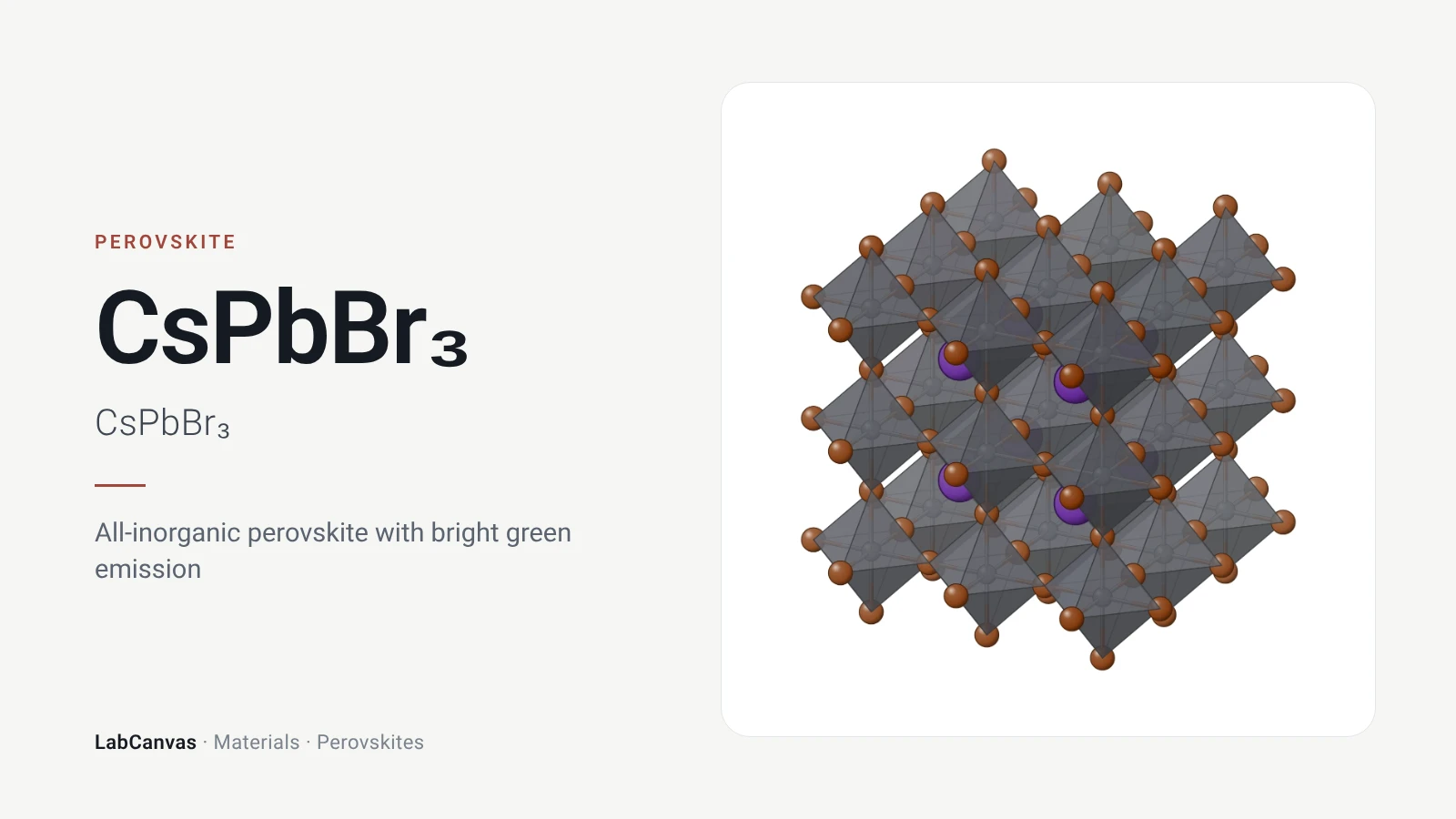
CsPbBr₃
CsPbBr₃ and CsPbX₃ perovskite quantum dots: orthorhombic structure, hot-injection synthesis, emission tunable over 410–700 nm, anion exchange and uses.
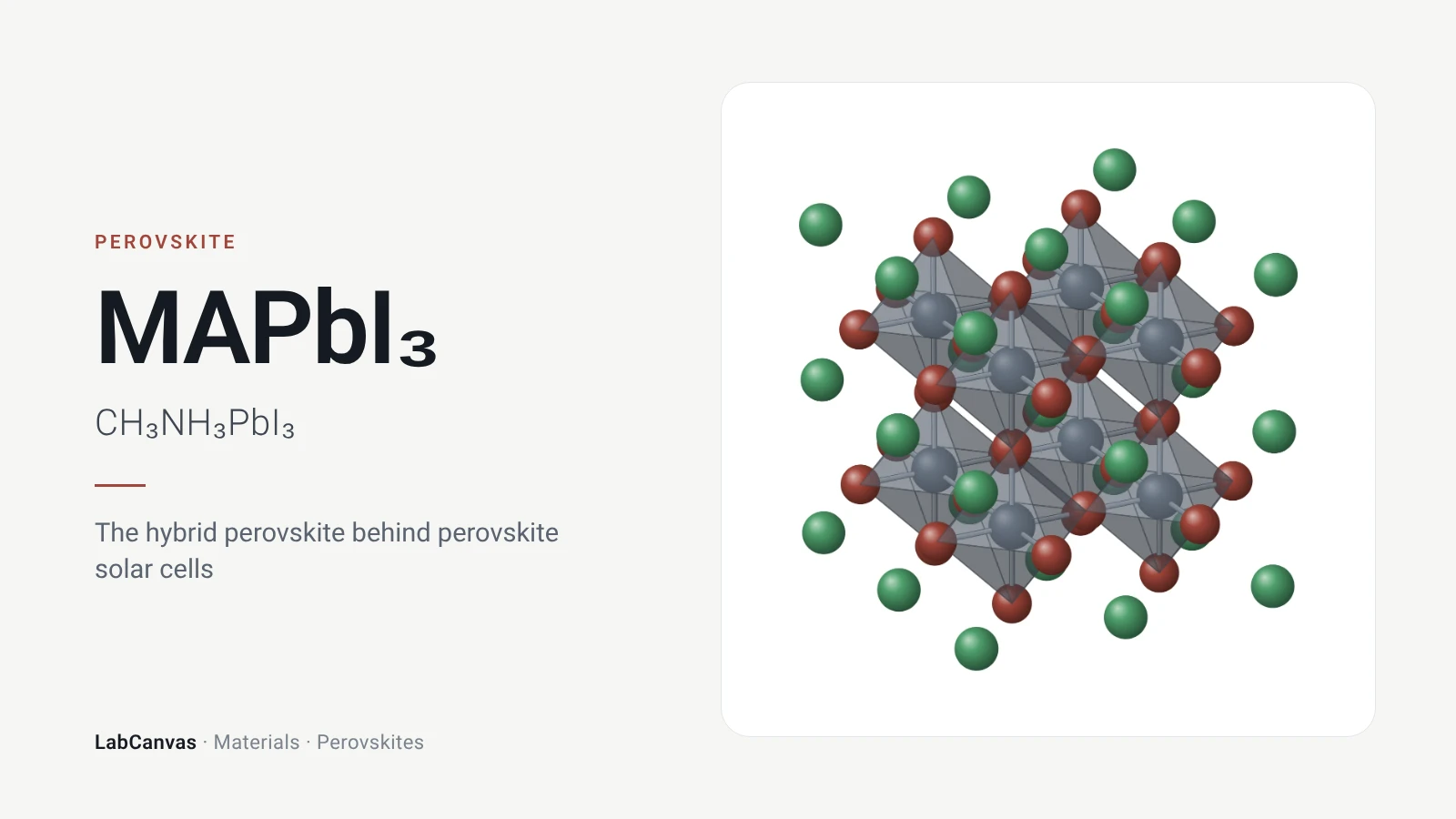
MAPbI₃
MAPbI₃ (CH₃NH₃PbI₃): tetragonal and cubic phases, 1.5 eV band gap, the first perovskite solar cells, long diffusion lengths, instability and lead toxicity.
More on LabCanvas
- Crystal structure figure software compared: VESTA, Mercury, CrystalMaker, Avogadro and LabCanvas
- Tauc plot band gap calculator: Free tool: optical band gap from UV–vis
- XRD Scherrer crystallite size calculator: Free tool
- Molar mass calculator: Free tool
- Journal figure size guide: Column widths and resolutions for 38 journals
- 3D models gallery: Turn MOFs, COFs, perovskites and more in 3D
Frequently asked questions
What is SrTiO₃?
Strontium titanate, an oxide with the perovskite structure: corner-sharing TiO₆ octahedra with Sr in the cavities. It is cubic at room temperature and is used as a substrate for oxide thin films, in oxide interface electronics and, doped with Al, as a water-splitting photocatalyst.
What is the crystal structure of SrTiO₃?
At room temperature SrTiO₃ is a cubic perovskite with a = 3.905 Å and one formula unit per cell (Leroy et al. 2025). Below about 105 K it becomes tetragonal as the TiO₆ octahedra rotate.
What is the lattice constant of SrTiO₃?
a = 3.905 Å for cubic SrTiO₃ at room temperature (Leroy et al. 2025).
What happens to SrTiO₃ at 105 K?
An antiferrodistortive phase transition: the TiO₆ octahedra rotate in opposite senses in neighbouring cells about one axis (a⁰a⁰c⁻ in Glazer notation), doubling the primitive cell and making the structure tetragonal (Leroy et al. 2025).
Is SrTiO₃ ferroelectric?
Not in bulk. It is an incipient ferroelectric whose polar soft mode softens and dielectric constant rises on cooling, but quantum fluctuations stop the ferroelectric transition, so it stays paraelectric down to the lowest temperatures (Leroy et al. 2025). Under epitaxial strain, SrTiO₃ films become ferroelectric even at room temperature (Haeni et al. 2004).
What is a quantum paraelectric?
A material that is on the verge of becoming ferroelectric but stays paraelectric down to the lowest temperatures because quantum zero-point fluctuations suppress the ordering. SrTiO₃ is the classic example: it is an incipient ferroelectric that quantum fluctuations keep paraelectric down to the lowest temperatures (Leroy et al. 2025).
Why is SrTiO₃ used as a substrate?
Its (100) surface can be made atomically flat and TiO₂-terminated, with single unit-cell steps, by a pH-controlled NH₄F–HF etch, which gives a well-defined surface for layer-by-layer growth of perovskite oxide films (Kawasaki et al. 1994).
What is the LaAlO₃/SrTiO₃ 2DEG?
A two-dimensional electron gas at the interface between the insulators LaAlO₃ and SrTiO₃. Ohtomo and Hwang found in 2004 that the electron-doped interface conducts with mobilities above 10,000 cm² V⁻¹ s⁻¹ and shows quantum oscillations, while the hole-doped interface stays insulating (Ohtomo & Hwang 2004).
References
- L. Leroy et al.. Antiferrodistortive and ferroelectric phase transitions in freestanding films of SrTiO₃. Nano Lett. 2025, 25, 7651–7657. doi:10.1021/acs.nanolett.4c05664
- J. H. Haeni et al.. Room-temperature ferroelectricity in strained SrTiO₃. Nature 2004, 430, 758–761. doi:10.1038/nature02773
- M. Kawasaki et al.. Atomic control of the SrTiO₃ crystal surface. Science 1994, 266, 1540–1542. doi:10.1126/science.266.5190.1540
- A. Ohtomo, H. Y. Hwang. A high-mobility electron gas at the LaAlO₃/SrTiO₃ heterointerface. Nature 2004, 427, 423–426. doi:10.1038/nature02308
- T. Takata, J. Jiang, Y. Sakata, M. Nakabayashi, N. Shibata, V. Nandal, K. Seki, T. Hisatomi, K. Domen. Photocatalytic water splitting with a quantum efficiency of almost unity. Nature 2020, 581, 411–414. doi:10.1038/s41586-020-2278-9
- C. J. Bartel et al.. New tolerance factor to predict the stability of perovskite oxides and halides. Sci. Adv. 2019, 5, eaav0693. doi:10.1126/sciadv.aav0693
- Y. Tan et al.. Unfolding grain size effects in barium titanate ferroelectric ceramics. Sci. Rep. 2015, 5, 9953. doi:10.1038/srep09953
- L. Protesescu et al.. Nanocrystals of cesium lead halide perovskites (CsPbX₃, X = Cl, Br, and I): novel optoelectronic materials showing bright emission with wide color gamut. Nano Lett. 2015, 15, 3692–3696. doi:10.1021/nl5048779
- A. Kojima, K. Teshima, Y. Shirai, T. Miyasaka. Organometal halide perovskites as visible-light sensitizers for photovoltaic cells. J. Am. Chem. Soc. 2009, 131, 6050–6051. doi:10.1021/ja809598r
Draw SrTiO₃ (strontium titanate) for your paper or slides
LabCanvas is a browser workspace for scientific figures: framework clusters, linkers and nets, crystal structures in 2D and 3D, graphs and posters, all editable.
Draw SrTiO₃ (strontium titanate) in LabCanvas