Graphical abstract template · Covalent organic frameworks · 3D COF design · Bottom-up
3D COFs: COF-102 and COF-300
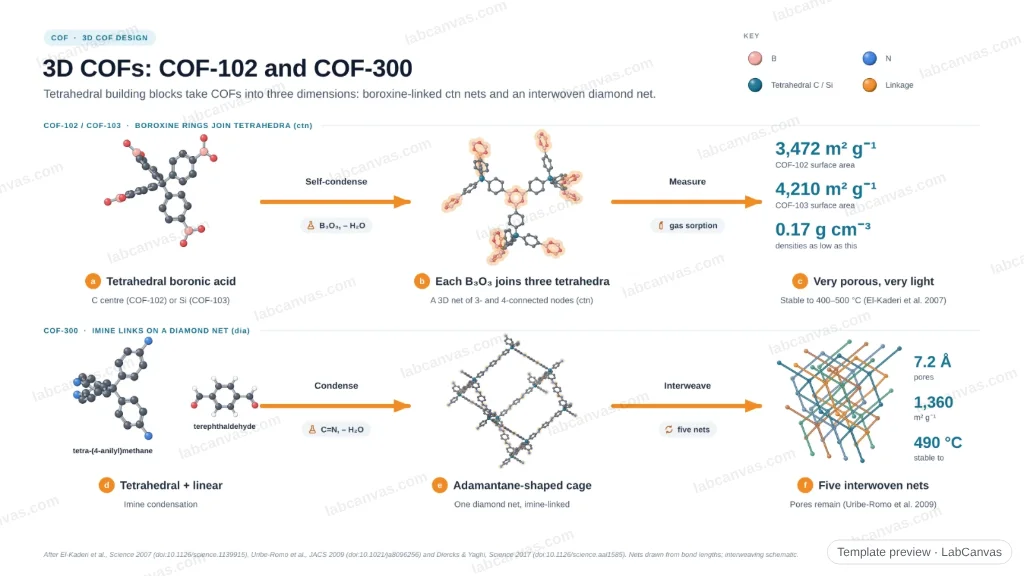
Tetrahedral building blocks take covalent organic frameworks into three dimensions. Boronic acids on a tetraphenylmethane or -silane core condense into boroxine rings, each joining three tetrahedra (COF-102 and COF-103): crystals of very low density with surface areas of 3472 and 4210 m² g⁻¹. Tetra(4-anilyl)methane and terephthaldehyde give imine-linked COF-300 on a diamond net; five such nets grow through one another, yet 7.2 Å pores remain.
Updated 3 cited papers82 editable layers
At a glance
- Category
- Covalent organic frameworks
- Method
- 3D COF design
- Approach
- Bottom-up
- Starting materials
- Tetra(4-dihydroxyborylphenyl)methane or -silane (COF-102, COF-103); tetra-(4-anilyl)methane and terephthaldehyde (COF-300)
- Product
- Crystalline 3D COFs: boroxine-linked ctn nets and an imine-linked, five-fold interwoven diamond net
- Key result
- COF-102 3472 and COF-103 4210 m² g⁻¹, stable to 400–500 °C, densities as low as 0.17 g cm⁻³ (El-Kaderi et al. 2007); COF-300 1360 m² g⁻¹, stable to 490 °C (Uribe-Romo et al. 2009)
- Figure
- 1920 × 1080 px (16:9), 82 editable layers, 10 generated objects
Step by step
- Tetrahedral nodesFour arms from a central C or Si point to the corners of a tetrahedron
- COF-102 / COF-103Self-condensation to boroxine rings: each B₃O₃ joins three tetrahedra (ctn net; El-Kaderi et al. 2007)
- COF-300Imine condensation with linear terephthaldehyde: a diamond (dia) net (Uribe-Romo et al. 2009)
- InterweavingFive independent diamond nets grow through one another; pores of 7.2 Å remain
Strengths
- Very high surface areas and low densities
- Pores open in three dimensions
- Designed from the geometry of the building blocks
Limitations
- Interweaving shrinks the pores
- Boroxine links are moisture-sensitive
Uses
- Gas storage (hydrogen, methane)
- Models for designing 3D organic frameworks
Papers this template follows
- El-Kaderi et al., “Designed Synthesis of 3D Covalent Organic Frameworks”, Science 2007. doi:10.1126/science.1139915primary
- Uribe-Romo et al., “A Crystalline Imine-Linked 3-D Porous Covalent Organic Framework”, J. Am. Chem. Soc. 2009. doi:10.1021/ja8096256primary
- Diercks & Yaghi, “The atom, the molecule, and the covalent organic framework”, Science 2017. doi:10.1126/science.aal1585review
After El-Kaderi et al., Science 2007 (doi:10.1126/science.1139915), Uribe-Romo et al., JACS 2009 (doi:10.1021/ja8096256) and Diercks & Yaghi, Science 2017 (doi:10.1126/science.aal1585). Nets drawn from bond lengths; interweaving schematic.
How templates are written and checked: editorial guidelines.
Questions
What does the “3D COFs: COF-102 and COF-300” template show?
Tetrahedral building blocks take covalent organic frameworks into three dimensions. Boronic acids on a tetraphenylmethane or -silane core condense into boroxine rings, each joining three tetrahedra (COF-102 and COF-103): crystals of very low density with surface areas of 3472 and 4210 m² g⁻¹. Tetra(4-anilyl)methane and terephthaldehyde give imine-linked COF-300 on a diamond net; five such nets grow through one another, yet 7.2 Å pores remain.
What are the steps shown in “3D COFs: COF-102 and COF-300”?
1. Tetrahedral nodes: Four arms from a central C or Si point to the corners of a tetrahedron. 2. COF-102 / COF-103: Self-condensation to boroxine rings: each B₃O₃ joins three tetrahedra (ctn net; El-Kaderi et al. 2007). 3. COF-300: Imine condensation with linear terephthaldehyde: a diamond (dia) net (Uribe-Romo et al. 2009). 4. Interweaving: Five independent diamond nets grow through one another; pores of 7.2 Å remain.
What are the starting materials and the product?
Starting materials: Tetra(4-dihydroxyborylphenyl)methane or -silane (COF-102, COF-103); tetra-(4-anilyl)methane and terephthaldehyde (COF-300). Product: Crystalline 3D COFs: boroxine-linked ctn nets and an imine-linked, five-fold interwoven diamond net.
Which papers is “3D COFs: COF-102 and COF-300” based on?
El-Kaderi et al., “Designed Synthesis of 3D Covalent Organic Frameworks”, Science 2007 (doi:10.1126/science.1139915); Uribe-Romo et al., “A Crystalline Imine-Linked 3-D Porous Covalent Organic Framework”, J. Am. Chem. Soc. 2009 (doi:10.1021/ja8096256); Diercks & Yaghi, “The atom, the molecule, and the covalent organic framework”, Science 2017 (doi:10.1126/science.aal1585).
Can I edit the “3D COFs: COF-102 and COF-300” template?
Yes. Open it in the LabCanvas editor: all 82 layers are editable, including 10 generated objects (structures, plots, equipment) with their own settings. Change the text, colours and layout, then export PNG, TIFF, SVG or PDF.
Do I need an account to use this template?
Not to view it here. To open and edit it, sign in to LabCanvas or create a free account (the free plan keeps one design of each kind). Downloading the figure is part of LabCanvas Pro (US$19 a month or US$199 a year).