Graphical abstract template · Covalent organic frameworks · Schiff base + tautomerism · Bottom-up
TpPa COFs: β-ketoenamine links that survive acid and base
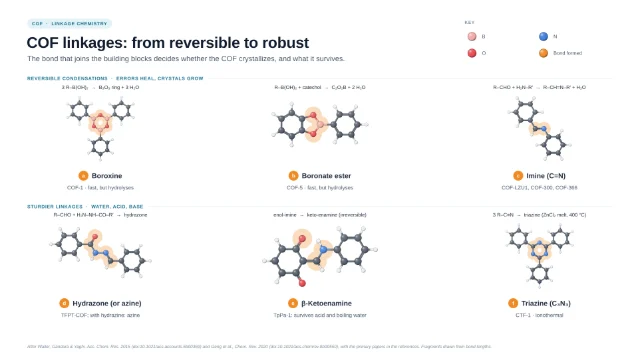
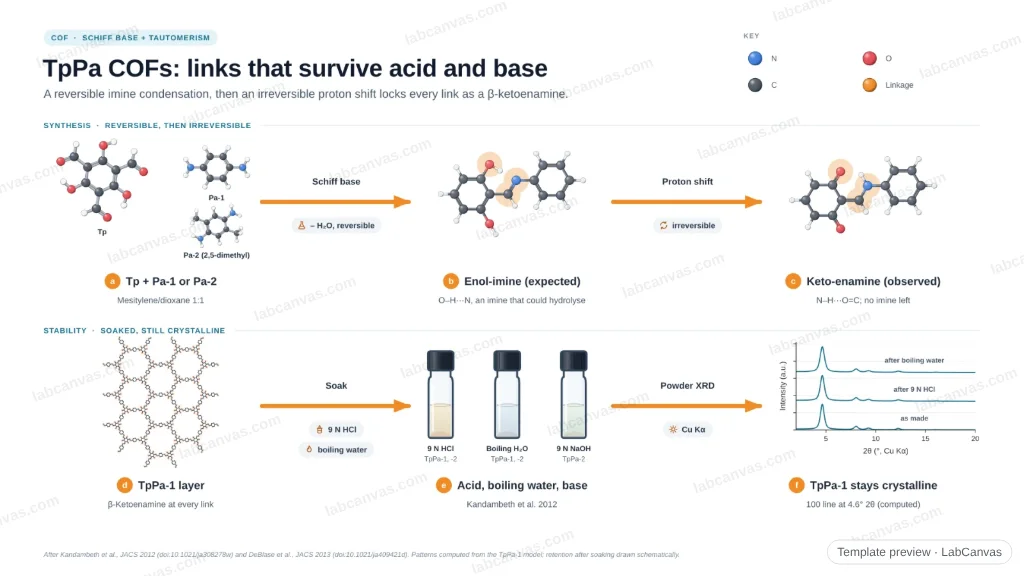
TpPa-1 and TpPa-2 are made from 1,3,5-triformylphloroglucinol (Tp) and p-phenylenediamine or its 2,5-dimethyl analogue. The Schiff base forms first, as the enol-imine, but the proton moves irreversibly from oxygen to nitrogen and only the keto-enamine remains. With no imine bond left to hydrolyse, both COFs survive 9 N hydrochloric acid and boiling water; TpPa-2 also survives 9 N sodium hydroxide.
Updated 3 cited papers87 editable layers
At a glance
- Category
- Covalent organic frameworks
- Method
- Schiff base + tautomerism
- Approach
- Bottom-up
- Starting materials
- 1,3,5-Triformylphloroglucinol (Tp) with p-phenylenediamine (Pa-1) or 2,5-dimethyl-p-phenylenediamine (Pa-2), in mesitylene/dioxane 1:1
- Product
- TpPa-1 and TpPa-2: 2D β-ketoenamine-linked COFs
- Key result
- Resistant to 9 N HCl and boiling water (TpPa-1, TpPa-2) and to 9 N NaOH (TpPa-2)
- Figure
- 1920 × 1080 px (16:9), 87 editable layers, 14 generated objects
Step by step
- Schiff baseTp and Pa condense in 1:1 mesitylene/dioxane; the expected product is the enol-imine (O–H···N)
- TautomerismThe proton moves irreversibly from O to N: only the keto-enamine (N–H···O=C) is observed
- LayersHoneycomb sheets with C=O and N–H facing each other at every link
- StabilityBoth resist 9 N HCl and boiling water; TpPa-2 also 9 N NaOH (Kandambeth et al. 2012)
Strengths
- Reversible step for crystallinity, irreversible step for stability
- No imine bond left to hydrolyse
- Simple, cheap monomers
Limitations
- Irreversibility limits error correction during growth
- Crystallinity lower than boronate COFs
Uses
- Catalysis and separations in acid, base or water
- Membranes and electrodes
Papers this template follows
- Kandambeth et al., “Construction of Crystalline 2D Covalent Organic Frameworks with Remarkable Chemical (Acid/Base) Stability via a Combined Reversible and Irreversible Route”, J. Am. Chem. Soc. 2012. doi:10.1021/ja308278wprimary
- DeBlase et al., “β-Ketoenamine-Linked Covalent Organic Frameworks Capable of Pseudocapacitive Energy Storage”, J. Am. Chem. Soc. 2013. doi:10.1021/ja409421dfurther reading
- Geng et al., “Covalent Organic Frameworks: Design, Synthesis, and Functions”, Chem. Rev. 2020. doi:10.1021/acs.chemrev.9b00550review
After Kandambeth et al., JACS 2012 (doi:10.1021/ja308278w) and DeBlase et al., JACS 2013 (doi:10.1021/ja409421d). Patterns computed from the TpPa-1 model; retention after soaking drawn schematically.
How templates are written and checked: editorial guidelines.
Questions
What does the “TpPa COFs: β-ketoenamine links that survive acid and base” template show?
TpPa-1 and TpPa-2 are made from 1,3,5-triformylphloroglucinol (Tp) and p-phenylenediamine or its 2,5-dimethyl analogue. The Schiff base forms first, as the enol-imine, but the proton moves irreversibly from oxygen to nitrogen and only the keto-enamine remains. With no imine bond left to hydrolyse, both COFs survive 9 N hydrochloric acid and boiling water; TpPa-2 also survives 9 N sodium hydroxide.
What are the steps shown in “TpPa COFs: β-ketoenamine links that survive acid and base”?
1. Schiff base: Tp and Pa condense in 1:1 mesitylene/dioxane; the expected product is the enol-imine (O–H···N). 2. Tautomerism: The proton moves irreversibly from O to N: only the keto-enamine (N–H···O=C) is observed. 3. Layers: Honeycomb sheets with C=O and N–H facing each other at every link. 4. Stability: Both resist 9 N HCl and boiling water; TpPa-2 also 9 N NaOH (Kandambeth et al. 2012).
What are the starting materials and the product?
Starting materials: 1,3,5-Triformylphloroglucinol (Tp) with p-phenylenediamine (Pa-1) or 2,5-dimethyl-p-phenylenediamine (Pa-2), in mesitylene/dioxane 1:1. Product: TpPa-1 and TpPa-2: 2D β-ketoenamine-linked COFs.
Which papers is “TpPa COFs: β-ketoenamine links that survive acid and base” based on?
Kandambeth et al., “Construction of Crystalline 2D Covalent Organic Frameworks with Remarkable Chemical (Acid/Base) Stability via a Combined Reversible and Irreversible Route”, J. Am. Chem. Soc. 2012 (doi:10.1021/ja308278w); DeBlase et al., “β-Ketoenamine-Linked Covalent Organic Frameworks Capable of Pseudocapacitive Energy Storage”, J. Am. Chem. Soc. 2013 (doi:10.1021/ja409421d); Geng et al., “Covalent Organic Frameworks: Design, Synthesis, and Functions”, Chem. Rev. 2020 (doi:10.1021/acs.chemrev.9b00550).
Can I edit the “TpPa COFs: β-ketoenamine links that survive acid and base” template?
Yes. Open it in the LabCanvas editor: all 87 layers are editable, including 14 generated objects (structures, plots, equipment) with their own settings. Change the text, colours and layout, then export PNG, TIFF, SVG or PDF.
Do I need an account to use this template?
Not to view it here. To open and edit it, sign in to LabCanvas or create a free account (the free plan keeps one design of each kind). Downloading the figure is part of LabCanvas Pro (US$19 a month or US$199 a year).