Graphical abstract template · Covalent organic frameworks · Linkage chemistry · Bottom-up
COF linkages: from reversible to robust
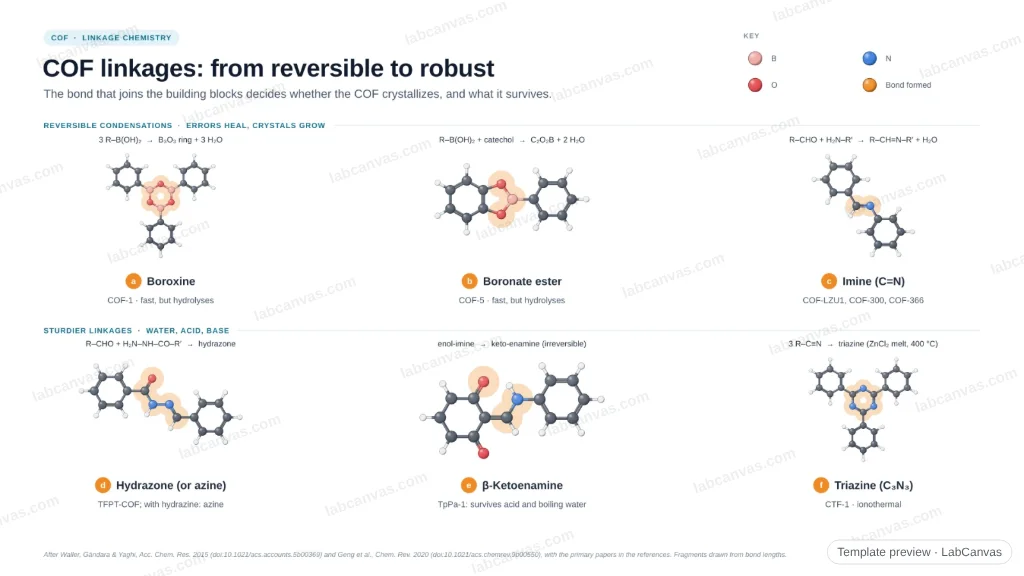
A COF crystallizes only if its bonds can break and re-form while it grows, so that mistakes heal. Boron–oxygen rings (boroxines, boronate esters) do this easily but fall apart in water; imines are sturdier; hydrazones and azines add hydrogen bonds; Tp-based imines turn irreversibly into β-ketoenamines that survive acid and base; and triazine rings made from nitriles in molten salt are tougher still.
Updated 6 cited papers54 editable layers
At a glance
- Category
- Covalent organic frameworks
- Method
- Linkage chemistry
- Approach
- Bottom-up
- Starting materials
- Boronic acids, catechols, aldehydes, amines, hydrazides, hydrazine, aromatic nitriles
- Product
- The bonds between COF building blocks and how robust each is
- Key result
- Reversibility gives crystals; irreversible or very strong links give stability to water, acid and base
- Figure
- 1920 × 1080 px (16:9), 54 editable layers, 6 generated objects
Step by step
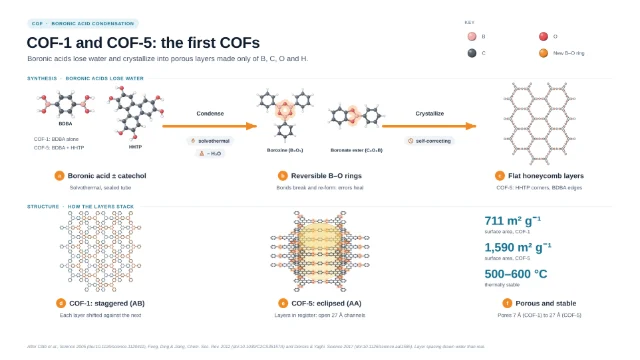
- BoroxineThree boronic acids close a B₃O₃ ring, releasing three water (COF-1; Côté et al. 2005)
- Boronate esterBoronic acid + catechol: a five-membered C₂O₂B ring (COF-5)
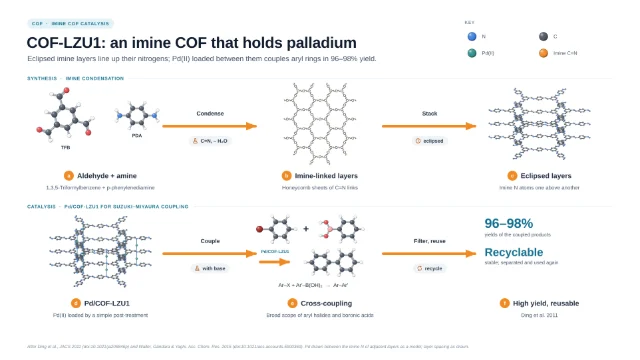
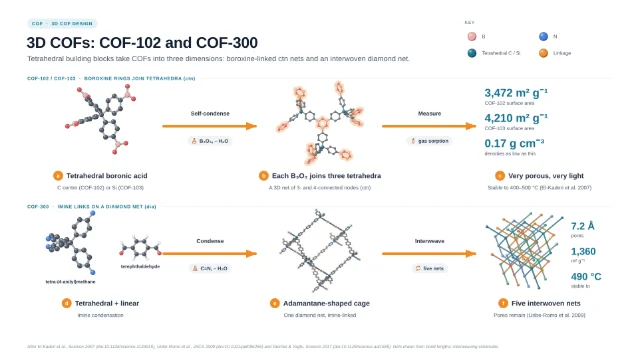
- ImineAldehyde + amine: C=N, reversible and sturdier than B–O links (COF-LZU1, COF-300, COF-366)
- Hydrazone and azineAldehyde + hydrazide or hydrazine; hydrogen bonds hold the layers flat (TFPT-COF; N₃-COF)
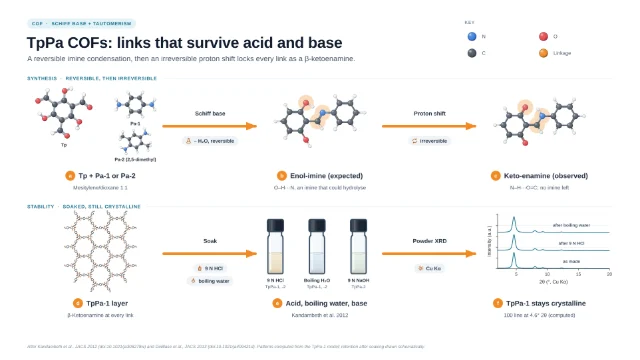
- β-KetoenamineTp aldehyde + amine: the enol-imine tautomerizes irreversibly to the keto-enamine (TpPa-1; Kandambeth et al. 2012)
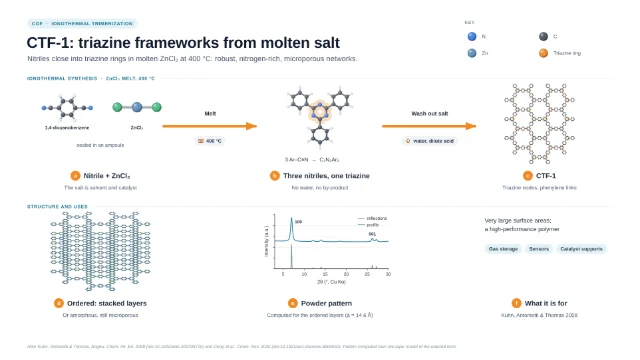
- TriazineThree nitriles trimerize in a ZnCl₂ melt at 400 °C (CTF-1; Kuhn et al. 2008)
Strengths
- One design language for many linkages
- Linkage choice sets stability and electronic properties
Limitations
- Robust linkages are harder to crystallize
- Boron–oxygen COFs hydrolyse in moist air
Uses
- Choosing a linkage for catalysis, separation or electrochemistry in water
Papers this template follows
- Waller, Gándara & Yaghi, “Chemistry of Covalent Organic Frameworks”, Acc. Chem. Res. 2015. doi:10.1021/acs.accounts.5b00369review
- Geng et al., “Covalent Organic Frameworks: Design, Synthesis, and Functions”, Chem. Rev. 2020. doi:10.1021/acs.chemrev.9b00550review
- Côté et al., “Porous, Crystalline, Covalent Organic Frameworks”, Science 2005. doi:10.1126/science.1120411primary
- Kandambeth et al., “Construction of Crystalline 2D Covalent Organic Frameworks with Remarkable Chemical (Acid/Base) Stability via a Combined Reversible and Irreversible Route”, J. Am. Chem. Soc. 2012. doi:10.1021/ja308278wprimary
- Kuhn, Antonietti & Thomas, “Porous, Covalent Triazine-Based Frameworks Prepared by Ionothermal Synthesis”, Angew. Chem. Int. Ed. 2008. doi:10.1002/anie.200705710primary
- Stegbauer et al., “A hydrazone-based covalent organic framework for photocatalytic hydrogen production”, Chem. Sci. 2014. doi:10.1039/C4SC00016Afurther reading
After Waller, Gándara & Yaghi, Acc. Chem. Res. 2015 (doi:10.1021/acs.accounts.5b00369) and Geng et al., Chem. Rev. 2020 (doi:10.1021/acs.chemrev.9b00550), with the primary papers in the references. Fragments drawn from bond lengths.
How templates are written and checked: editorial guidelines.
Questions
What does the “COF linkages: from reversible to robust” template show?
A COF crystallizes only if its bonds can break and re-form while it grows, so that mistakes heal. Boron–oxygen rings (boroxines, boronate esters) do this easily but fall apart in water; imines are sturdier; hydrazones and azines add hydrogen bonds; Tp-based imines turn irreversibly into β-ketoenamines that survive acid and base; and triazine rings made from nitriles in molten salt are tougher still.
What are the steps shown in “COF linkages: from reversible to robust”?
1. Boroxine: Three boronic acids close a B₃O₃ ring, releasing three water (COF-1; Côté et al. 2005). 2. Boronate ester: Boronic acid + catechol: a five-membered C₂O₂B ring (COF-5). 3. Imine: Aldehyde + amine: C=N, reversible and sturdier than B–O links (COF-LZU1, COF-300, COF-366). 4. Hydrazone and azine: Aldehyde + hydrazide or hydrazine; hydrogen bonds hold the layers flat (TFPT-COF; N₃-COF). 5. β-Ketoenamine: Tp aldehyde + amine: the enol-imine tautomerizes irreversibly to the keto-enamine (TpPa-1; Kandambeth et al. 2012). 6. Triazine: Three nitriles trimerize in a ZnCl₂ melt at 400 °C (CTF-1; Kuhn et al. 2008).
What are the starting materials and the product?
Starting materials: Boronic acids, catechols, aldehydes, amines, hydrazides, hydrazine, aromatic nitriles. Product: The bonds between COF building blocks and how robust each is.
Which papers is “COF linkages: from reversible to robust” based on?
Waller, Gándara & Yaghi, “Chemistry of Covalent Organic Frameworks”, Acc. Chem. Res. 2015 (doi:10.1021/acs.accounts.5b00369); Geng et al., “Covalent Organic Frameworks: Design, Synthesis, and Functions”, Chem. Rev. 2020 (doi:10.1021/acs.chemrev.9b00550); Côté et al., “Porous, Crystalline, Covalent Organic Frameworks”, Science 2005 (doi:10.1126/science.1120411); Kandambeth et al., “Construction of Crystalline 2D Covalent Organic Frameworks with Remarkable Chemical (Acid/Base) Stability via a Combined Reversible and Irreversible Route”, J. Am. Chem. Soc. 2012 (doi:10.1021/ja308278w); Kuhn, Antonietti & Thomas, “Porous, Covalent Triazine-Based Frameworks Prepared by Ionothermal Synthesis”, Angew. Chem. Int. Ed. 2008 (doi:10.1002/anie.200705710); Stegbauer et al., “A hydrazone-based covalent organic framework for photocatalytic hydrogen production”, Chem. Sci. 2014 (doi:10.1039/C4SC00016A).
Can I edit the “COF linkages: from reversible to robust” template?
Yes. Open it in the LabCanvas editor: all 54 layers are editable, including 6 generated objects (structures, plots, equipment) with their own settings. Change the text, colours and layout, then export PNG, TIFF, SVG or PDF.
Do I need an account to use this template?
Not to view it here. To open and edit it, sign in to LabCanvas or create a free account (the free plan keeps one design of each kind). Downloading the figure is part of LabCanvas Pro (US$19 a month or US$199 a year).