Graphical abstract template · Covalent organic frameworks · Ionothermal trimerization · Bottom-up
CTF-1: triazine frameworks from molten salt
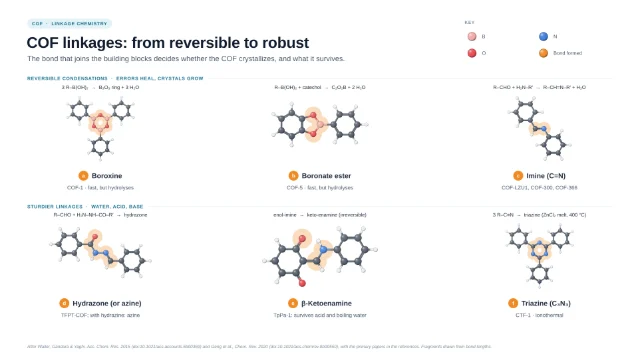
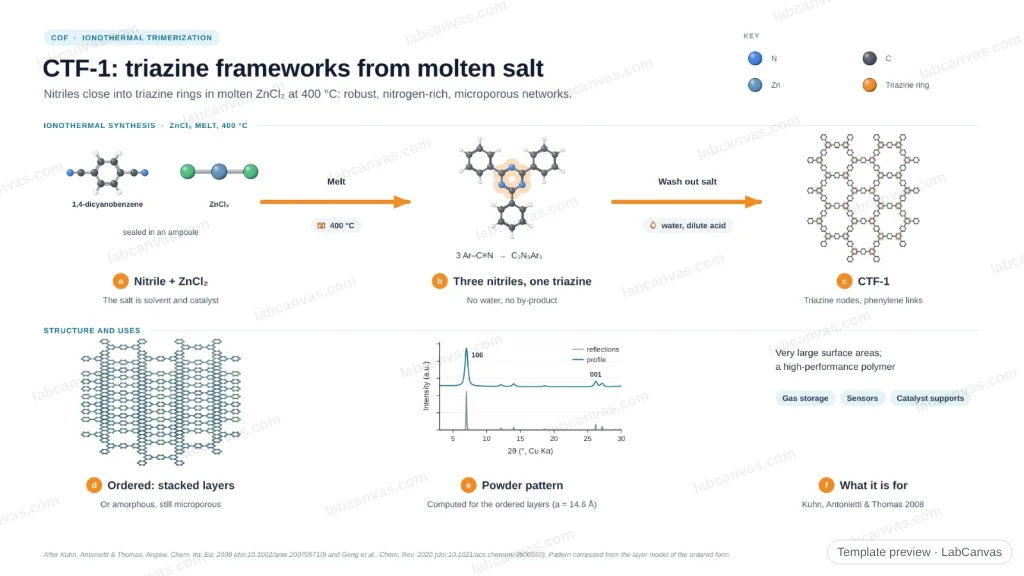
Covalent triazine frameworks are made without any condensation water: aromatic nitriles trimerize into triazine rings in molten zinc chloride at 400 °C, the salt serving as solvent and catalyst. 1,4-Dicyanobenzene gives CTF-1, layers of triazine rings joined by phenylene that can come out ordered or amorphous. The products are microporous, high-performance polymers with very large surface areas, suited to gas storage, sensing and catalyst supports.
Updated 3 cited papers72 editable layers
At a glance
- Category
- Covalent organic frameworks
- Method
- Ionothermal trimerization
- Approach
- Bottom-up
- Starting materials
- 1,4-Dicyanobenzene and ZnCl₂, in a sealed ampoule
- Product
- CTF-1: triazine rings joined by phenylene, ordered (layered) or amorphous; microporous
- Key result
- Ordered and amorphous microporous networks with very large surface areas (Kuhn et al. 2008)
- Figure
- 1920 × 1080 px (16:9), 72 editable layers, 7 generated objects
Step by step
- IonothermalNitrile and ZnCl₂ sealed together and heated to 400 °C: the salt melts and acts as solvent and catalyst
- TrimerizationThree C≡N groups close a 1,3,5-triazine ring; no water or other by-product forms
- Work-upThe solidified salt is washed out, leaving the porous network
- NetworkTriazine nodes joined by phenylene: hexagonal layers in the ordered material, a disordered network otherwise
Strengths
- Very robust aromatic links
- Cheap monomers, simple set-up
- Nitrogen-rich: binds metals and CO₂
Limitations
- Needs high temperature; hotter syntheses partly carbonize the network
- Often only partly crystalline
Uses
- Gas storage
- Sensors
- Catalyst supports
Papers this template follows
- Kuhn, Antonietti & Thomas, “Porous, Covalent Triazine-Based Frameworks Prepared by Ionothermal Synthesis”, Angew. Chem. Int. Ed. 2008. doi:10.1002/anie.200705710primary
- Geng et al., “Covalent Organic Frameworks: Design, Synthesis, and Functions”, Chem. Rev. 2020. doi:10.1021/acs.chemrev.9b00550review
- Waller, Gándara & Yaghi, “Chemistry of Covalent Organic Frameworks”, Acc. Chem. Res. 2015. doi:10.1021/acs.accounts.5b00369review
After Kuhn, Antonietti & Thomas, Angew. Chem. Int. Ed. 2008 (doi:10.1002/anie.200705710) and Geng et al., Chem. Rev. 2020 (doi:10.1021/acs.chemrev.9b00550). Pattern computed from the layer model of the ordered form.
How templates are written and checked: editorial guidelines.
Questions
What does the “CTF-1: triazine frameworks from molten salt” template show?
Covalent triazine frameworks are made without any condensation water: aromatic nitriles trimerize into triazine rings in molten zinc chloride at 400 °C, the salt serving as solvent and catalyst. 1,4-Dicyanobenzene gives CTF-1, layers of triazine rings joined by phenylene that can come out ordered or amorphous. The products are microporous, high-performance polymers with very large surface areas, suited to gas storage, sensing and catalyst supports.
What are the steps shown in “CTF-1: triazine frameworks from molten salt”?
1. Ionothermal: Nitrile and ZnCl₂ sealed together and heated to 400 °C: the salt melts and acts as solvent and catalyst. 2. Trimerization: Three C≡N groups close a 1,3,5-triazine ring; no water or other by-product forms. 3. Work-up: The solidified salt is washed out, leaving the porous network. 4. Network: Triazine nodes joined by phenylene: hexagonal layers in the ordered material, a disordered network otherwise.
What are the starting materials and the product?
Starting materials: 1,4-Dicyanobenzene and ZnCl₂, in a sealed ampoule. Product: CTF-1: triazine rings joined by phenylene, ordered (layered) or amorphous; microporous.
Which papers is “CTF-1: triazine frameworks from molten salt” based on?
Kuhn, Antonietti & Thomas, “Porous, Covalent Triazine-Based Frameworks Prepared by Ionothermal Synthesis”, Angew. Chem. Int. Ed. 2008 (doi:10.1002/anie.200705710); Geng et al., “Covalent Organic Frameworks: Design, Synthesis, and Functions”, Chem. Rev. 2020 (doi:10.1021/acs.chemrev.9b00550); Waller, Gándara & Yaghi, “Chemistry of Covalent Organic Frameworks”, Acc. Chem. Res. 2015 (doi:10.1021/acs.accounts.5b00369).
Can I edit the “CTF-1: triazine frameworks from molten salt” template?
Yes. Open it in the LabCanvas editor: all 72 layers are editable, including 7 generated objects (structures, plots, equipment) with their own settings. Change the text, colours and layout, then export PNG, TIFF, SVG or PDF.
Do I need an account to use this template?
Not to view it here. To open and edit it, sign in to LabCanvas or create a free account (the free plan keeps one design of each kind). Downloading the figure is part of LabCanvas Pro (US$19 a month or US$199 a year).