Graphical abstract template · Covalent organic frameworks · Characterization · Bottom-up
Characterizing a 2D COF
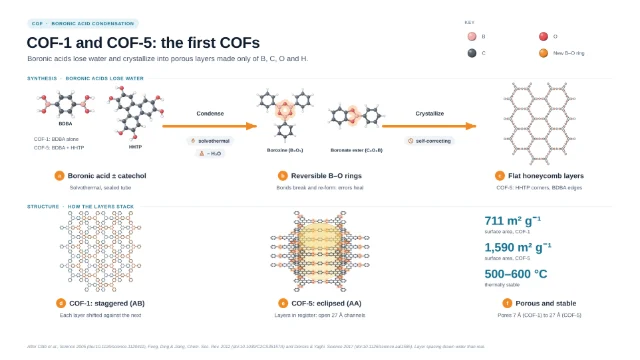
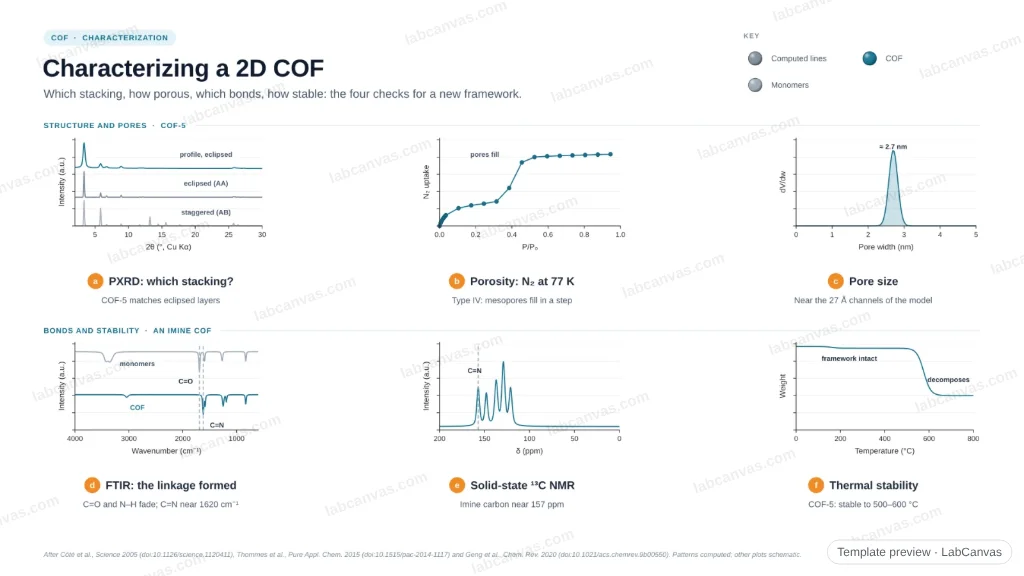
Four questions decide whether a new 2D COF is the framework that was designed. Does the powder pattern match the one computed for the layers, and for which stacking? Are the pores open, and how wide? Did the linkage form, with the starting groups used up? And how much heat does it take? Drawn with COF-5 for structure and porosity, and an imine COF for the bonds.
Updated 3 cited papers58 editable layers
At a glance
- Category
- Covalent organic frameworks
- Method
- Characterization
- Approach
- Bottom-up
- Starting materials
- An activated COF powder (here COF-5, and an imine-linked COF)
- Product
- Evidence for the structure, the porosity and the bonds of the framework
- Key result
- Report the pattern with its fit to a stacking model, the isotherm with its surface area and pore size, spectra of monomers and COF side by side, and TGA
- Figure
- 1920 × 1080 px (16:9), 58 editable layers
Step by step
- PXRDCompare the measured pattern with those computed for eclipsed and staggered stackings of the layer model; COF-5 fits eclipsed (Côté et al. 2005)
- N₂ at 77 KType IV isotherm for mesoporous COFs: a step as the pores fill (Thommes et al. 2015)
- Pore sizeDistribution from the isotherm, centred near the pore width of the model (27 Å for COF-5)
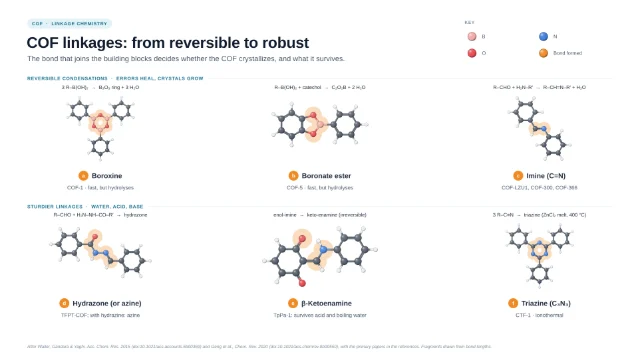
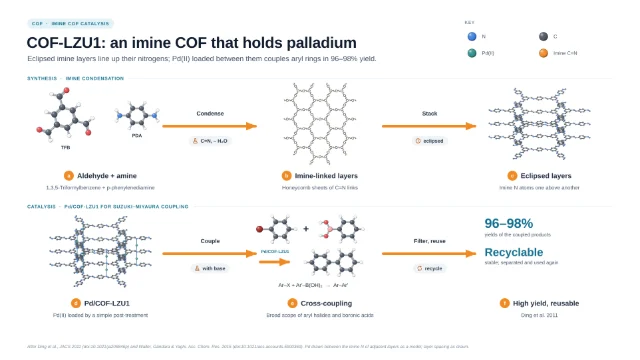
- FTIRAldehyde C=O (about 1690 cm⁻¹) and amine N–H bands fade; imine C=N (about 1620 cm⁻¹) appears
- Solid-state ¹³C NMRImine carbon near 157 ppm, aromatic carbons at 120–150 ppm
- TGAWeight held until the framework decomposes (COF-5: stable to 500–600 °C)
Strengths
- Computed patterns turn PXRD into a test of the model
- Spectra show which bonds formed
Limitations
- Broad lines can fit more than one stacking
- Surface areas depend on activation and on the pressure range
Uses
- Any new COF
- Checking batches and activation
Papers this template follows
- Côté et al., “Porous, Crystalline, Covalent Organic Frameworks”, Science 2005. doi:10.1126/science.1120411primary
- Thommes et al., “Physisorption of gases, with special reference to the evaluation of surface area and pore size distribution (IUPAC Technical Report)”, Pure Appl. Chem. 2015. doi:10.1515/pac-2014-1117method origin
- Geng et al., “Covalent Organic Frameworks: Design, Synthesis, and Functions”, Chem. Rev. 2020. doi:10.1021/acs.chemrev.9b00550review
After Côté et al., Science 2005 (doi:10.1126/science.1120411), Thommes et al., Pure Appl. Chem. 2015 (doi:10.1515/pac-2014-1117) and Geng et al., Chem. Rev. 2020 (doi:10.1021/acs.chemrev.9b00550). Patterns computed; other plots schematic.
How templates are written and checked: editorial guidelines.
Questions
What does the “Characterizing a 2D COF” template show?
Four questions decide whether a new 2D COF is the framework that was designed. Does the powder pattern match the one computed for the layers, and for which stacking? Are the pores open, and how wide? Did the linkage form, with the starting groups used up? And how much heat does it take? Drawn with COF-5 for structure and porosity, and an imine COF for the bonds.
What are the steps shown in “Characterizing a 2D COF”?
1. PXRD: Compare the measured pattern with those computed for eclipsed and staggered stackings of the layer model; COF-5 fits eclipsed (Côté et al. 2005). 2. N₂ at 77 K: Type IV isotherm for mesoporous COFs: a step as the pores fill (Thommes et al. 2015). 3. Pore size: Distribution from the isotherm, centred near the pore width of the model (27 Å for COF-5). 4. FTIR: Aldehyde C=O (about 1690 cm⁻¹) and amine N–H bands fade; imine C=N (about 1620 cm⁻¹) appears. 5. Solid-state ¹³C NMR: Imine carbon near 157 ppm, aromatic carbons at 120–150 ppm. 6. TGA: Weight held until the framework decomposes (COF-5: stable to 500–600 °C).
What are the starting materials and the product?
Starting materials: An activated COF powder (here COF-5, and an imine-linked COF). Product: Evidence for the structure, the porosity and the bonds of the framework.
Which papers is “Characterizing a 2D COF” based on?
Côté et al., “Porous, Crystalline, Covalent Organic Frameworks”, Science 2005 (doi:10.1126/science.1120411); Thommes et al., “Physisorption of gases, with special reference to the evaluation of surface area and pore size distribution (IUPAC Technical Report)”, Pure Appl. Chem. 2015 (doi:10.1515/pac-2014-1117); Geng et al., “Covalent Organic Frameworks: Design, Synthesis, and Functions”, Chem. Rev. 2020 (doi:10.1021/acs.chemrev.9b00550).
Can I edit the “Characterizing a 2D COF” template?
Yes. Open it in the LabCanvas editor: all 58 layers are editable. Change the text, colours and layout, then export PNG, TIFF, SVG or PDF.
Do I need an account to use this template?
Not to view it here. To open and edit it, sign in to LabCanvas or create a free account (the free plan keeps one design of each kind). Downloading the figure is part of LabCanvas Pro (US$19 a month or US$199 a year).