Graphical abstract template · Covalent organic frameworks · Imine COF catalysis · Bottom-up
COF-LZU1: an imine COF that holds palladium
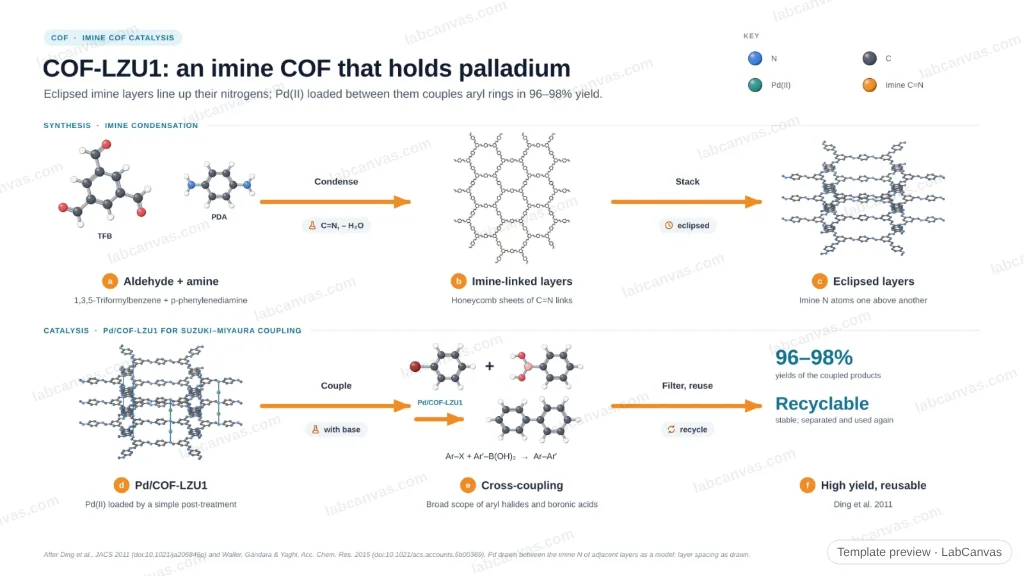
COF-LZU1 condenses 1,3,5-triformylbenzene with p-phenylenediamine into imine-linked layers that stack eclipsed, so the imine nitrogens of neighbouring layers line up. A simple post-treatment loads Pd(II) into the framework. The resulting Pd/COF-LZU1 catalyses Suzuki–Miyaura cross-coupling across a broad range of aryl halides and boronic acids in 96–98% yield, and stays stable and easy to recycle.
Updated 3 cited papers80 editable layers
At a glance
- Category
- Covalent organic frameworks
- Method
- Imine COF catalysis
- Approach
- Bottom-up
- Starting materials
- 1,3,5-Triformylbenzene (TFB) and p-phenylenediamine (PDA); a Pd(II) salt for the post-treatment
- Product
- COF-LZU1 (imine-linked, eclipsed 2D layers) and Pd/COF-LZU1
- Key result
- Yields of 96–98% across a broad range of reactants; high stability and easy recycling (Ding et al. 2011)
- Figure
- 1920 × 1080 px (16:9), 80 editable layers, 12 generated objects
Step by step
- Imine condensationTFB + PDA: C=N links join the building blocks into honeycomb layers
- Eclipsed layersLayers stack in register, so imine N atoms of adjacent layers face each other
- Pd loadingA simple post-treatment incorporates Pd(II) into the framework
- CatalysisSuzuki–Miyaura coupling of aryl halides with arylboronic acids: 96–98% yields, broad scope
- ReuseThe catalyst is stable and easily recycled (Ding et al. 2011)
Strengths
- Ordered, accessible Pd sites in a porous solid
- Separated and reused by filtration
- Easily prepared
Limitations
- Imine links can hydrolyse in strong acid
- Pd leaching has to be checked on every reuse
Uses
- Cross-coupling in fine-chemical synthesis
- A model for metal sites in COFs
Papers this template follows
- Ding et al., “Construction of Covalent Organic Framework for Catalysis: Pd/COF-LZU1 in Suzuki–Miyaura Coupling Reaction”, J. Am. Chem. Soc. 2011. doi:10.1021/ja206846pprimary
- Waller, Gándara & Yaghi, “Chemistry of Covalent Organic Frameworks”, Acc. Chem. Res. 2015. doi:10.1021/acs.accounts.5b00369review
- Geng et al., “Covalent Organic Frameworks: Design, Synthesis, and Functions”, Chem. Rev. 2020. doi:10.1021/acs.chemrev.9b00550review
After Ding et al., JACS 2011 (doi:10.1021/ja206846p) and Waller, Gándara & Yaghi, Acc. Chem. Res. 2015 (doi:10.1021/acs.accounts.5b00369). Pd drawn between the imine N of adjacent layers as a model; layer spacing as drawn.
How templates are written and checked: editorial guidelines.
Questions
What does the “COF-LZU1: an imine COF that holds palladium” template show?
COF-LZU1 condenses 1,3,5-triformylbenzene with p-phenylenediamine into imine-linked layers that stack eclipsed, so the imine nitrogens of neighbouring layers line up. A simple post-treatment loads Pd(II) into the framework. The resulting Pd/COF-LZU1 catalyses Suzuki–Miyaura cross-coupling across a broad range of aryl halides and boronic acids in 96–98% yield, and stays stable and easy to recycle.
What are the steps shown in “COF-LZU1: an imine COF that holds palladium”?
1. Imine condensation: TFB + PDA: C=N links join the building blocks into honeycomb layers. 2. Eclipsed layers: Layers stack in register, so imine N atoms of adjacent layers face each other. 3. Pd loading: A simple post-treatment incorporates Pd(II) into the framework. 4. Catalysis: Suzuki–Miyaura coupling of aryl halides with arylboronic acids: 96–98% yields, broad scope. 5. Reuse: The catalyst is stable and easily recycled (Ding et al. 2011).
What are the starting materials and the product?
Starting materials: 1,3,5-Triformylbenzene (TFB) and p-phenylenediamine (PDA); a Pd(II) salt for the post-treatment. Product: COF-LZU1 (imine-linked, eclipsed 2D layers) and Pd/COF-LZU1.
Which papers is “COF-LZU1: an imine COF that holds palladium” based on?
Ding et al., “Construction of Covalent Organic Framework for Catalysis: Pd/COF-LZU1 in Suzuki–Miyaura Coupling Reaction”, J. Am. Chem. Soc. 2011 (doi:10.1021/ja206846p); Waller, Gándara & Yaghi, “Chemistry of Covalent Organic Frameworks”, Acc. Chem. Res. 2015 (doi:10.1021/acs.accounts.5b00369); Geng et al., “Covalent Organic Frameworks: Design, Synthesis, and Functions”, Chem. Rev. 2020 (doi:10.1021/acs.chemrev.9b00550).
Can I edit the “COF-LZU1: an imine COF that holds palladium” template?
Yes. Open it in the LabCanvas editor: all 80 layers are editable, including 12 generated objects (structures, plots, equipment) with their own settings. Change the text, colours and layout, then export PNG, TIFF, SVG or PDF.
Do I need an account to use this template?
Not to view it here. To open and edit it, sign in to LabCanvas or create a free account (the free plan keeps one design of each kind). Downloading the figure is part of LabCanvas Pro (US$19 a month or US$199 a year).