Graphical abstract template · Covalent organic frameworks · Boronic acid condensation · Bottom-up
COF-1 and COF-5: the first COFs
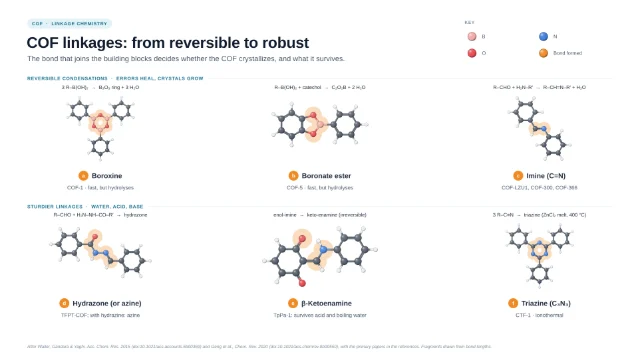
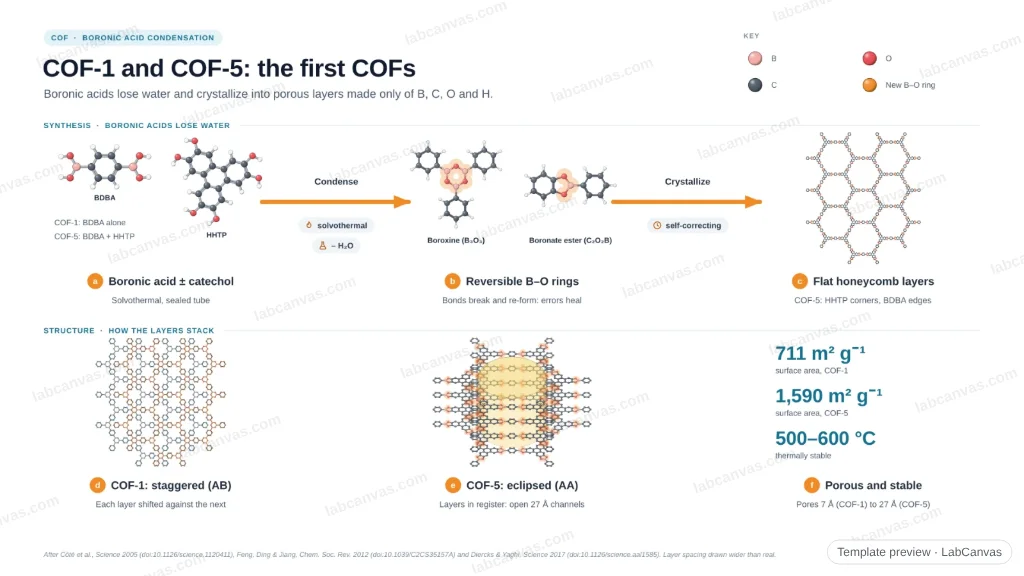
The first covalent organic frameworks were made in 2005 by condensing boronic acids. Benzene-1,4-diboronic acid alone loses water to form flat six-membered boroxine rings (COF-1); together with hexahydroxytriphenylene it forms five-membered boronate esters (COF-5). Both crystallize as porous layers built only from light elements: COF-1 stacks staggered, COF-5 eclipsed, leaving open channels 27 Å across.
Updated 3 cited papers74 editable layers
At a glance
- Category
- Covalent organic frameworks
- Method
- Boronic acid condensation
- Approach
- Bottom-up
- Starting materials
- Benzene-1,4-diboronic acid (BDBA); with 2,3,6,7,10,11-hexahydroxytriphenylene (HHTP) for COF-5
- Product
- COF-1 (boroxine-linked layers, staggered, P6₃/mmc) and COF-5 (boronate ester-linked layers, eclipsed, P6/mmm)
- Key result
- Surface areas 711 (COF-1) and 1590 m² g⁻¹ (COF-5); pores 7 to 27 Å; thermally stable to 500–600 °C (Côté et al. 2005)
- Figure
- 1920 × 1080 px (16:9), 74 editable layers, 10 generated objects
Step by step
- CondensationSolvothermal, in a sealed tube: three BDBA close a boroxine ring, or BDBA and HHTP close boronate esters, each releasing water
- Reversible bondsB–O bonds form and break while the solid grows, so defects heal and the product is crystalline
- LayersFlat hexagonal sheets: B₃O₃ rings joined by phenylene (COF-1); HHTP corners joined by BDBA (COF-5)
- StackingCOF-1 layers staggered (P6₃/mmc); COF-5 layers eclipsed (P6/mmm), giving open one-dimensional channels
Strengths
- Crystalline and porous, from light elements only (B, C, O, H)
- Pore size set by the choice of building blocks
- Thermally robust
Limitations
- Boroxine and boronate ester links are sensitive to water
- Powders, not single crystals
Uses
- Gas storage
- A model for designing organic frameworks
- Teaching reticular chemistry
Papers this template follows
- Côté et al., “Porous, Crystalline, Covalent Organic Frameworks”, Science 2005. doi:10.1126/science.1120411primary
- Feng, Ding & Jiang, “Covalent organic frameworks”, Chem. Soc. Rev. 2012. doi:10.1039/C2CS35157Areview
- Diercks & Yaghi, “The atom, the molecule, and the covalent organic framework”, Science 2017. doi:10.1126/science.aal1585further reading
After Côté et al., Science 2005 (doi:10.1126/science.1120411), Feng, Ding & Jiang, Chem. Soc. Rev. 2012 (doi:10.1039/C2CS35157A) and Diercks & Yaghi, Science 2017 (doi:10.1126/science.aal1585). Layer spacing drawn wider than real.
How templates are written and checked: editorial guidelines.
Questions
What does the “COF-1 and COF-5: the first COFs” template show?
The first covalent organic frameworks were made in 2005 by condensing boronic acids. Benzene-1,4-diboronic acid alone loses water to form flat six-membered boroxine rings (COF-1); together with hexahydroxytriphenylene it forms five-membered boronate esters (COF-5). Both crystallize as porous layers built only from light elements: COF-1 stacks staggered, COF-5 eclipsed, leaving open channels 27 Å across.
What are the steps shown in “COF-1 and COF-5: the first COFs”?
1. Condensation: Solvothermal, in a sealed tube: three BDBA close a boroxine ring, or BDBA and HHTP close boronate esters, each releasing water. 2. Reversible bonds: B–O bonds form and break while the solid grows, so defects heal and the product is crystalline. 3. Layers: Flat hexagonal sheets: B₃O₃ rings joined by phenylene (COF-1); HHTP corners joined by BDBA (COF-5). 4. Stacking: COF-1 layers staggered (P6₃/mmc); COF-5 layers eclipsed (P6/mmm), giving open one-dimensional channels.
What are the starting materials and the product?
Starting materials: Benzene-1,4-diboronic acid (BDBA); with 2,3,6,7,10,11-hexahydroxytriphenylene (HHTP) for COF-5. Product: COF-1 (boroxine-linked layers, staggered, P6₃/mmc) and COF-5 (boronate ester-linked layers, eclipsed, P6/mmm).
Which papers is “COF-1 and COF-5: the first COFs” based on?
Côté et al., “Porous, Crystalline, Covalent Organic Frameworks”, Science 2005 (doi:10.1126/science.1120411); Feng, Ding & Jiang, “Covalent organic frameworks”, Chem. Soc. Rev. 2012 (doi:10.1039/C2CS35157A); Diercks & Yaghi, “The atom, the molecule, and the covalent organic framework”, Science 2017 (doi:10.1126/science.aal1585).
Can I edit the “COF-1 and COF-5: the first COFs” template?
Yes. Open it in the LabCanvas editor: all 74 layers are editable, including 10 generated objects (structures, plots, equipment) with their own settings. Change the text, colours and layout, then export PNG, TIFF, SVG or PDF.
Do I need an account to use this template?
Not to view it here. To open and edit it, sign in to LabCanvas or create a free account (the free plan keeps one design of each kind). Downloading the figure is part of LabCanvas Pro (US$19 a month or US$199 a year).