Graphical abstract template · Covalent organic frameworks · Electrocatalysis · Bottom-up
COF-366-Co: cobalt porphyrin COF for CO₂ reduction
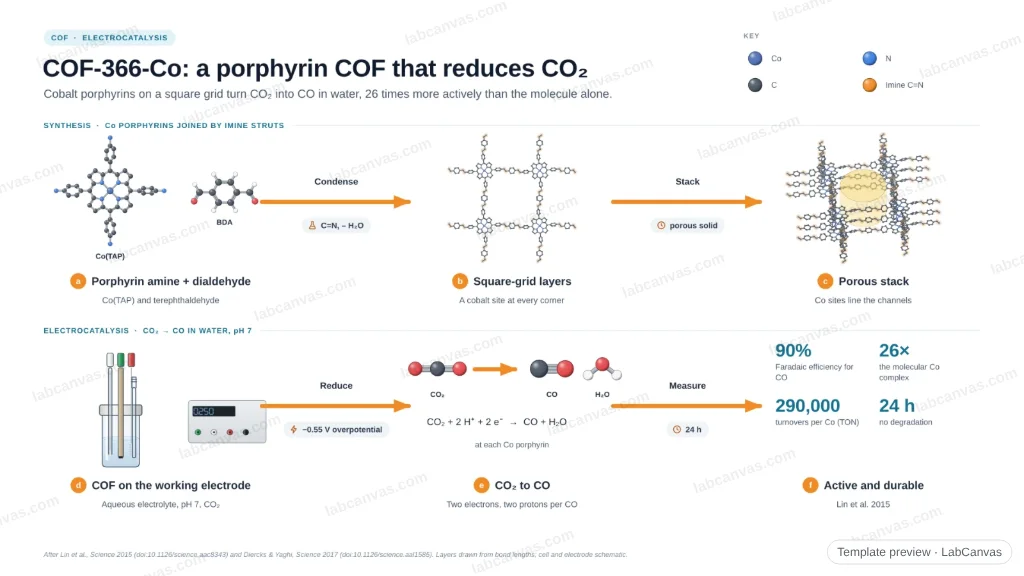
Cobalt porphyrins joined by imine struts form square-grid layers that stack into a porous solid with a catalytic cobalt site at every corner. On an electrode in water at pH 7, the framework reduces CO₂ to CO with 90% Faradaic efficiency and up to 290,000 turnovers per cobalt, at an overpotential of −0.55 V: a 26-fold gain in activity over the molecular cobalt complex, with no degradation over 24 hours.
Updated 3 cited papers87 editable layers
At a glance
- Category
- Covalent organic frameworks
- Method
- Electrocatalysis
- Approach
- Bottom-up
- Starting materials
- 5,10,15,20-Tetrakis(4-aminophenyl)porphinato cobalt (Co(TAP)) and terephthaldehyde (BDA)
- Product
- COF-366-Co: imine-linked square-grid layers of cobalt porphyrins
- Key result
- 90% Faradaic efficiency for CO; TON up to 290,000, initial TOF 9400 h⁻¹; 26-fold activity of the molecular Co complex; stable for 24 h
- Figure
- 1920 × 1080 px (16:9), 87 editable layers, 13 generated objects
Step by step
- Imine condensationCo(TAP) corners joined by BDA struts: square-grid (sql) layers
- StackingLayers stack into a porous solid with Co sites along the channels
- ElectrodeThe COF on a working electrode in water at pH 7
- CO₂ → COCO₂ + 2 H⁺ + 2 e⁻ → CO + H₂O at the Co centres; 90% Faradaic efficiency at −0.55 V overpotential
- DurabilityUp to 290,000 turnovers (initial TOF 9400 h⁻¹); no degradation over 24 h (Lin et al. 2015)
Strengths
- Every porphyrin a catalytic site, held apart and accessible
- Works in water at neutral pH
- Modular: struts and metal can be changed
Limitations
- The powder has to be made into an electrode film
- Imine links limit use in strong acid
Uses
- Electrochemical CO₂ conversion to CO
- A platform for molecular catalysts in frameworks
Papers this template follows
- Lin et al., “Covalent organic frameworks comprising cobalt porphyrins for catalytic CO₂ reduction in water”, Science 2015. doi:10.1126/science.aac8343primary
- Diercks & Yaghi, “The atom, the molecule, and the covalent organic framework”, Science 2017. doi:10.1126/science.aal1585review
- Geng et al., “Covalent Organic Frameworks: Design, Synthesis, and Functions”, Chem. Rev. 2020. doi:10.1021/acs.chemrev.9b00550review
After Lin et al., Science 2015 (doi:10.1126/science.aac8343) and Diercks & Yaghi, Science 2017 (doi:10.1126/science.aal1585). Layers drawn from bond lengths; cell and electrode schematic.
How templates are written and checked: editorial guidelines.
Questions
What does the “COF-366-Co: cobalt porphyrin COF for CO₂ reduction” template show?
Cobalt porphyrins joined by imine struts form square-grid layers that stack into a porous solid with a catalytic cobalt site at every corner. On an electrode in water at pH 7, the framework reduces CO₂ to CO with 90% Faradaic efficiency and up to 290,000 turnovers per cobalt, at an overpotential of −0.55 V: a 26-fold gain in activity over the molecular cobalt complex, with no degradation over 24 hours.
What are the steps shown in “COF-366-Co: cobalt porphyrin COF for CO₂ reduction”?
1. Imine condensation: Co(TAP) corners joined by BDA struts: square-grid (sql) layers. 2. Stacking: Layers stack into a porous solid with Co sites along the channels. 3. Electrode: The COF on a working electrode in water at pH 7. 4. CO₂ → CO: CO₂ + 2 H⁺ + 2 e⁻ → CO + H₂O at the Co centres; 90% Faradaic efficiency at −0.55 V overpotential. 5. Durability: Up to 290,000 turnovers (initial TOF 9400 h⁻¹); no degradation over 24 h (Lin et al. 2015).
What are the starting materials and the product?
Starting materials: 5,10,15,20-Tetrakis(4-aminophenyl)porphinato cobalt (Co(TAP)) and terephthaldehyde (BDA). Product: COF-366-Co: imine-linked square-grid layers of cobalt porphyrins.
Which papers is “COF-366-Co: cobalt porphyrin COF for CO₂ reduction” based on?
Lin et al., “Covalent organic frameworks comprising cobalt porphyrins for catalytic CO₂ reduction in water”, Science 2015 (doi:10.1126/science.aac8343); Diercks & Yaghi, “The atom, the molecule, and the covalent organic framework”, Science 2017 (doi:10.1126/science.aal1585); Geng et al., “Covalent Organic Frameworks: Design, Synthesis, and Functions”, Chem. Rev. 2020 (doi:10.1021/acs.chemrev.9b00550).
Can I edit the “COF-366-Co: cobalt porphyrin COF for CO₂ reduction” template?
Yes. Open it in the LabCanvas editor: all 87 layers are editable, including 13 generated objects (structures, plots, equipment) with their own settings. Change the text, colours and layout, then export PNG, TIFF, SVG or PDF.
Do I need an account to use this template?
Not to view it here. To open and edit it, sign in to LabCanvas or create a free account (the free plan keeps one design of each kind). Downloading the figure is part of LabCanvas Pro (US$19 a month or US$199 a year).