Graphical abstract template · Covalent organic frameworks · Photocatalysis · Bottom-up
COF photocatalysts for hydrogen from water
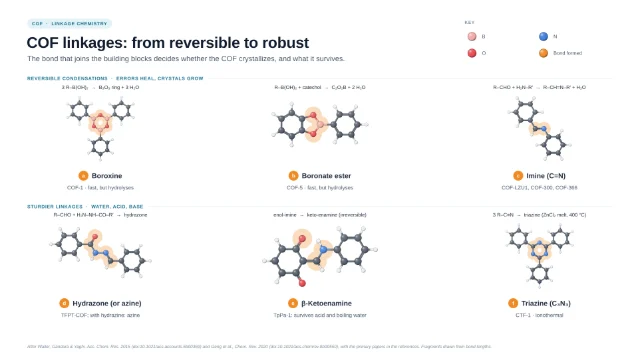
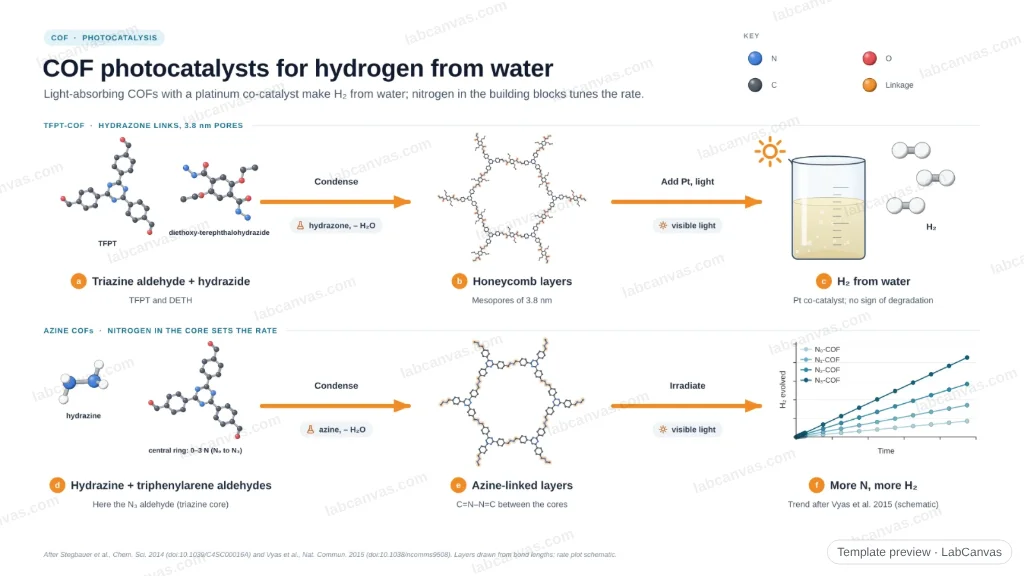
Some COFs are semiconductors that absorb visible light. TFPT-COF, hydrazone-linked triazine and phenyl units in honeycomb layers with 3.8 nm pores, produces hydrogen from water under visible light once platinum is added as the proton reduction catalyst, and keeps doing so without degrading. In a series of azine-linked COFs made from hydrazine, swapping C–H for N in the central ring of the aldehyde (N₀ to N₃) raises the rate of hydrogen evolution step by step.
Updated 3 cited papers79 editable layers
At a glance
- Category
- Covalent organic frameworks
- Method
- Photocatalysis
- Approach
- Bottom-up
- Starting materials
- 1,3,5-Tris(4-formylphenyl)triazine (TFPT) with 2,5-diethoxyterephthalohydrazide (TFPT-COF); triphenylarene aldehydes with hydrazine (Nₓ-COFs)
- Product
- Hydrazone- and azine-linked COFs that evolve H₂ from water under visible light with Pt
- Key result
- TFPT-COF: highest surface area of the hydrazone COFs then reported; steady H₂ production without degradation. Nₓ-COFs: H₂ evolution increases with N content
- Figure
- 1920 × 1080 px (16:9), 79 editable layers, 15 generated objects
Step by step
- Hydrazone COFTFPT + diethoxyterephthalohydrazide: honeycomb layers with 3.8 nm mesopores (Stegbauer et al. 2014)
- PhotocatalysisPt added as proton reduction catalyst; under visible light H₂ forms from water continuously, without degradation
- Azine seriesHydrazine + aldehydes whose central ring holds 0 to 3 N atoms (N₀- to N₃-COF; Vyas et al. 2015)
- TuningMore nitrogen in the central ring, more hydrogen evolved
Strengths
- Light absorption and pores in one designed solid
- Activity tuned atom by atom in the building blocks
- Water- and light-stable
Limitations
- Needs a platinum co-catalyst
- Hydrogen evolution only (a half reaction)
Uses
- Solar hydrogen
- Model systems for photocatalyst design
Papers this template follows
- Stegbauer et al., “A hydrazone-based covalent organic framework for photocatalytic hydrogen production”, Chem. Sci. 2014. doi:10.1039/C4SC00016Aprimary
- Vyas et al., “A tunable azine covalent organic framework platform for visible light-induced hydrogen generation”, Nat. Commun. 2015. doi:10.1038/ncomms9508primary
- Geng et al., “Covalent Organic Frameworks: Design, Synthesis, and Functions”, Chem. Rev. 2020. doi:10.1021/acs.chemrev.9b00550review
After Stegbauer et al., Chem. Sci. 2014 (doi:10.1039/C4SC00016A) and Vyas et al., Nat. Commun. 2015 (doi:10.1038/ncomms9508). Layers drawn from bond lengths; rate plot schematic.
How templates are written and checked: editorial guidelines.
Questions
What does the “COF photocatalysts for hydrogen from water” template show?
Some COFs are semiconductors that absorb visible light. TFPT-COF, hydrazone-linked triazine and phenyl units in honeycomb layers with 3.8 nm pores, produces hydrogen from water under visible light once platinum is added as the proton reduction catalyst, and keeps doing so without degrading. In a series of azine-linked COFs made from hydrazine, swapping C–H for N in the central ring of the aldehyde (N₀ to N₃) raises the rate of hydrogen evolution step by step.
What are the steps shown in “COF photocatalysts for hydrogen from water”?
1. Hydrazone COF: TFPT + diethoxyterephthalohydrazide: honeycomb layers with 3.8 nm mesopores (Stegbauer et al. 2014). 2. Photocatalysis: Pt added as proton reduction catalyst; under visible light H₂ forms from water continuously, without degradation. 3. Azine series: Hydrazine + aldehydes whose central ring holds 0 to 3 N atoms (N₀- to N₃-COF; Vyas et al. 2015). 4. Tuning: More nitrogen in the central ring, more hydrogen evolved.
What are the starting materials and the product?
Starting materials: 1,3,5-Tris(4-formylphenyl)triazine (TFPT) with 2,5-diethoxyterephthalohydrazide (TFPT-COF); triphenylarene aldehydes with hydrazine (Nₓ-COFs). Product: Hydrazone- and azine-linked COFs that evolve H₂ from water under visible light with Pt.
Which papers is “COF photocatalysts for hydrogen from water” based on?
Stegbauer et al., “A hydrazone-based covalent organic framework for photocatalytic hydrogen production”, Chem. Sci. 2014 (doi:10.1039/C4SC00016A); Vyas et al., “A tunable azine covalent organic framework platform for visible light-induced hydrogen generation”, Nat. Commun. 2015 (doi:10.1038/ncomms9508); Geng et al., “Covalent Organic Frameworks: Design, Synthesis, and Functions”, Chem. Rev. 2020 (doi:10.1021/acs.chemrev.9b00550).
Can I edit the “COF photocatalysts for hydrogen from water” template?
Yes. Open it in the LabCanvas editor: all 79 layers are editable, including 15 generated objects (structures, plots, equipment) with their own settings. Change the text, colours and layout, then export PNG, TIFF, SVG or PDF.
Do I need an account to use this template?
Not to view it here. To open and edit it, sign in to LabCanvas or create a free account (the free plan keeps one design of each kind). Downloading the figure is part of LabCanvas Pro (US$19 a month or US$199 a year).