Graphical abstract template · Covalent organic frameworks · Interfacial crystallization · Bottom-up
COF thin films for molecular separation
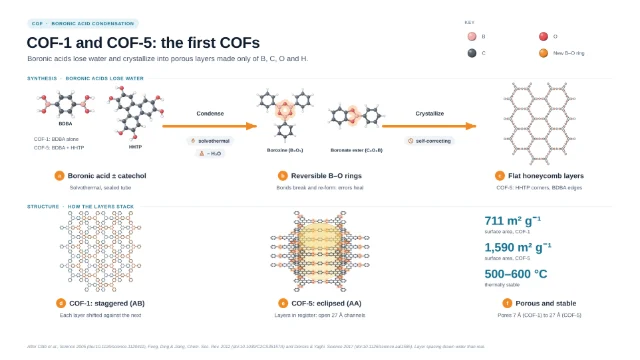
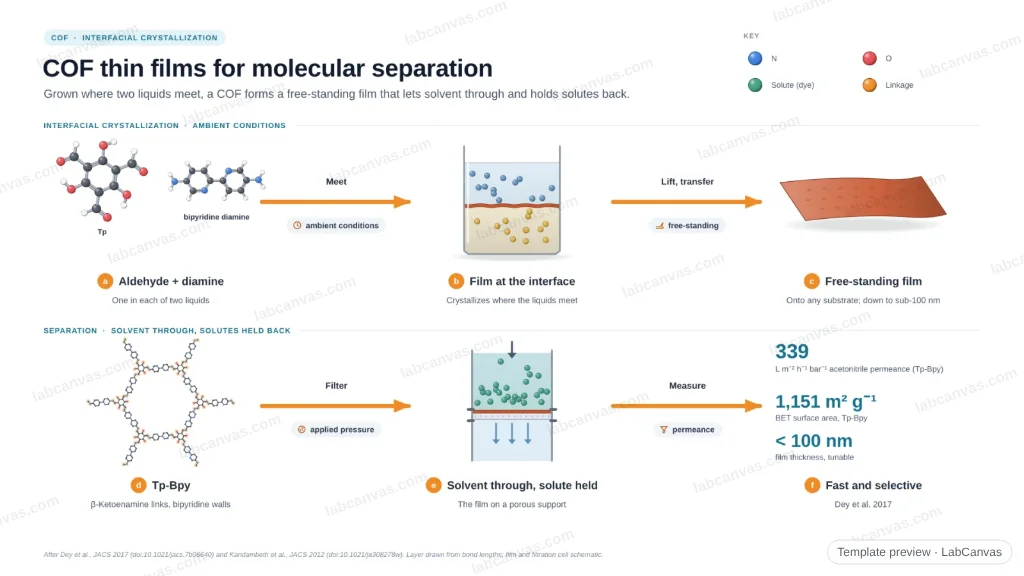
COFs usually come out as insoluble powders. Grown instead where two liquids that do not mix meet, β-ketoenamine COFs form continuous, free-standing films under ambient conditions; they can be lifted onto any support and made thinner than 100 nm. Tp-Bpy, from Tp and a bipyridine diamine, has a surface area of 1151 m² g⁻¹ and lets acetonitrile through at 339 L m⁻² h⁻¹ bar⁻¹ while holding dissolved molecules back.
Updated 3 cited papers76 editable layers
At a glance
- Category
- Covalent organic frameworks
- Method
- Interfacial crystallization
- Approach
- Bottom-up
- Starting materials
- Tp (1,3,5-triformylphloroglucinol) and 2,2′-bipyridine-5,5′-diamine, each in one of two liquids that do not mix
- Product
- Free-standing, crystalline, porous Tp-Bpy films, transferable onto any substrate
- Key result
- Tp-Bpy: BET surface area 1151 m² g⁻¹; acetonitrile permeance 339 L m⁻² h⁻¹ bar⁻¹; high chemical and thermal stability (Dey et al. 2017)
- Figure
- 1920 × 1080 px (16:9), 76 editable layers, 10 generated objects
Step by step
- Two liquidsThe two monomers start in separate liquids that do not mix
- InterfaceThey meet and react only at the liquid–liquid interface, under ambient conditions
- Free-standing filmA continuous crystalline film grows without any support; thickness can be tuned down to sub-100 nm
- TransferLifted off and laid on any desired substrate
- SeparationSolvent passes; dissolved molecules are held back (Dey et al. 2017)
Strengths
- Processable films instead of powders
- Ordered pores of one size
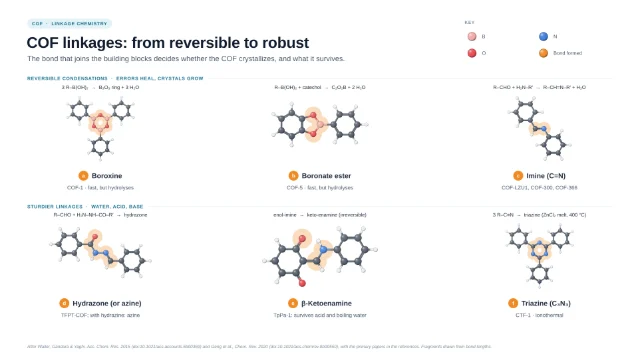
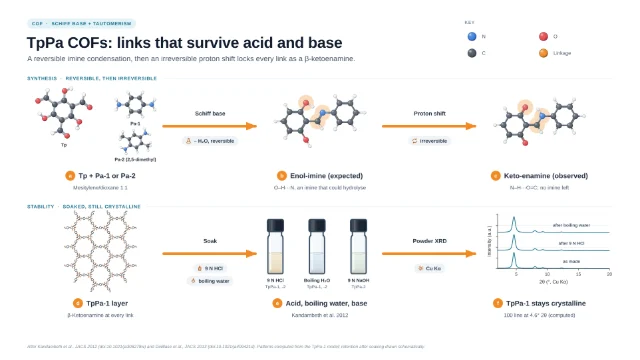
- Chemically robust β-ketoenamine links
Limitations
- Large, defect-free films are hard to make
- Pores of 2D COFs are larger than small solutes
Uses
- Organic solvent nanofiltration
- Dye removal
- Membranes and coatings
Papers this template follows
- Dey et al., “Selective Molecular Separation by Interfacially Crystallized Covalent Organic Framework Thin Films”, J. Am. Chem. Soc. 2017. doi:10.1021/jacs.7b06640primary
- Kandambeth et al., “Construction of Crystalline 2D Covalent Organic Frameworks with Remarkable Chemical (Acid/Base) Stability via a Combined Reversible and Irreversible Route”, J. Am. Chem. Soc. 2012. doi:10.1021/ja308278wfurther reading
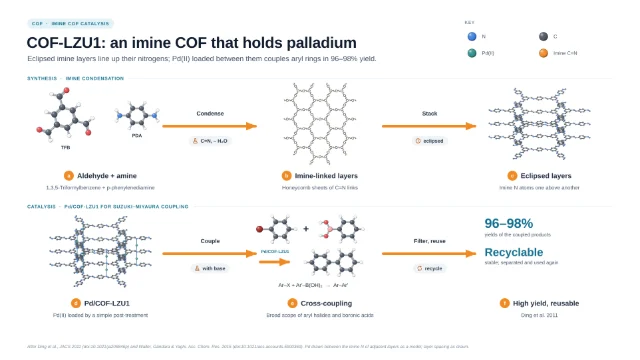
- Geng et al., “Covalent Organic Frameworks: Design, Synthesis, and Functions”, Chem. Rev. 2020. doi:10.1021/acs.chemrev.9b00550review
After Dey et al., JACS 2017 (doi:10.1021/jacs.7b06640) and Kandambeth et al., JACS 2012 (doi:10.1021/ja308278w). Layer drawn from bond lengths; film and filtration cell schematic.
How templates are written and checked: editorial guidelines.
Questions
What does the “COF thin films for molecular separation” template show?
COFs usually come out as insoluble powders. Grown instead where two liquids that do not mix meet, β-ketoenamine COFs form continuous, free-standing films under ambient conditions; they can be lifted onto any support and made thinner than 100 nm. Tp-Bpy, from Tp and a bipyridine diamine, has a surface area of 1151 m² g⁻¹ and lets acetonitrile through at 339 L m⁻² h⁻¹ bar⁻¹ while holding dissolved molecules back.
What are the steps shown in “COF thin films for molecular separation”?
1. Two liquids: The two monomers start in separate liquids that do not mix. 2. Interface: They meet and react only at the liquid–liquid interface, under ambient conditions. 3. Free-standing film: A continuous crystalline film grows without any support; thickness can be tuned down to sub-100 nm. 4. Transfer: Lifted off and laid on any desired substrate. 5. Separation: Solvent passes; dissolved molecules are held back (Dey et al. 2017).
What are the starting materials and the product?
Starting materials: Tp (1,3,5-triformylphloroglucinol) and 2,2′-bipyridine-5,5′-diamine, each in one of two liquids that do not mix. Product: Free-standing, crystalline, porous Tp-Bpy films, transferable onto any substrate.
Which papers is “COF thin films for molecular separation” based on?
Dey et al., “Selective Molecular Separation by Interfacially Crystallized Covalent Organic Framework Thin Films”, J. Am. Chem. Soc. 2017 (doi:10.1021/jacs.7b06640); Kandambeth et al., “Construction of Crystalline 2D Covalent Organic Frameworks with Remarkable Chemical (Acid/Base) Stability via a Combined Reversible and Irreversible Route”, J. Am. Chem. Soc. 2012 (doi:10.1021/ja308278w); Geng et al., “Covalent Organic Frameworks: Design, Synthesis, and Functions”, Chem. Rev. 2020 (doi:10.1021/acs.chemrev.9b00550).
Can I edit the “COF thin films for molecular separation” template?
Yes. Open it in the LabCanvas editor: all 76 layers are editable, including 10 generated objects (structures, plots, equipment) with their own settings. Change the text, colours and layout, then export PNG, TIFF, SVG or PDF.
Do I need an account to use this template?
Not to view it here. To open and edit it, sign in to LabCanvas or create a free account (the free plan keeps one design of each kind). Downloading the figure is part of LabCanvas Pro (US$19 a month or US$199 a year).