Graphical abstract template · Electrocatalysis · Flow electrolyzer
CO₂ electrolyzers: gas-diffusion electrodes
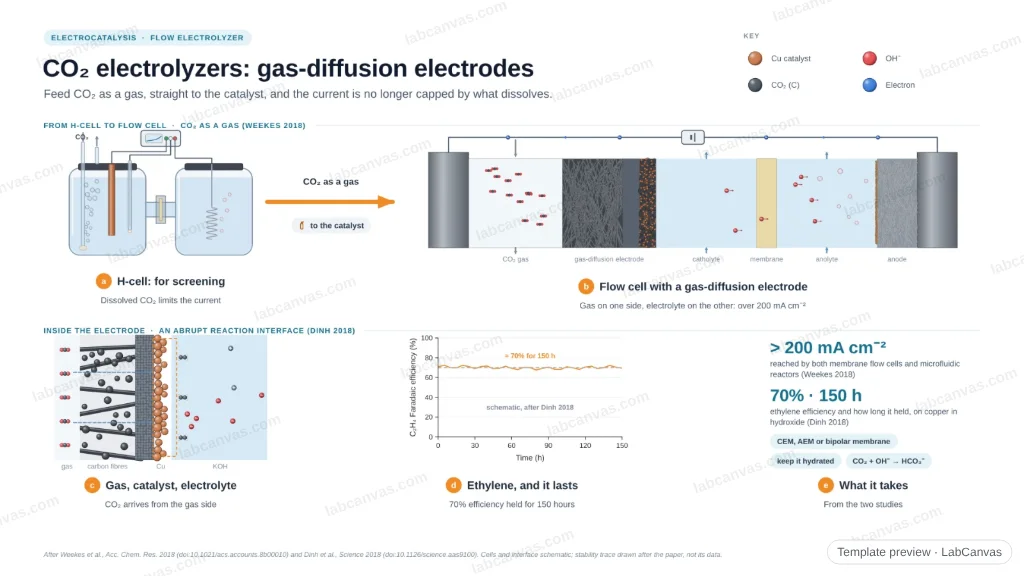
In an H-cell, CO₂ must dissolve before it reaches the catalyst, and that caps the current. Flow electrolyzers feed CO₂ as a gas through a gas-diffusion electrode right up to the catalyst, reaching more than 200 mA cm⁻². On copper at an abrupt interface in hydroxide, CO₂ became ethylene with 70% efficiency for 150 hours.
Updated 3 cited papers70 editable layers
At a glance
- Category
- Electrocatalysis
- Method
- Flow electrolyzer
- Starting materials
- A copper catalyst on a gas-diffusion layer, CO₂ gas, a hydroxide or bicarbonate electrolyte, a membrane and an anode
- Product
- CO₂ reduced at high current: ethylene and other products from the gas and liquid streams
- Key result
- Current densities and ethylene results from the abstracts of Weekes et al. (2018) and Dinh et al. (2018); cells, interface and the stability trace are schematic
- Figure
- 1920 × 1080 px (16:9), 70 editable layers, 4 generated objects
Step by step
- H-cellGood for screening catalysts, but dissolved CO₂ limits mass transport and current (Weekes et al. 2018)
- Flow cellCO₂ goes to the cathode as a gas through a gas-diffusion electrode; flow cells and microfluidic reactors both exceed 200 mA cm⁻²
- MembraneCation-exchange, anion-exchange or bipolar: it sets the ions that cross and the electrolytes you can use
- Abrupt interfaceCopper in hydroxide at a sharp gas–catalyst–electrolyte interface: 70% ethylene efficiency held for 150 h (Dinh et al. 2018)
Strengths
- High current densities
- Gas-phase CO₂ avoids its low solubility in water
Limitations
- Water management: the cell must stay hydrated
- CO₂ reacts with hydroxide to bicarbonate
- Long-term stability of the electrode
Uses
- Ethylene, CO and formate from CO₂ at scale
Papers this template follows
- Weekes, Salvatore, Reyes, Huang & Berlinguette, “Electrolytic CO2 Reduction in a Flow Cell”, Acc. Chem. Res. 2018. doi:10.1021/acs.accounts.8b00010review
- Dinh, Burdyny, Kibria, Seifitokaldani, Gabardo, García de Arquer, Kiani, Edwards, De Luna, Bushuyev, Zou, Quintero-Bermudez, Pang, Sinton & Sargent, “CO2 electroreduction to ethylene via hydroxide-mediated copper catalysis at an abrupt interface”, Science 2018. doi:10.1126/science.aas9100primary
- Nitopi et al., “Progress and Perspectives of Electrochemical CO2 Reduction on Copper in Aqueous Electrolyte”, Chem. Rev. 2019. doi:10.1021/acs.chemrev.8b00705further reading
After Weekes et al., Acc. Chem. Res. 2018 (doi:10.1021/acs.accounts.8b00010) and Dinh et al., Science 2018 (doi:10.1126/science.aas9100). Cells and interface schematic; stability trace drawn after the paper, not its data.
How templates are written and checked: editorial guidelines.
Questions
What does the “CO₂ electrolyzers: gas-diffusion electrodes” template show?
In an H-cell, CO₂ must dissolve before it reaches the catalyst, and that caps the current. Flow electrolyzers feed CO₂ as a gas through a gas-diffusion electrode right up to the catalyst, reaching more than 200 mA cm⁻². On copper at an abrupt interface in hydroxide, CO₂ became ethylene with 70% efficiency for 150 hours.
What are the steps shown in “CO₂ electrolyzers: gas-diffusion electrodes”?
1. H-cell: Good for screening catalysts, but dissolved CO₂ limits mass transport and current (Weekes et al. 2018). 2. Flow cell: CO₂ goes to the cathode as a gas through a gas-diffusion electrode; flow cells and microfluidic reactors both exceed 200 mA cm⁻². 3. Membrane: Cation-exchange, anion-exchange or bipolar: it sets the ions that cross and the electrolytes you can use. 4. Abrupt interface: Copper in hydroxide at a sharp gas–catalyst–electrolyte interface: 70% ethylene efficiency held for 150 h (Dinh et al. 2018).
What are the starting materials and the product?
Starting materials: A copper catalyst on a gas-diffusion layer, CO₂ gas, a hydroxide or bicarbonate electrolyte, a membrane and an anode. Product: CO₂ reduced at high current: ethylene and other products from the gas and liquid streams.
Which papers is “CO₂ electrolyzers: gas-diffusion electrodes” based on?
Weekes, Salvatore, Reyes, Huang & Berlinguette, “Electrolytic CO2 Reduction in a Flow Cell”, Acc. Chem. Res. 2018 (doi:10.1021/acs.accounts.8b00010); Dinh, Burdyny, Kibria, Seifitokaldani, Gabardo, García de Arquer, Kiani, Edwards, De Luna, Bushuyev, Zou, Quintero-Bermudez, Pang, Sinton & Sargent, “CO2 electroreduction to ethylene via hydroxide-mediated copper catalysis at an abrupt interface”, Science 2018 (doi:10.1126/science.aas9100); Nitopi et al., “Progress and Perspectives of Electrochemical CO2 Reduction on Copper in Aqueous Electrolyte”, Chem. Rev. 2019 (doi:10.1021/acs.chemrev.8b00705).
Can I edit the “CO₂ electrolyzers: gas-diffusion electrodes” template?
Yes. Open it in the LabCanvas editor: all 70 layers are editable, including 4 generated objects (structures, plots, equipment) with their own settings. Change the text, colours and layout, then export PNG, TIFF, SVG or PDF.
Do I need an account to use this template?
Not to view it here. To open and edit it, sign in to LabCanvas or create a free account (the free plan keeps one design of each kind). Downloading the figure is part of LabCanvas Pro (US$19 a month or US$199 a year).