Graphical abstract template · Electrocatalysis · HER catalyst
MoS₂ for hydrogen: the edges do the work
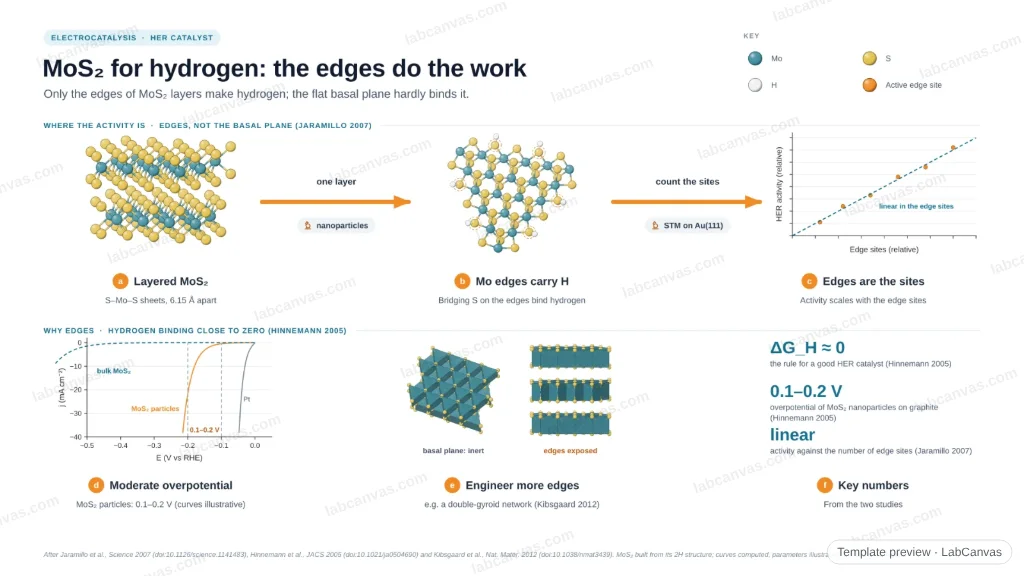
Molybdenum disulfide is a cheap, layered alternative to platinum for making hydrogen, but only the edges of its layers are active: the flat basal plane hardly binds hydrogen. Counting the sites of MoS₂ nanoparticles showed activity rising in step with the number of edge sites, so MoS₂ catalysts are built to expose as many edges as possible.
Updated 4 cited papers71 editable layers
At a glance
- Category
- Electrocatalysis
- Method
- HER catalyst
- Starting materials
- MoS₂ nanoparticles (on Au(111) or graphite) or nanostructured MoS₂ films
- Product
- A non-precious HER catalyst whose activity comes from its edges
- Key result
- MoS₂ built from its 2H structure (a = 3.16 Å, c = 12.29 Å); polarization curves computed with illustrative parameters; the edge–activity plot shows the reported linear trend, not measured points
- Figure
- 1920 × 1080 px (16:9), 71 editable layers, 6 generated objects
Step by step
- Design ruleA good HER catalyst binds hydrogen with a free energy close to zero (Hinnemann et al. 2005)
- MoS₂ nanoparticlesOn graphite they evolved hydrogen at a moderate overpotential of 0.1–0.2 V (Hinnemann et al. 2005)
- Edges are the sitesActivity rose linearly with the number of edge sites counted by STM on Au(111) (Jaramillo et al. 2007)
- Expose more edgesMesoporous double-gyroid MoS₂ engineered to expose edge sites (Kibsgaard et al. 2012)
Strengths
- Earth-abundant elements
- Stable in acid
- Edges can be engineered
Limitations
- The basal plane is inert
- Poorer conductivity than metals
Uses
- Hydrogen evolution in acid
- Photo- and electrocatalytic water splitting
Papers this template follows
- Jaramillo, Jørgensen, Bonde, Nielsen, Horch & Chorkendorff, “Identification of Active Edge Sites for Electrochemical H2 Evolution from MoS2 Nanocatalysts”, Science 2007. doi:10.1126/science.1141483primary
- Hinnemann, Moses, Bonde, Jørgensen, Nielsen, Horch, Chorkendorff & Nørskov, “Biomimetic Hydrogen Evolution: MoS2 Nanoparticles as Catalyst for Hydrogen Evolution”, J. Am. Chem. Soc. 2005. doi:10.1021/ja0504690primary
- Kibsgaard, Chen, Reinecke & Jaramillo, “Engineering the surface structure of MoS2 to preferentially expose active edge sites for electrocatalysis”, Nat. Mater. 2012. doi:10.1038/nmat3439primary
- Nørskov et al., “Trends in the Exchange Current for Hydrogen Evolution”, J. Electrochem. Soc. 2005. doi:10.1149/1.1856988further reading
After Jaramillo et al., Science 2007 (doi:10.1126/science.1141483), Hinnemann et al., JACS 2005 (doi:10.1021/ja0504690) and Kibsgaard et al., Nat. Mater. 2012 (doi:10.1038/nmat3439). MoS₂ built from its 2H structure; curves computed, parameters illustrative; trend plot schematic.
How templates are written and checked: editorial guidelines.
Questions
What does the “MoS₂ for hydrogen: the edges do the work” template show?
Molybdenum disulfide is a cheap, layered alternative to platinum for making hydrogen, but only the edges of its layers are active: the flat basal plane hardly binds hydrogen. Counting the sites of MoS₂ nanoparticles showed activity rising in step with the number of edge sites, so MoS₂ catalysts are built to expose as many edges as possible.
What are the steps shown in “MoS₂ for hydrogen: the edges do the work”?
1. Design rule: A good HER catalyst binds hydrogen with a free energy close to zero (Hinnemann et al. 2005). 2. MoS₂ nanoparticles: On graphite they evolved hydrogen at a moderate overpotential of 0.1–0.2 V (Hinnemann et al. 2005). 3. Edges are the sites: Activity rose linearly with the number of edge sites counted by STM on Au(111) (Jaramillo et al. 2007). 4. Expose more edges: Mesoporous double-gyroid MoS₂ engineered to expose edge sites (Kibsgaard et al. 2012).
What are the starting materials and the product?
Starting materials: MoS₂ nanoparticles (on Au(111) or graphite) or nanostructured MoS₂ films. Product: A non-precious HER catalyst whose activity comes from its edges.
Which papers is “MoS₂ for hydrogen: the edges do the work” based on?
Jaramillo, Jørgensen, Bonde, Nielsen, Horch & Chorkendorff, “Identification of Active Edge Sites for Electrochemical H2 Evolution from MoS2 Nanocatalysts”, Science 2007 (doi:10.1126/science.1141483); Hinnemann, Moses, Bonde, Jørgensen, Nielsen, Horch, Chorkendorff & Nørskov, “Biomimetic Hydrogen Evolution: MoS2 Nanoparticles as Catalyst for Hydrogen Evolution”, J. Am. Chem. Soc. 2005 (doi:10.1021/ja0504690); Kibsgaard, Chen, Reinecke & Jaramillo, “Engineering the surface structure of MoS2 to preferentially expose active edge sites for electrocatalysis”, Nat. Mater. 2012 (doi:10.1038/nmat3439); Nørskov et al., “Trends in the Exchange Current for Hydrogen Evolution”, J. Electrochem. Soc. 2005 (doi:10.1149/1.1856988).
Can I edit the “MoS₂ for hydrogen: the edges do the work” template?
Yes. Open it in the LabCanvas editor: all 71 layers are editable, including 6 generated objects (structures, plots, equipment) with their own settings. Change the text, colours and layout, then export PNG, TIFF, SVG or PDF.
Do I need an account to use this template?
Not to view it here. To open and edit it, sign in to LabCanvas or create a free account (the free plan keeps one design of each kind). Downloading the figure is part of LabCanvas Pro (US$19 a month or US$199 a year).