Graphical abstract template · Electrocatalysis · Water electrolysis
Water splitting: hydrogen and oxygen evolution
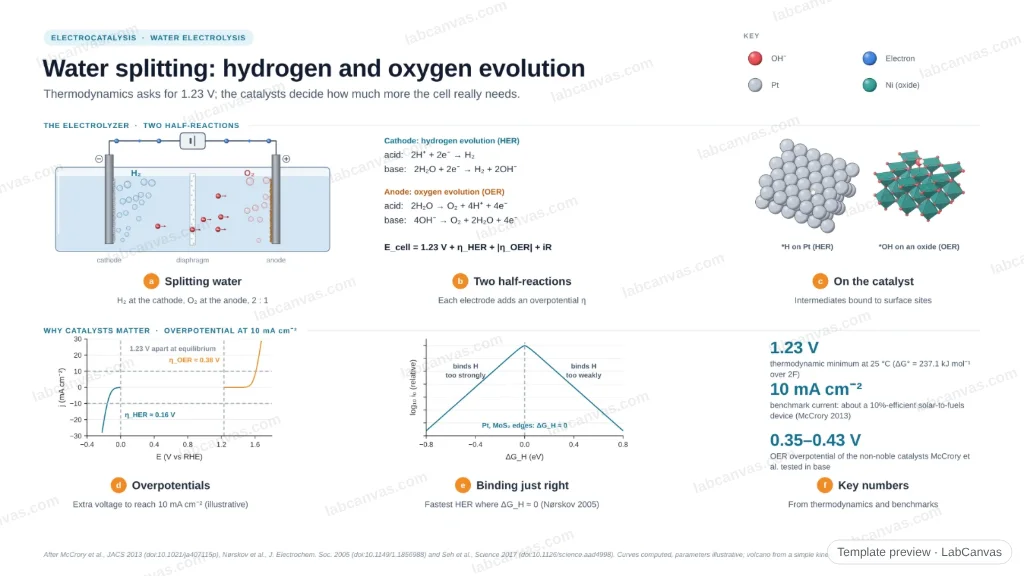
An electrolyzer splits water into hydrogen at the cathode and oxygen at the anode. Thermodynamics asks for 1.23 V, but each electrode adds an overpotential, and that is what catalysts cut. The common figure of merit is the overpotential at 10 mA cm⁻²; hydrogen evolution is fastest on catalysts that bind hydrogen neither too strongly nor too weakly.
Updated 5 cited papers75 editable layers
At a glance
- Category
- Electrocatalysis
- Method
- Water electrolysis
- Starting materials
- Water, an electrolyte (KOH, or a proton-exchange membrane), a cathode catalyst for H₂ and an anode catalyst for O₂
- Product
- H₂ at the cathode and O₂ at the anode, in a 2 : 1 ratio
- Key result
- In alkaline solution, the non-noble OER catalysts benchmarked by McCrory et al. (2013) reached 10 mA cm⁻² at 0.35–0.43 V overpotential. Curves computed from Butler–Volmer kinetics with illustrative parameters
- Figure
- 1920 × 1080 px (16:9), 75 editable layers, 3 generated objects
Step by step
- Cathode (HER)2H⁺ + 2e⁻ → H₂ in acid; 2H₂O + 2e⁻ → H₂ + 2OH⁻ in base
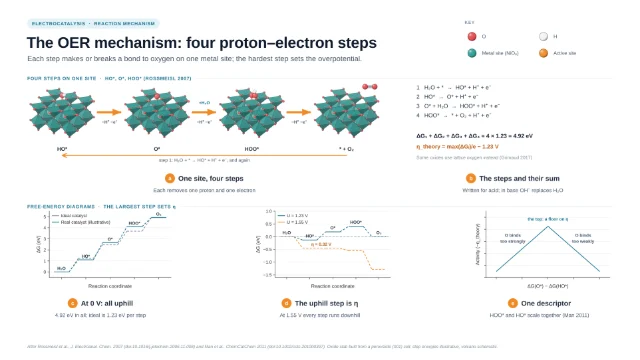
- Anode (OER)2H₂O → O₂ + 4H⁺ + 4e⁻ in acid; 4OH⁻ → O₂ + 2H₂O + 4e⁻ in base
- VoltageE_cell = 1.23 V + η_HER + |η_OER| + iR; 1.23 V from ΔG° = 237.1 kJ mol⁻¹ at 25 °C
- Figure of meritThe overpotential at 10 mA cm⁻² per geometric area, about the current of a 10%-efficient solar-to-fuels device (McCrory et al. 2013)
- Design ruleHydrogen evolution is fastest where the hydrogen binding free energy is close to zero (Nørskov et al. 2005; Hinnemann et al. 2005)
Strengths
- Hydrogen and oxygen from water and electricity
- Runs on renewable power
Limitations
- The four-electron OER is slow: most of the extra voltage
- Most non-noble OER catalysts tested were unstable in acid (McCrory et al. 2013)
Uses
- Green hydrogen
- Energy storage
- Solar fuels
Papers this template follows
- Seh, Kibsgaard, Dickens, Chorkendorff, Nørskov & Jaramillo, “Combining theory and experiment in electrocatalysis: Insights into materials design”, Science 2017. doi:10.1126/science.aad4998review
- McCrory, Jung, Peters & Jaramillo, “Benchmarking Heterogeneous Electrocatalysts for the Oxygen Evolution Reaction”, J. Am. Chem. Soc. 2013. doi:10.1021/ja407115pprimary
- Nørskov, Bligaard, Logadottir, Kitchin, Chen, Pandelov & Stimming, “Trends in the Exchange Current for Hydrogen Evolution”, J. Electrochem. Soc. 2005. doi:10.1149/1.1856988primary
- Hinnemann, Moses, Bonde, Jørgensen, Nielsen, Horch, Chorkendorff & Nørskov, “Biomimetic Hydrogen Evolution: MoS2 Nanoparticles as Catalyst for Hydrogen Evolution”, J. Am. Chem. Soc. 2005. doi:10.1021/ja0504690primary
- Wei, Rao, Peng, Huang, Stephens, Risch, Xu & Shao-Horn, “Recommended Practices and Benchmark Activity for Hydrogen and Oxygen Electrocatalysis in Water Splitting and Fuel Cells”, Adv. Mater. 2019. doi:10.1002/adma.201806296further reading
After McCrory et al., JACS 2013 (doi:10.1021/ja407115p), Nørskov et al., J. Electrochem. Soc. 2005 (doi:10.1149/1.1856988) and Seh et al., Science 2017 (doi:10.1126/science.aad4998). Curves computed, parameters illustrative; volcano from a simple kinetic model.
How templates are written and checked: editorial guidelines.
Questions
What does the “Water splitting: hydrogen and oxygen evolution” template show?
An electrolyzer splits water into hydrogen at the cathode and oxygen at the anode. Thermodynamics asks for 1.23 V, but each electrode adds an overpotential, and that is what catalysts cut. The common figure of merit is the overpotential at 10 mA cm⁻²; hydrogen evolution is fastest on catalysts that bind hydrogen neither too strongly nor too weakly.
What are the steps shown in “Water splitting: hydrogen and oxygen evolution”?
1. Cathode (HER): 2H⁺ + 2e⁻ → H₂ in acid; 2H₂O + 2e⁻ → H₂ + 2OH⁻ in base. 2. Anode (OER): 2H₂O → O₂ + 4H⁺ + 4e⁻ in acid; 4OH⁻ → O₂ + 2H₂O + 4e⁻ in base. 3. Voltage: E_cell = 1.23 V + η_HER + |η_OER| + iR; 1.23 V from ΔG° = 237.1 kJ mol⁻¹ at 25 °C. 4. Figure of merit: The overpotential at 10 mA cm⁻² per geometric area, about the current of a 10%-efficient solar-to-fuels device (McCrory et al. 2013). 5. Design rule: Hydrogen evolution is fastest where the hydrogen binding free energy is close to zero (Nørskov et al. 2005; Hinnemann et al. 2005).
What are the starting materials and the product?
Starting materials: Water, an electrolyte (KOH, or a proton-exchange membrane), a cathode catalyst for H₂ and an anode catalyst for O₂. Product: H₂ at the cathode and O₂ at the anode, in a 2 : 1 ratio.
Which papers is “Water splitting: hydrogen and oxygen evolution” based on?
Seh, Kibsgaard, Dickens, Chorkendorff, Nørskov & Jaramillo, “Combining theory and experiment in electrocatalysis: Insights into materials design”, Science 2017 (doi:10.1126/science.aad4998); McCrory, Jung, Peters & Jaramillo, “Benchmarking Heterogeneous Electrocatalysts for the Oxygen Evolution Reaction”, J. Am. Chem. Soc. 2013 (doi:10.1021/ja407115p); Nørskov, Bligaard, Logadottir, Kitchin, Chen, Pandelov & Stimming, “Trends in the Exchange Current for Hydrogen Evolution”, J. Electrochem. Soc. 2005 (doi:10.1149/1.1856988); Hinnemann, Moses, Bonde, Jørgensen, Nielsen, Horch, Chorkendorff & Nørskov, “Biomimetic Hydrogen Evolution: MoS2 Nanoparticles as Catalyst for Hydrogen Evolution”, J. Am. Chem. Soc. 2005 (doi:10.1021/ja0504690); Wei, Rao, Peng, Huang, Stephens, Risch, Xu & Shao-Horn, “Recommended Practices and Benchmark Activity for Hydrogen and Oxygen Electrocatalysis in Water Splitting and Fuel Cells”, Adv. Mater. 2019 (doi:10.1002/adma.201806296).
Can I edit the “Water splitting: hydrogen and oxygen evolution” template?
Yes. Open it in the LabCanvas editor: all 75 layers are editable, including 3 generated objects (structures, plots, equipment) with their own settings. Change the text, colours and layout, then export PNG, TIFF, SVG or PDF.
Do I need an account to use this template?
Not to view it here. To open and edit it, sign in to LabCanvas or create a free account (the free plan keeps one design of each kind). Downloading the figure is part of LabCanvas Pro (US$19 a month or US$199 a year).