Graphical abstract template · Electrocatalysis · Fuel-cell cathode
Fuel cells: oxygen reduction on platinum alloys
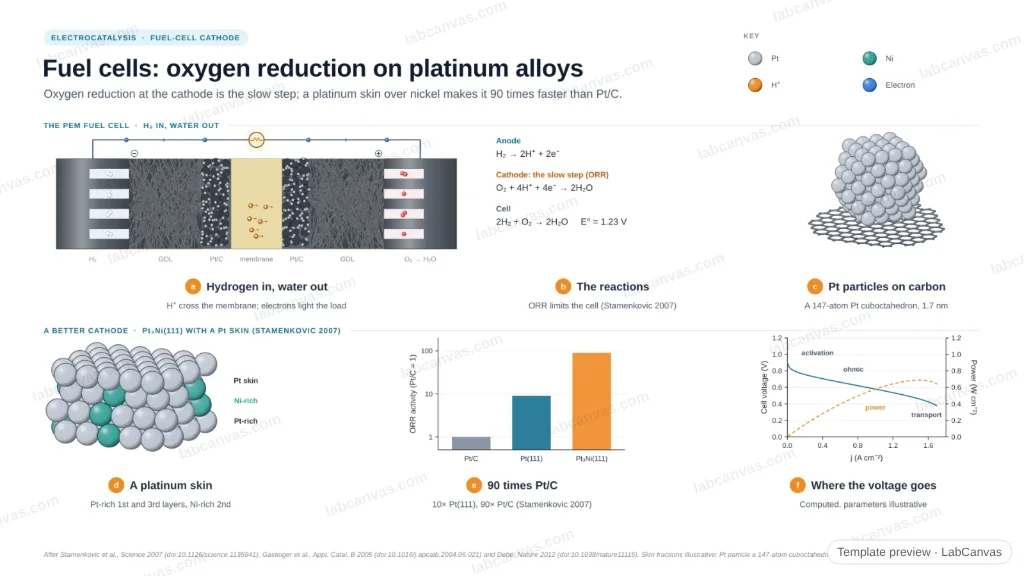
A PEM fuel cell turns hydrogen and oxygen into water and electricity; the slow step is oxygen reduction at the platinum cathode. Alloying helps: Pt₃Ni(111), with a pure platinum skin over a nickel-rich layer, reduced oxygen 10 times faster than Pt(111) and 90 times faster than the Pt/C catalysts in use.
Updated 4 cited papers67 editable layers
At a glance
- Category
- Electrocatalysis
- Method
- Fuel-cell cathode
- Starting materials
- H₂ at the anode, O₂ (air) at the cathode, Pt-based catalysts on carbon, a proton-exchange membrane
- Product
- Electricity and water
- Key result
- Activity ratios from the abstract of Stamenkovic et al. (2007); skin layer fractions illustrative; polarization curve computed with illustrative parameters
- Figure
- 1920 × 1080 px (16:9), 67 editable layers, 3 generated objects
Step by step
- AnodeH₂ → 2H⁺ + 2e⁻, fast on Pt
- CathodeO₂ + 4H⁺ + 4e⁻ → 2H₂O: the slow oxygen reduction reaction
- Pt skinOn Pt₃Ni(111) the outermost and third layers are Pt-rich and the second Ni-rich (Stamenkovic et al. 2007)
- ActivityPt₃Ni(111) was 10 times more ORR-active than Pt(111) and 90 times more than state-of-the-art Pt/C
Strengths
- Water is the only product
- High efficiency at low temperature
Limitations
- Platinum is scarce and costly
- Slow oxygen reduction costs most of the voltage
- Catalyst durability over a car’s life (Debe 2012)
Uses
- Fuel-cell vehicles
- Stationary and backup power
Papers this template follows
- Stamenkovic, Fowler, Mun, Wang, Ross, Lucas & Marković, “Improved Oxygen Reduction Activity on Pt3Ni(111) via Increased Surface Site Availability”, Science 2007. doi:10.1126/science.1135941primary
- Gasteiger, Kocha, Sompalli & Wagner, “Activity benchmarks and requirements for Pt, Pt-alloy, and non-Pt oxygen reduction catalysts for PEMFCs”, Appl. Catal. B 2005. doi:10.1016/j.apcatb.2004.06.021primary
- Debe, “Electrocatalyst approaches and challenges for automotive fuel cells”, Nature 2012. doi:10.1038/nature11115review
- Shao, Chang, Dodelet & Chenitz, “Recent Advances in Electrocatalysts for Oxygen Reduction Reaction”, Chem. Rev. 2016. doi:10.1021/acs.chemrev.5b00462review
After Stamenkovic et al., Science 2007 (doi:10.1126/science.1135941), Gasteiger et al., Appl. Catal. B 2005 (doi:10.1016/j.apcatb.2004.06.021) and Debe, Nature 2012 (doi:10.1038/nature11115). Skin fractions illustrative; Pt particle a 147-atom cuboctahedron; curve computed, parameters illustrative.
How templates are written and checked: editorial guidelines.
Questions
What does the “Fuel cells: oxygen reduction on platinum alloys” template show?
A PEM fuel cell turns hydrogen and oxygen into water and electricity; the slow step is oxygen reduction at the platinum cathode. Alloying helps: Pt₃Ni(111), with a pure platinum skin over a nickel-rich layer, reduced oxygen 10 times faster than Pt(111) and 90 times faster than the Pt/C catalysts in use.
What are the steps shown in “Fuel cells: oxygen reduction on platinum alloys”?
1. Anode: H₂ → 2H⁺ + 2e⁻, fast on Pt. 2. Cathode: O₂ + 4H⁺ + 4e⁻ → 2H₂O: the slow oxygen reduction reaction. 3. Pt skin: On Pt₃Ni(111) the outermost and third layers are Pt-rich and the second Ni-rich (Stamenkovic et al. 2007). 4. Activity: Pt₃Ni(111) was 10 times more ORR-active than Pt(111) and 90 times more than state-of-the-art Pt/C.
What are the starting materials and the product?
Starting materials: H₂ at the anode, O₂ (air) at the cathode, Pt-based catalysts on carbon, a proton-exchange membrane. Product: Electricity and water.
Which papers is “Fuel cells: oxygen reduction on platinum alloys” based on?
Stamenkovic, Fowler, Mun, Wang, Ross, Lucas & Marković, “Improved Oxygen Reduction Activity on Pt3Ni(111) via Increased Surface Site Availability”, Science 2007 (doi:10.1126/science.1135941); Gasteiger, Kocha, Sompalli & Wagner, “Activity benchmarks and requirements for Pt, Pt-alloy, and non-Pt oxygen reduction catalysts for PEMFCs”, Appl. Catal. B 2005 (doi:10.1016/j.apcatb.2004.06.021); Debe, “Electrocatalyst approaches and challenges for automotive fuel cells”, Nature 2012 (doi:10.1038/nature11115); Shao, Chang, Dodelet & Chenitz, “Recent Advances in Electrocatalysts for Oxygen Reduction Reaction”, Chem. Rev. 2016 (doi:10.1021/acs.chemrev.5b00462).
Can I edit the “Fuel cells: oxygen reduction on platinum alloys” template?
Yes. Open it in the LabCanvas editor: all 67 layers are editable, including 3 generated objects (structures, plots, equipment) with their own settings. Change the text, colours and layout, then export PNG, TIFF, SVG or PDF.
Do I need an account to use this template?
Not to view it here. To open and edit it, sign in to LabCanvas or create a free account (the free plan keeps one design of each kind). Downloading the figure is part of LabCanvas Pro (US$19 a month or US$199 a year).