Graphical abstract template · Electrocatalysis · Single-atom catalysis
Single-atom catalysts: one metal atom, four nitrogens
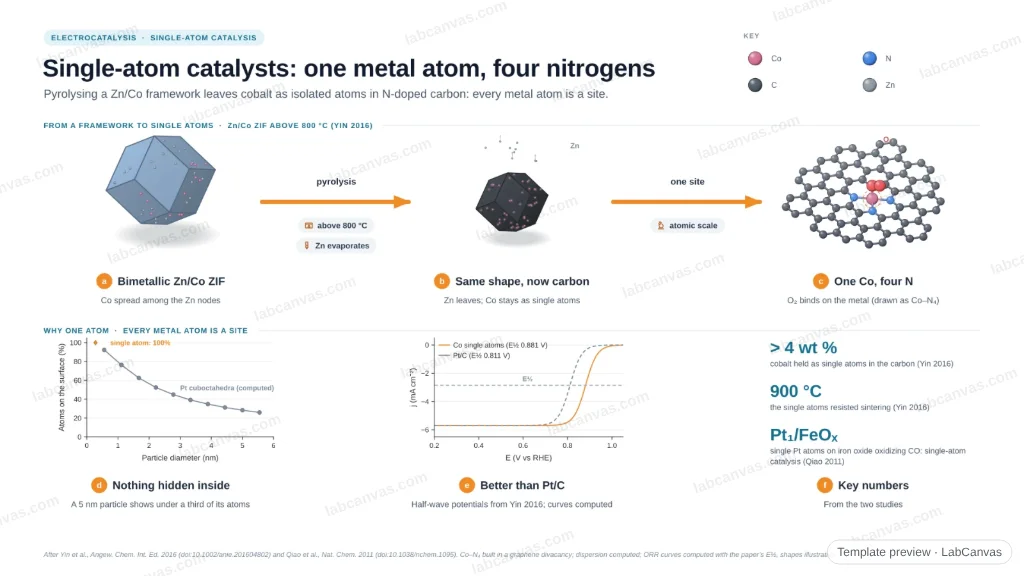
A single-atom catalyst spreads its metal as isolated atoms, each held by nitrogen in a carbon sheet, so every metal atom can be an active site. Pyrolysing a bimetallic Zn/Co framework does it: the linker turns into N-doped carbon, zinc evaporates above 800 °C, and cobalt stays behind as single atoms that reduce oxygen better than commercial platinum on carbon.
Updated 4 cited papers71 editable layers
At a glance
- Category
- Electrocatalysis
- Method
- Single-atom catalysis
- Starting materials
- A bimetallic Zn/Co zeolitic imidazolate framework (ZIF)
- Product
- Co single atoms on N-doped porous carbon, over 4 wt% Co (Yin et al. 2016)
- Key result
- Atomic dispersion confirmed by aberration-corrected electron microscopy and EXAFS (Yin et al. 2016). Share of surface atoms computed for cuboctahedral clusters; ORR curves computed with the paper’s half-wave potentials, shapes illustrative
- Figure
- 1920 × 1080 px (16:9), 71 editable layers, 6 generated objects
Step by step
- FrameworkCo mixed into a zinc imidazolate framework: the metals start apart, on the framework nodes
- PyrolysisCarbonizing the linker reduces Co; above 800 °C the Zn evaporates (Yin et al. 2016)
- Single atomsCo stays as isolated atoms held by N in porous carbon, seen by aberration-corrected microscopy and EXAFS
- ActivityORR half-wave potential 0.881 V, more positive than commercial Pt/C (0.811 V) in the same study
- StabilityThe single atoms resisted sintering at 900 °C (Yin et al. 2016)
Strengths
- Every metal atom can be a site
- Cheap metals (Co, Fe) instead of Pt
- Well-defined sites that theory can model
Limitations
- Metal loading is limited before atoms cluster
- Long-term stability in fuel cells is still debated
Uses
- Fuel-cell cathodes (ORR)
- CO₂ reduction
- Hydrogen evolution
Papers this template follows
- Yin, Yao, Wu, Zheng, Lin, Liu, Ju, Zhu, Hong, Deng, Zhou, Wei & Li, “Single Cobalt Atoms with Precise N-Coordination as Superior Oxygen Reduction Reaction Catalysts”, Angew. Chem. Int. Ed. 2016. doi:10.1002/anie.201604802primary
- Qiao, Wang, Yang, Allard, Jiang, Cui, Liu, Li & Zhang, “Single-atom catalysis of CO oxidation using Pt1/FeOx”, Nat. Chem. 2011. doi:10.1038/nchem.1095primary
- Chen, Ji, Wang, Dong, Chen, Li, Shen, Zheng, Zhuang, Wang & Li, “Isolated Single Iron Atoms Anchored on N-Doped Porous Carbon as an Efficient Electrocatalyst for the Oxygen Reduction Reaction”, Angew. Chem. Int. Ed. 2017. doi:10.1002/anie.201702473further reading
- Lefèvre, Proietti, Jaouen & Dodelet, “Iron-Based Catalysts with Improved Oxygen Reduction Activity in Polymer Electrolyte Fuel Cells”, Science 2009. doi:10.1126/science.1170051further reading
After Yin et al., Angew. Chem. Int. Ed. 2016 (doi:10.1002/anie.201604802) and Qiao et al., Nat. Chem. 2011 (doi:10.1038/nchem.1095). Co–N₄ built in a graphene divacancy; dispersion computed; ORR curves computed with the paper’s E½, shapes illustrative.
How templates are written and checked: editorial guidelines.
Questions
What does the “Single-atom catalysts: one metal atom, four nitrogens” template show?
A single-atom catalyst spreads its metal as isolated atoms, each held by nitrogen in a carbon sheet, so every metal atom can be an active site. Pyrolysing a bimetallic Zn/Co framework does it: the linker turns into N-doped carbon, zinc evaporates above 800 °C, and cobalt stays behind as single atoms that reduce oxygen better than commercial platinum on carbon.
What are the steps shown in “Single-atom catalysts: one metal atom, four nitrogens”?
1. Framework: Co mixed into a zinc imidazolate framework: the metals start apart, on the framework nodes. 2. Pyrolysis: Carbonizing the linker reduces Co; above 800 °C the Zn evaporates (Yin et al. 2016). 3. Single atoms: Co stays as isolated atoms held by N in porous carbon, seen by aberration-corrected microscopy and EXAFS. 4. Activity: ORR half-wave potential 0.881 V, more positive than commercial Pt/C (0.811 V) in the same study. 5. Stability: The single atoms resisted sintering at 900 °C (Yin et al. 2016).
What are the starting materials and the product?
Starting materials: A bimetallic Zn/Co zeolitic imidazolate framework (ZIF). Product: Co single atoms on N-doped porous carbon, over 4 wt% Co (Yin et al. 2016).
Which papers is “Single-atom catalysts: one metal atom, four nitrogens” based on?
Yin, Yao, Wu, Zheng, Lin, Liu, Ju, Zhu, Hong, Deng, Zhou, Wei & Li, “Single Cobalt Atoms with Precise N-Coordination as Superior Oxygen Reduction Reaction Catalysts”, Angew. Chem. Int. Ed. 2016 (doi:10.1002/anie.201604802); Qiao, Wang, Yang, Allard, Jiang, Cui, Liu, Li & Zhang, “Single-atom catalysis of CO oxidation using Pt1/FeOx”, Nat. Chem. 2011 (doi:10.1038/nchem.1095); Chen, Ji, Wang, Dong, Chen, Li, Shen, Zheng, Zhuang, Wang & Li, “Isolated Single Iron Atoms Anchored on N-Doped Porous Carbon as an Efficient Electrocatalyst for the Oxygen Reduction Reaction”, Angew. Chem. Int. Ed. 2017 (doi:10.1002/anie.201702473); Lefèvre, Proietti, Jaouen & Dodelet, “Iron-Based Catalysts with Improved Oxygen Reduction Activity in Polymer Electrolyte Fuel Cells”, Science 2009 (doi:10.1126/science.1170051).
Can I edit the “Single-atom catalysts: one metal atom, four nitrogens” template?
Yes. Open it in the LabCanvas editor: all 71 layers are editable, including 6 generated objects (structures, plots, equipment) with their own settings. Change the text, colours and layout, then export PNG, TIFF, SVG or PDF.
Do I need an account to use this template?
Not to view it here. To open and edit it, sign in to LabCanvas or create a free account (the free plan keeps one design of each kind). Downloading the figure is part of LabCanvas Pro (US$19 a month or US$199 a year).