Graphical abstract template · Electrocatalysis · Reaction mechanism
The OER mechanism: four proton–electron steps
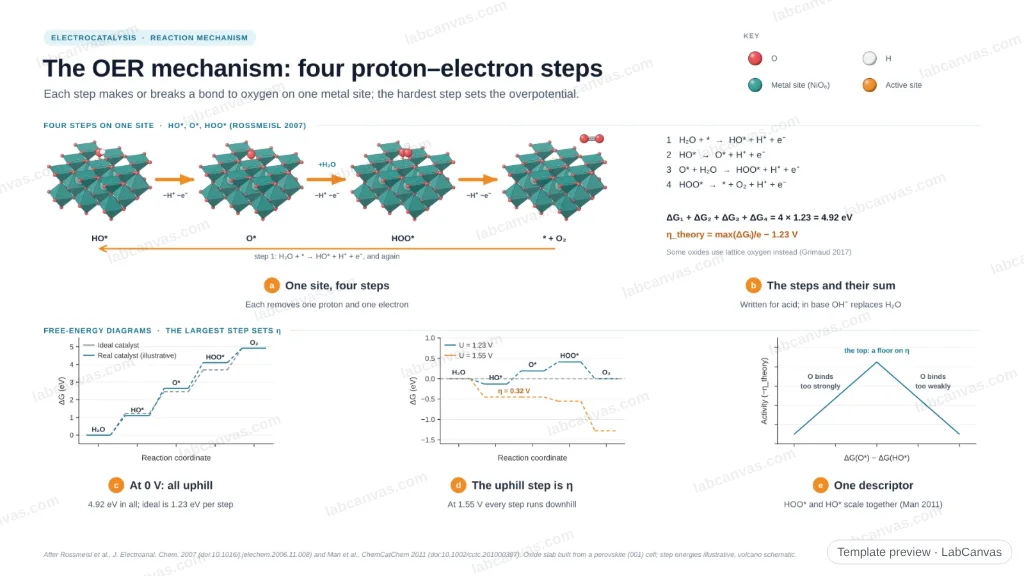
Oxygen evolution on an oxide takes four proton–electron steps on one metal site, through HO*, O* and HOO*. Together they need 4.92 eV, 1.23 eV per electron; on a real catalyst the steps are uneven and the largest one sets the overpotential. Because HOO* and HO* bind together, oxides fall on one volcano, with a floor under their overpotential.
Updated 5 cited papers82 editable layers
At a glance
- Category
- Electrocatalysis
- Method
- Reaction mechanism
- Starting materials
- A metal site on an oxide surface, water (or OH⁻), an applied potential
- Product
- O₂ and four protons and electrons (in acid), one per step
- Key result
- Step energies illustrative (they add up to 4.92 eV); volcano schematic. Oxide surface from a perovskite (001) cell, a = 3.9 Å
- Figure
- 1920 × 1080 px (16:9), 82 editable layers, 5 generated objects
Step by step
- Step 1H₂O + * → HO* + H⁺ + e⁻
- Step 2HO* → O* + H⁺ + e⁻
- Step 3O* + H₂O → HOO* + H⁺ + e⁻
- Step 4HOO* → * + O₂ + H⁺ + e⁻ (Rossmeisl et al. 2007)
- OverpotentialThe four ΔG add up to 4.92 eV; the largest sets η = max ΔGᵢ/e − 1.23 V
- ScalingHOO* and HO* binding energies scale together on oxides: one volcano, one descriptor, a limit for planar oxides (Man et al. 2011)
Strengths
- A simple model that explains activity trends across oxides
- Points to one descriptor for design
Limitations
- Thermodynamics only: no barriers, no solvent
- Some oxides evolve oxygen from their lattice instead (Grimaud et al. 2017)
Uses
- Screening OER catalysts
- Water electrolyzers
- Metal–air batteries
Papers this template follows
- Rossmeisl, Qu, Zhu, Kroes & Nørskov, “Electrolysis of water on oxide surfaces”, J. Electroanal. Chem. 2007. doi:10.1016/j.jelechem.2006.11.008primary
- Man, Su, Calle-Vallejo, Hansen, Martínez, Inoglu, Kitchin, Jaramillo, Nørskov & Rossmeisl, “Universality in Oxygen Evolution Electrocatalysis on Oxide Surfaces”, ChemCatChem 2011. doi:10.1002/cctc.201000397primary
- Suntivich, May, Gasteiger, Goodenough & Shao-Horn, “A Perovskite Oxide Optimized for Oxygen Evolution Catalysis from Molecular Orbital Principles”, Science 2011. doi:10.1126/science.1212858further reading
- Grimaud, Diaz-Morales, Han, Hong, Lee, Giordano, Stoerzinger, Koper & Shao-Horn, “Activating lattice oxygen redox reactions in metal oxides to catalyse oxygen evolution”, Nat. Chem. 2017. doi:10.1038/nchem.2695further reading
- Seh, Kibsgaard, Dickens, Chorkendorff, Nørskov & Jaramillo, “Combining theory and experiment in electrocatalysis: Insights into materials design”, Science 2017. doi:10.1126/science.aad4998review
After Rossmeisl et al., J. Electroanal. Chem. 2007 (doi:10.1016/j.jelechem.2006.11.008) and Man et al., ChemCatChem 2011 (doi:10.1002/cctc.201000397). Oxide slab built from a perovskite (001) cell; step energies illustrative, volcano schematic.
How templates are written and checked: editorial guidelines.
Questions
What does the “The OER mechanism: four proton–electron steps” template show?
Oxygen evolution on an oxide takes four proton–electron steps on one metal site, through HO*, O* and HOO*. Together they need 4.92 eV, 1.23 eV per electron; on a real catalyst the steps are uneven and the largest one sets the overpotential. Because HOO* and HO* bind together, oxides fall on one volcano, with a floor under their overpotential.
What are the steps shown in “The OER mechanism: four proton–electron steps”?
1. Step 1: H₂O + * → HO* + H⁺ + e⁻. 2. Step 2: HO* → O* + H⁺ + e⁻. 3. Step 3: O* + H₂O → HOO* + H⁺ + e⁻. 4. Step 4: HOO* → * + O₂ + H⁺ + e⁻ (Rossmeisl et al. 2007). 5. Overpotential: The four ΔG add up to 4.92 eV; the largest sets η = max ΔGᵢ/e − 1.23 V. 6. Scaling: HOO* and HO* binding energies scale together on oxides: one volcano, one descriptor, a limit for planar oxides (Man et al. 2011).
What are the starting materials and the product?
Starting materials: A metal site on an oxide surface, water (or OH⁻), an applied potential. Product: O₂ and four protons and electrons (in acid), one per step.
Which papers is “The OER mechanism: four proton–electron steps” based on?
Rossmeisl, Qu, Zhu, Kroes & Nørskov, “Electrolysis of water on oxide surfaces”, J. Electroanal. Chem. 2007 (doi:10.1016/j.jelechem.2006.11.008); Man, Su, Calle-Vallejo, Hansen, Martínez, Inoglu, Kitchin, Jaramillo, Nørskov & Rossmeisl, “Universality in Oxygen Evolution Electrocatalysis on Oxide Surfaces”, ChemCatChem 2011 (doi:10.1002/cctc.201000397); Suntivich, May, Gasteiger, Goodenough & Shao-Horn, “A Perovskite Oxide Optimized for Oxygen Evolution Catalysis from Molecular Orbital Principles”, Science 2011 (doi:10.1126/science.1212858); Grimaud, Diaz-Morales, Han, Hong, Lee, Giordano, Stoerzinger, Koper & Shao-Horn, “Activating lattice oxygen redox reactions in metal oxides to catalyse oxygen evolution”, Nat. Chem. 2017 (doi:10.1038/nchem.2695); Seh, Kibsgaard, Dickens, Chorkendorff, Nørskov & Jaramillo, “Combining theory and experiment in electrocatalysis: Insights into materials design”, Science 2017 (doi:10.1126/science.aad4998).
Can I edit the “The OER mechanism: four proton–electron steps” template?
Yes. Open it in the LabCanvas editor: all 82 layers are editable, including 5 generated objects (structures, plots, equipment) with their own settings. Change the text, colours and layout, then export PNG, TIFF, SVG or PDF.
Do I need an account to use this template?
Not to view it here. To open and edit it, sign in to LabCanvas or create a free account (the free plan keeps one design of each kind). Downloading the figure is part of LabCanvas Pro (US$19 a month or US$199 a year).