Graphical abstract template · Electrocatalysis · CO₂ reduction
CO₂ reduction on copper: many products
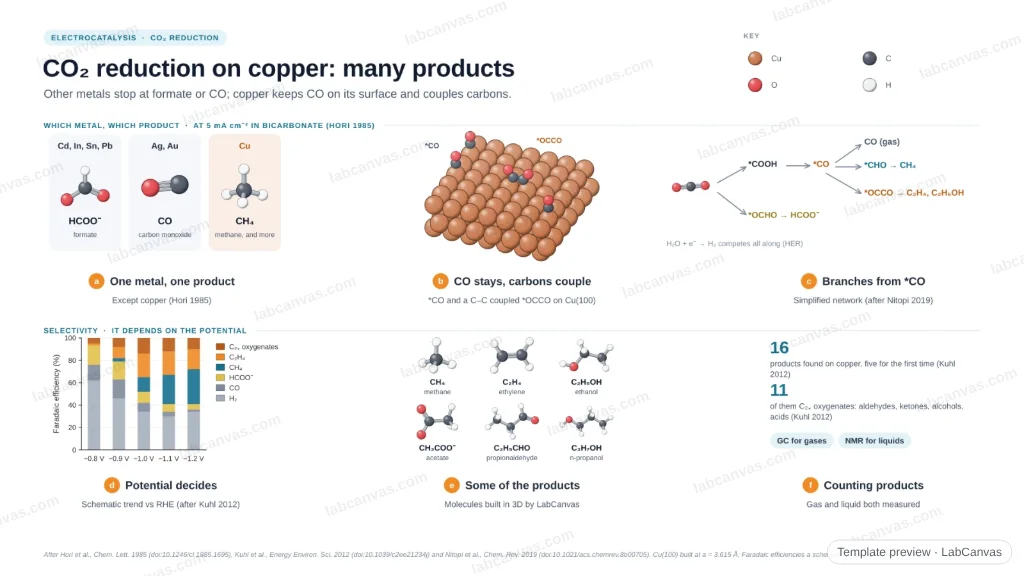
Most metals reduce CO₂ to one simple product: formate on tin, indium or lead, CO on silver or gold. Copper is the exception: it holds on to CO and couples carbons, making methane, ethylene, ethanol and a dozen more products, with hydrogen competing all the way. Which ones you get depends strongly on the potential.
Updated 3 cited papers101 editable layers
At a glance
- Category
- Electrocatalysis
- Method
- CO₂ reduction
- Starting materials
- CO₂ in aqueous bicarbonate (KHCO₃), a copper cathode
- Product
- H₂, CO, formate, methane, ethylene, ethanol and other C₂₊ products, depending on the potential
- Key result
- Product counts from Kuhl et al. (2012); Faradaic efficiencies drawn as a schematic trend against potential, not measured values; pathways simplified
- Figure
- 1920 × 1080 px (16:9), 101 editable layers, 11 generated objects
Step by step
- Metals sort by productFormate on Cd, In, Sn and Pb; CO on Ag and Au; methane on Cu, at 5 mA cm⁻² (Hori et al. 1985)
- Copper is differentThe only heterogeneous catalyst that makes hydrocarbons and alcohols such as ethylene and ethanol (Nitopi et al. 2019)
- Through *COAdsorbed CO is hydrogenated toward methane or coupled into C₂ (simplified)
- Sixteen productsGC and NMR found 16 products on copper, five for the first time, eleven of them C₂₊ oxygenates (Kuhl et al. 2012)
Strengths
- Turns CO₂ and water into fuels and feedstocks
- Copper is cheap
Limitations
- Many products at once: poor selectivity
- Hydrogen evolution competes
- Mass transport of dissolved CO₂ limits the current
Uses
- Ethylene and ethanol from CO₂
- Storing renewable electricity in chemicals
Papers this template follows
- Hori, Kikuchi & Suzuki, “Production of CO and CH4 in electrochemical reduction of CO2 at metal electrodes in aqueous hydrogencarbonate solution”, Chem. Lett. 1985. doi:10.1246/cl.1985.1695primary
- Kuhl, Cave, Abram & Jaramillo, “New insights into the electrochemical reduction of carbon dioxide on metallic copper surfaces”, Energy Environ. Sci. 2012. doi:10.1039/c2ee21234jprimary
- Nitopi, Bertheussen, Scott, Liu, Engstfeld, Horch, Seger, Stephens, Chan, Hahn, Nørskov, Jaramillo & Chorkendorff, “Progress and Perspectives of Electrochemical CO2 Reduction on Copper in Aqueous Electrolyte”, Chem. Rev. 2019. doi:10.1021/acs.chemrev.8b00705review
After Hori et al., Chem. Lett. 1985 (doi:10.1246/cl.1985.1695), Kuhl et al., Energy Environ. Sci. 2012 (doi:10.1039/c2ee21234j) and Nitopi et al., Chem. Rev. 2019 (doi:10.1021/acs.chemrev.8b00705). Cu(100) built at a = 3.615 Å; Faradaic efficiencies a schematic trend; pathways simplified.
How templates are written and checked: editorial guidelines.
Questions
What does the “CO₂ reduction on copper: many products” template show?
Most metals reduce CO₂ to one simple product: formate on tin, indium or lead, CO on silver or gold. Copper is the exception: it holds on to CO and couples carbons, making methane, ethylene, ethanol and a dozen more products, with hydrogen competing all the way. Which ones you get depends strongly on the potential.
What are the steps shown in “CO₂ reduction on copper: many products”?
1. Metals sort by product: Formate on Cd, In, Sn and Pb; CO on Ag and Au; methane on Cu, at 5 mA cm⁻² (Hori et al. 1985). 2. Copper is different: The only heterogeneous catalyst that makes hydrocarbons and alcohols such as ethylene and ethanol (Nitopi et al. 2019). 3. Through *CO: Adsorbed CO is hydrogenated toward methane or coupled into C₂ (simplified). 4. Sixteen products: GC and NMR found 16 products on copper, five for the first time, eleven of them C₂₊ oxygenates (Kuhl et al. 2012).
What are the starting materials and the product?
Starting materials: CO₂ in aqueous bicarbonate (KHCO₃), a copper cathode. Product: H₂, CO, formate, methane, ethylene, ethanol and other C₂₊ products, depending on the potential.
Which papers is “CO₂ reduction on copper: many products” based on?
Hori, Kikuchi & Suzuki, “Production of CO and CH4 in electrochemical reduction of CO2 at metal electrodes in aqueous hydrogencarbonate solution”, Chem. Lett. 1985 (doi:10.1246/cl.1985.1695); Kuhl, Cave, Abram & Jaramillo, “New insights into the electrochemical reduction of carbon dioxide on metallic copper surfaces”, Energy Environ. Sci. 2012 (doi:10.1039/c2ee21234j); Nitopi, Bertheussen, Scott, Liu, Engstfeld, Horch, Seger, Stephens, Chan, Hahn, Nørskov, Jaramillo & Chorkendorff, “Progress and Perspectives of Electrochemical CO2 Reduction on Copper in Aqueous Electrolyte”, Chem. Rev. 2019 (doi:10.1021/acs.chemrev.8b00705).
Can I edit the “CO₂ reduction on copper: many products” template?
Yes. Open it in the LabCanvas editor: all 101 layers are editable, including 11 generated objects (structures, plots, equipment) with their own settings. Change the text, colours and layout, then export PNG, TIFF, SVG or PDF.
Do I need an account to use this template?
Not to view it here. To open and edit it, sign in to LabCanvas or create a free account (the free plan keeps one design of each kind). Downloading the figure is part of LabCanvas Pro (US$19 a month or US$199 a year).