Graphical abstract template · Electrocatalysis · Benchmarking
Benchmarking an electrocatalyst
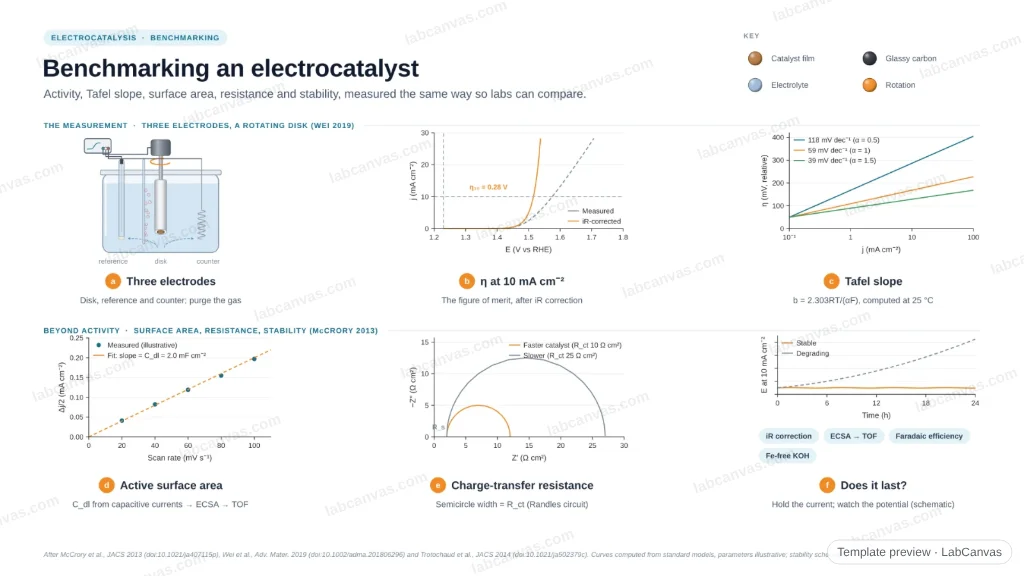
To compare catalysts across labs, measure them the same way: in a three-electrode cell with a rotating disk, correct for the ohmic drop, report the overpotential at 10 mA cm⁻², the Tafel slope, the active surface area from the double-layer capacitance, the charge-transfer resistance, and how the potential holds over time.
Updated 3 cited papers61 editable layers
At a glance
- Category
- Electrocatalysis
- Method
- Benchmarking
- Starting materials
- A catalyst ink drop-cast on a glassy-carbon disk, a reference and a counter electrode, a purged electrolyte, a potentiostat
- Product
- Comparable numbers: η at 10 mA cm⁻², Tafel slope, ECSA and TOF, charge-transfer resistance, stability
- Key result
- Curves computed from the standard models with illustrative parameters; Tafel slopes computed at 25 °C; stability traces schematic
- Figure
- 1920 × 1080 px (16:9), 61 editable layers, 1 generated objects
Step by step
- CellThree electrodes; the choice of reference and counter electrode matters (Wei et al. 2019)
- ActivityThe overpotential at 10 mA cm⁻² per geometric area, after ohmic (iR) correction (McCrory et al. 2013; Wei et al. 2019)
- Tafel slopeb = 2.303RT/(αF): 118, 59 and 39 mV dec⁻¹ for α = 0.5, 1 and 1.5 at 25 °C
- Surface areaDouble-layer capacitance from capacitive currents against scan rate gives the ECSA, and with it turnover frequencies
- ImpedanceA semicircle whose width is the charge-transfer resistance, after the series resistance
- Stability and purityHold a current and watch the potential; check Faradaic efficiency; keep KOH free of Fe for Ni catalysts (Trotochaud et al. 2014)
Strengths
- Numbers that compare across labs
- Separates intrinsic activity from surface area
Limitations
- Geometric-area activity favours rough, high-loading films
- Capacitance-based ECSA is approximate
Uses
- HER, OER, ORR and HOR catalysts
- Reporting in papers
Papers this template follows
- McCrory, Jung, Peters & Jaramillo, “Benchmarking Heterogeneous Electrocatalysts for the Oxygen Evolution Reaction”, J. Am. Chem. Soc. 2013. doi:10.1021/ja407115pprimary
- Wei, Rao, Peng, Huang, Stephens, Risch, Xu & Shao-Horn, “Recommended Practices and Benchmark Activity for Hydrogen and Oxygen Electrocatalysis in Water Splitting and Fuel Cells”, Adv. Mater. 2019. doi:10.1002/adma.201806296review
- Trotochaud, Young, Ranney & Boettcher, “Nickel–Iron Oxyhydroxide Oxygen-Evolution Electrocatalysts: The Role of Intentional and Incidental Iron Incorporation”, J. Am. Chem. Soc. 2014. doi:10.1021/ja502379cfurther reading
After McCrory et al., JACS 2013 (doi:10.1021/ja407115p), Wei et al., Adv. Mater. 2019 (doi:10.1002/adma.201806296) and Trotochaud et al., JACS 2014 (doi:10.1021/ja502379c). Curves computed from standard models, parameters illustrative; stability schematic.
How templates are written and checked: editorial guidelines.
Questions
What does the “Benchmarking an electrocatalyst” template show?
To compare catalysts across labs, measure them the same way: in a three-electrode cell with a rotating disk, correct for the ohmic drop, report the overpotential at 10 mA cm⁻², the Tafel slope, the active surface area from the double-layer capacitance, the charge-transfer resistance, and how the potential holds over time.
What are the steps shown in “Benchmarking an electrocatalyst”?
1. Cell: Three electrodes; the choice of reference and counter electrode matters (Wei et al. 2019). 2. Activity: The overpotential at 10 mA cm⁻² per geometric area, after ohmic (iR) correction (McCrory et al. 2013; Wei et al. 2019). 3. Tafel slope: b = 2.303RT/(αF): 118, 59 and 39 mV dec⁻¹ for α = 0.5, 1 and 1.5 at 25 °C. 4. Surface area: Double-layer capacitance from capacitive currents against scan rate gives the ECSA, and with it turnover frequencies. 5. Impedance: A semicircle whose width is the charge-transfer resistance, after the series resistance. 6. Stability and purity: Hold a current and watch the potential; check Faradaic efficiency; keep KOH free of Fe for Ni catalysts (Trotochaud et al. 2014).
What are the starting materials and the product?
Starting materials: A catalyst ink drop-cast on a glassy-carbon disk, a reference and a counter electrode, a purged electrolyte, a potentiostat. Product: Comparable numbers: η at 10 mA cm⁻², Tafel slope, ECSA and TOF, charge-transfer resistance, stability.
Which papers is “Benchmarking an electrocatalyst” based on?
McCrory, Jung, Peters & Jaramillo, “Benchmarking Heterogeneous Electrocatalysts for the Oxygen Evolution Reaction”, J. Am. Chem. Soc. 2013 (doi:10.1021/ja407115p); Wei, Rao, Peng, Huang, Stephens, Risch, Xu & Shao-Horn, “Recommended Practices and Benchmark Activity for Hydrogen and Oxygen Electrocatalysis in Water Splitting and Fuel Cells”, Adv. Mater. 2019 (doi:10.1002/adma.201806296); Trotochaud, Young, Ranney & Boettcher, “Nickel–Iron Oxyhydroxide Oxygen-Evolution Electrocatalysts: The Role of Intentional and Incidental Iron Incorporation”, J. Am. Chem. Soc. 2014 (doi:10.1021/ja502379c).
Can I edit the “Benchmarking an electrocatalyst” template?
Yes. Open it in the LabCanvas editor: all 61 layers are editable, including 1 generated objects (structures, plots, equipment) with their own settings. Change the text, colours and layout, then export PNG, TIFF, SVG or PDF.
Do I need an account to use this template?
Not to view it here. To open and edit it, sign in to LabCanvas or create a free account (the free plan keeps one design of each kind). Downloading the figure is part of LabCanvas Pro (US$19 a month or US$199 a year).