Graphical abstract template · Electrocatalysis · MOF-derived catalyst
MOF-derived catalysts: from framework to carbon
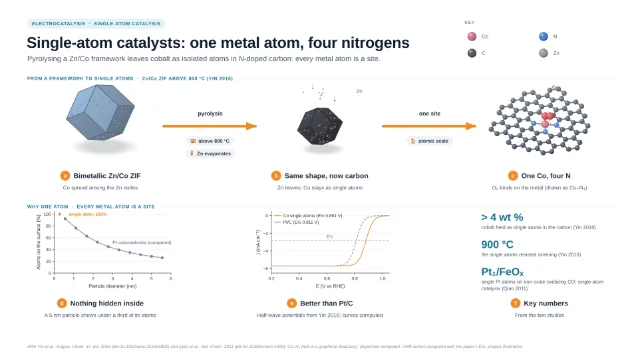
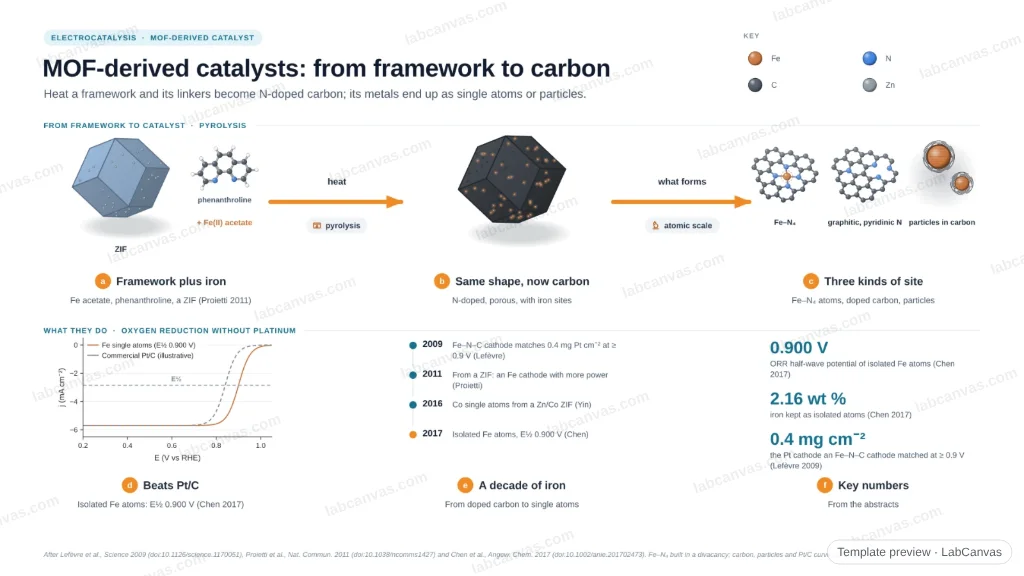
Heat a metal–organic framework and its linkers become nitrogen-doped carbon that often keeps the crystal’s shape, while its metals end up as single atoms held by nitrogen or as small particles. Iron catalysts made this way reduce oxygen without platinum: one matched a platinum cathode at 0.9 V, and isolated iron atoms beat commercial Pt/C.
Updated 5 cited papers87 editable layers
At a glance
- Category
- Electrocatalysis
- Method
- MOF-derived catalyst
- Starting materials
- A zeolitic imidazolate framework (ZIF) with an iron source (iron acetate, 1,10-phenanthroline)
- Product
- N-doped porous carbon carrying Fe–Nₓ sites (single atoms) and sometimes metal particles in graphitic shells
- Key result
- Activities and loadings from the abstracts; Fe–N₄ built in a graphene divacancy; particles and carbon schematic; Pt/C curve illustrative
- Figure
- 1920 × 1080 px (16:9), 87 editable layers, 8 generated objects
Step by step
- PrecursorIron acetate, phenanthroline and a ZIF (Proietti et al. 2011)
- PyrolysisThe linkers carbonize into N-doped porous carbon that often keeps the crystal’s shape
- SitesFe cations held by pyridinic N in the micropores (Lefèvre et al. 2009); isolated Fe atoms, 2.16 wt% (Chen et al. 2017)
- ActivityA cathode matching 0.4 mg cm⁻² of Pt at ≥ 0.9 V (Lefèvre et al. 2009); ORR half-wave potential 0.900 V, above commercial Pt/C (Chen et al. 2017)
Strengths
- No platinum
- Porous, conductive, N-doped carbon in one step
- The MOF sets the shape and spreads the metal
Limitations
- Several kinds of sites form at once
- Durability in acidic fuel cells
Uses
- Fuel-cell cathodes (ORR)
- Zinc–air batteries
- CO₂ reduction
Papers this template follows
- Lefèvre, Proietti, Jaouen & Dodelet, “Iron-Based Catalysts with Improved Oxygen Reduction Activity in Polymer Electrolyte Fuel Cells”, Science 2009. doi:10.1126/science.1170051primary
- Proietti, Jaouen, Lefèvre, Larouche, Tian, Herranz & Dodelet, “Iron-based cathode catalyst with enhanced power density in polymer electrolyte membrane fuel cells”, Nat. Commun. 2011. doi:10.1038/ncomms1427primary
- Chen, Ji, Wang, Dong, Chen, Li, Shen, Zheng, Zhuang, Wang & Li, “Isolated Single Iron Atoms Anchored on N-Doped Porous Carbon as an Efficient Electrocatalyst for the Oxygen Reduction Reaction”, Angew. Chem. Int. Ed. 2017. doi:10.1002/anie.201702473primary
- Yin et al., “Single Cobalt Atoms with Precise N-Coordination as Superior Oxygen Reduction Reaction Catalysts”, Angew. Chem. Int. Ed. 2016. doi:10.1002/anie.201604802further reading
- Shao, Chang, Dodelet & Chenitz, “Recent Advances in Electrocatalysts for Oxygen Reduction Reaction”, Chem. Rev. 2016. doi:10.1021/acs.chemrev.5b00462review
After Lefèvre et al., Science 2009 (doi:10.1126/science.1170051), Proietti et al., Nat. Commun. 2011 (doi:10.1038/ncomms1427) and Chen et al., Angew. Chem. 2017 (doi:10.1002/anie.201702473). Fe–N₄ built in a divacancy; carbon, particles and Pt/C curve schematic.
How templates are written and checked: editorial guidelines.
Questions
What does the “MOF-derived catalysts: from framework to carbon” template show?
Heat a metal–organic framework and its linkers become nitrogen-doped carbon that often keeps the crystal’s shape, while its metals end up as single atoms held by nitrogen or as small particles. Iron catalysts made this way reduce oxygen without platinum: one matched a platinum cathode at 0.9 V, and isolated iron atoms beat commercial Pt/C.
What are the steps shown in “MOF-derived catalysts: from framework to carbon”?
1. Precursor: Iron acetate, phenanthroline and a ZIF (Proietti et al. 2011). 2. Pyrolysis: The linkers carbonize into N-doped porous carbon that often keeps the crystal’s shape. 3. Sites: Fe cations held by pyridinic N in the micropores (Lefèvre et al. 2009); isolated Fe atoms, 2.16 wt% (Chen et al. 2017). 4. Activity: A cathode matching 0.4 mg cm⁻² of Pt at ≥ 0.9 V (Lefèvre et al. 2009); ORR half-wave potential 0.900 V, above commercial Pt/C (Chen et al. 2017).
What are the starting materials and the product?
Starting materials: A zeolitic imidazolate framework (ZIF) with an iron source (iron acetate, 1,10-phenanthroline). Product: N-doped porous carbon carrying Fe–Nₓ sites (single atoms) and sometimes metal particles in graphitic shells.
Which papers is “MOF-derived catalysts: from framework to carbon” based on?
Lefèvre, Proietti, Jaouen & Dodelet, “Iron-Based Catalysts with Improved Oxygen Reduction Activity in Polymer Electrolyte Fuel Cells”, Science 2009 (doi:10.1126/science.1170051); Proietti, Jaouen, Lefèvre, Larouche, Tian, Herranz & Dodelet, “Iron-based cathode catalyst with enhanced power density in polymer electrolyte membrane fuel cells”, Nat. Commun. 2011 (doi:10.1038/ncomms1427); Chen, Ji, Wang, Dong, Chen, Li, Shen, Zheng, Zhuang, Wang & Li, “Isolated Single Iron Atoms Anchored on N-Doped Porous Carbon as an Efficient Electrocatalyst for the Oxygen Reduction Reaction”, Angew. Chem. Int. Ed. 2017 (doi:10.1002/anie.201702473); Yin et al., “Single Cobalt Atoms with Precise N-Coordination as Superior Oxygen Reduction Reaction Catalysts”, Angew. Chem. Int. Ed. 2016 (doi:10.1002/anie.201604802); Shao, Chang, Dodelet & Chenitz, “Recent Advances in Electrocatalysts for Oxygen Reduction Reaction”, Chem. Rev. 2016 (doi:10.1021/acs.chemrev.5b00462).
Can I edit the “MOF-derived catalysts: from framework to carbon” template?
Yes. Open it in the LabCanvas editor: all 87 layers are editable, including 8 generated objects (structures, plots, equipment) with their own settings. Change the text, colours and layout, then export PNG, TIFF, SVG or PDF.
Do I need an account to use this template?
Not to view it here. To open and edit it, sign in to LabCanvas or create a free account (the free plan keeps one design of each kind). Downloading the figure is part of LabCanvas Pro (US$19 a month or US$199 a year).