Graphical abstract template · Electrocatalysis · OER catalyst
NiFe layered double hydroxides for oxygen evolution
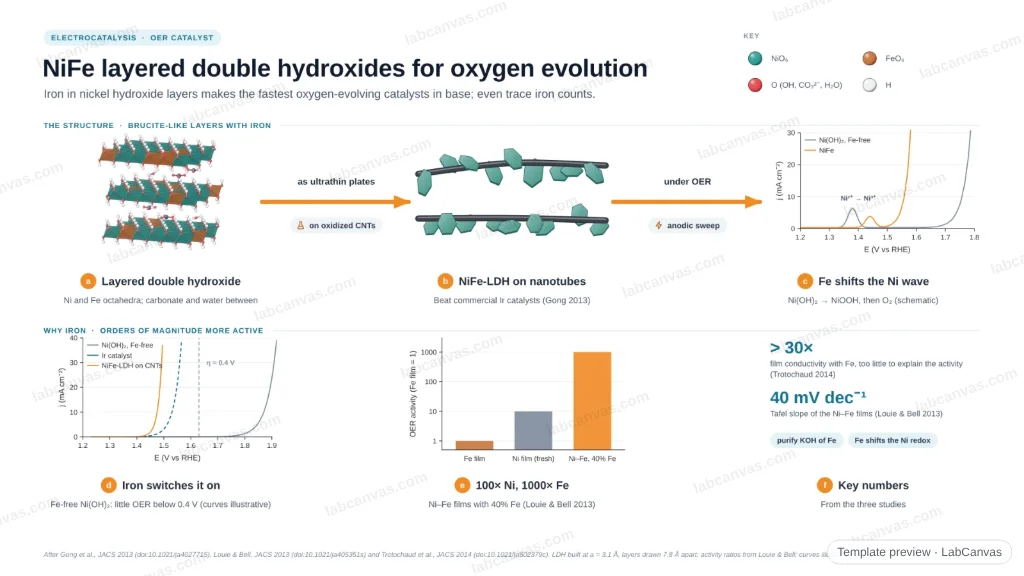
Nickel–iron layered double hydroxides are the benchmark oxygen-evolution catalysts in alkaline water. Iron in the nickel hydroxide layers boosts activity by orders of magnitude, far more than its effect on conductivity explains; grown as ultrathin plates on carbon nanotubes, NiFe-LDH outperformed iridium. Even trace iron in the KOH electrolyte matters.
Updated 4 cited papers67 editable layers
At a glance
- Category
- Electrocatalysis
- Method
- OER catalyst
- Starting materials
- Ni and Fe salts; for the hybrid, mildly oxidized multiwalled carbon nanotubes
- Product
- NiFe-LDH: brucite-like (Ni,Fe)(OH)₂ layers with anions and water between them; ultrathin nanoplates on CNTs
- Key result
- Activity ratios, Tafel slope and conductivity from the abstracts; LDH drawn from brucite-like layers (a = 3.1 Å) 7.8 Å apart; curves illustrative
- Figure
- 1920 × 1080 px (16:9), 67 editable layers, 4 generated objects
Step by step
- StructureEdge-sharing (Ni,Fe)(OH)₆ octahedra in layers; Fe³⁺ leaves a positive charge that carbonate between the layers balances
- HybridIncorporating Fe into nickel hydroxide gave NiFe-LDH nanoplates on CNTs, more active and stable than commercial Ir catalysts (Gong et al. 2013)
- Iron40% Fe films: about 100× a fresh Ni film and 1000× an Fe film; Tafel slope 40 mV dec⁻¹ (Louie & Bell 2013)
- Under OERFe shifts the Ni(OH)₂/NiOOH wave positive and lowers the average Ni oxidation state; they concluded the OER is catalysed by Ni (Louie & Bell 2013)
- PurityFe-free Ni(OH)₂ shows no significant OER below 400 mV; KOH must be purified of Fe (Trotochaud et al. 2014)
Strengths
- Earth-abundant Ni and Fe
- Among the fastest OER catalysts in base (Trotochaud et al. 2014)
Limitations
- Alkaline only: not stable in acid
- Activity depends on Fe, including Fe impurities from the electrolyte
Uses
- Alkaline and AEM water electrolyzers
- Metal–air batteries
Papers this template follows
- Gong, Li, Wang, Liang, Wu, Zhou, Wang, Regier, Wei & Dai, “An Advanced Ni–Fe Layered Double Hydroxide Electrocatalyst for Water Oxidation”, J. Am. Chem. Soc. 2013. doi:10.1021/ja4027715primary
- Louie & Bell, “An Investigation of Thin-Film Ni–Fe Oxide Catalysts for the Electrochemical Evolution of Oxygen”, J. Am. Chem. Soc. 2013. doi:10.1021/ja405351sprimary
- Trotochaud, Young, Ranney & Boettcher, “Nickel–Iron Oxyhydroxide Oxygen-Evolution Electrocatalysts: The Role of Intentional and Incidental Iron Incorporation”, J. Am. Chem. Soc. 2014. doi:10.1021/ja502379cprimary
- McCrory, Jung, Peters & Jaramillo, “Benchmarking Heterogeneous Electrocatalysts for the Oxygen Evolution Reaction”, J. Am. Chem. Soc. 2013. doi:10.1021/ja407115pfurther reading
After Gong et al., JACS 2013 (doi:10.1021/ja4027715), Louie & Bell, JACS 2013 (doi:10.1021/ja405351s) and Trotochaud et al., JACS 2014 (doi:10.1021/ja502379c). LDH built at a = 3.1 Å, layers drawn 7.8 Å apart; activity ratios from Louie & Bell; curves illustrative.
How templates are written and checked: editorial guidelines.
Questions
What does the “NiFe layered double hydroxides for oxygen evolution” template show?
Nickel–iron layered double hydroxides are the benchmark oxygen-evolution catalysts in alkaline water. Iron in the nickel hydroxide layers boosts activity by orders of magnitude, far more than its effect on conductivity explains; grown as ultrathin plates on carbon nanotubes, NiFe-LDH outperformed iridium. Even trace iron in the KOH electrolyte matters.
What are the steps shown in “NiFe layered double hydroxides for oxygen evolution”?
1. Structure: Edge-sharing (Ni,Fe)(OH)₆ octahedra in layers; Fe³⁺ leaves a positive charge that carbonate between the layers balances. 2. Hybrid: Incorporating Fe into nickel hydroxide gave NiFe-LDH nanoplates on CNTs, more active and stable than commercial Ir catalysts (Gong et al. 2013). 3. Iron: 40% Fe films: about 100× a fresh Ni film and 1000× an Fe film; Tafel slope 40 mV dec⁻¹ (Louie & Bell 2013). 4. Under OER: Fe shifts the Ni(OH)₂/NiOOH wave positive and lowers the average Ni oxidation state; they concluded the OER is catalysed by Ni (Louie & Bell 2013). 5. Purity: Fe-free Ni(OH)₂ shows no significant OER below 400 mV; KOH must be purified of Fe (Trotochaud et al. 2014).
What are the starting materials and the product?
Starting materials: Ni and Fe salts; for the hybrid, mildly oxidized multiwalled carbon nanotubes. Product: NiFe-LDH: brucite-like (Ni,Fe)(OH)₂ layers with anions and water between them; ultrathin nanoplates on CNTs.
Which papers is “NiFe layered double hydroxides for oxygen evolution” based on?
Gong, Li, Wang, Liang, Wu, Zhou, Wang, Regier, Wei & Dai, “An Advanced Ni–Fe Layered Double Hydroxide Electrocatalyst for Water Oxidation”, J. Am. Chem. Soc. 2013 (doi:10.1021/ja4027715); Louie & Bell, “An Investigation of Thin-Film Ni–Fe Oxide Catalysts for the Electrochemical Evolution of Oxygen”, J. Am. Chem. Soc. 2013 (doi:10.1021/ja405351s); Trotochaud, Young, Ranney & Boettcher, “Nickel–Iron Oxyhydroxide Oxygen-Evolution Electrocatalysts: The Role of Intentional and Incidental Iron Incorporation”, J. Am. Chem. Soc. 2014 (doi:10.1021/ja502379c); McCrory, Jung, Peters & Jaramillo, “Benchmarking Heterogeneous Electrocatalysts for the Oxygen Evolution Reaction”, J. Am. Chem. Soc. 2013 (doi:10.1021/ja407115p).
Can I edit the “NiFe layered double hydroxides for oxygen evolution” template?
Yes. Open it in the LabCanvas editor: all 67 layers are editable, including 4 generated objects (structures, plots, equipment) with their own settings. Change the text, colours and layout, then export PNG, TIFF, SVG or PDF.
Do I need an account to use this template?
Not to view it here. To open and edit it, sign in to LabCanvas or create a free account (the free plan keeps one design of each kind). Downloading the figure is part of LabCanvas Pro (US$19 a month or US$199 a year).