Graphical abstract template · Metal–organic frameworks · Solvothermal synthesis · Bottom-up
HKUST-1: copper paddlewheels and open metal sites
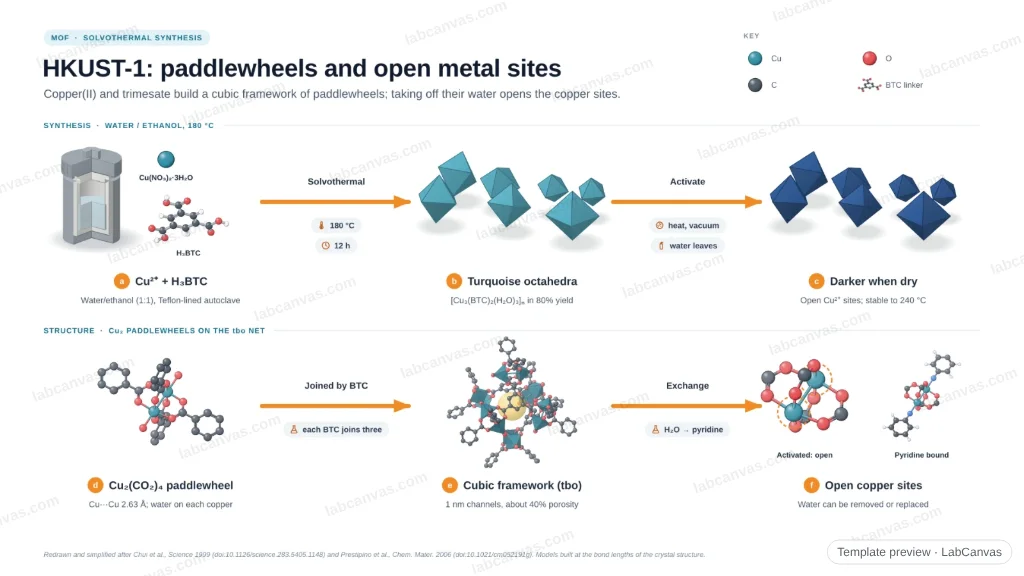
HKUST-1 (Cu-BTC) forms in high yield when copper(II) nitrate and trimesic acid are heated in water and ethanol. Pairs of Cu²⁺ ions bridged by four carboxylates (paddlewheels) are joined by the triangular trimesate into a cubic framework with 1 nm channels. Each copper carries a water molecule; heating under vacuum removes it and leaves an open metal site that binds guests, and pyridine can take its place.
Updated 2 cited papers81 editable layers
At a glance
- Category
- Metal–organic frameworks
- Method
- Solvothermal synthesis
- Approach
- Bottom-up
- Starting materials
- Copper(II) nitrate trihydrate and trimesic acid (benzene-1,3,5-tricarboxylic acid, H₃BTC) in water/ethanol (1:1)
- Product
- Turquoise octahedral crystals of [Cu₃(BTC)₂(H₂O)₃]ₙ (cubic, a ≈ 26.3 Å)
- Key result
- Stable up to 240 °C by thermogravimetry and high-temperature single-crystal diffraction (Chui et al. 1999)
- Figure
- 1920 × 1080 px (16:9), 81 editable layers, 15 generated objects
Step by step
- SolvothermalCu(NO₃)₂·3H₂O and H₃BTC in H₂O/EtOH, Teflon-lined autoclave, 180 °C for 12 h; 80% yield (Chui et al. 1999)
- PaddlewheelsCu₂(CO₂)₄ units, Cu···Cu 2.63 Å, one water on each copper
- FrameworkPaddlewheels joined by BTC (tbo net): 1 nm channels, about 40% accessible porosity
- ActivationHeating under vacuum removes the axial water: open Cu²⁺ sites, darker crystals (Prestipino et al. 2006)
- ExchangeThe aqua ligands can be replaced by pyridines (Chui et al. 1999)
Strengths
- High-yield synthesis from inexpensive reagents
- Open Cu²⁺ sites that bind small molecules
- Channel linings that can be functionalized
Limitations
- Takes up water from air; moisture slowly degrades it
- Open sites must be kept dry after activation
Uses
- Gas storage and separation
- Catalysis at open copper sites
- Sensing
Papers this template follows
- Chui et al., “A Chemically Functionalizable Nanoporous Material [Cu₃(TMA)₂(H₂O)₃]ₙ”, Science 1999. doi:10.1126/science.283.5405.1148primary
- Prestipino et al., “Local Structure of Framework Cu(II) in HKUST-1 Metallorganic Framework: Spectroscopic Characterization upon Activation and Interaction with Adsorbates”, Chem. Mater. 2006. doi:10.1021/cm052191gfurther reading
Redrawn and simplified after Chui et al., Science 1999 (doi:10.1126/science.283.5405.1148) and Prestipino et al., Chem. Mater. 2006 (doi:10.1021/cm052191g). Models built at the bond lengths of the crystal structure.
How templates are written and checked: editorial guidelines.
Questions
What does the “HKUST-1: copper paddlewheels and open metal sites” template show?
HKUST-1 (Cu-BTC) forms in high yield when copper(II) nitrate and trimesic acid are heated in water and ethanol. Pairs of Cu²⁺ ions bridged by four carboxylates (paddlewheels) are joined by the triangular trimesate into a cubic framework with 1 nm channels. Each copper carries a water molecule; heating under vacuum removes it and leaves an open metal site that binds guests, and pyridine can take its place.
What are the steps shown in “HKUST-1: copper paddlewheels and open metal sites”?
1. Solvothermal: Cu(NO₃)₂·3H₂O and H₃BTC in H₂O/EtOH, Teflon-lined autoclave, 180 °C for 12 h; 80% yield (Chui et al. 1999). 2. Paddlewheels: Cu₂(CO₂)₄ units, Cu···Cu 2.63 Å, one water on each copper. 3. Framework: Paddlewheels joined by BTC (tbo net): 1 nm channels, about 40% accessible porosity. 4. Activation: Heating under vacuum removes the axial water: open Cu²⁺ sites, darker crystals (Prestipino et al. 2006). 5. Exchange: The aqua ligands can be replaced by pyridines (Chui et al. 1999).
What are the starting materials and the product?
Starting materials: Copper(II) nitrate trihydrate and trimesic acid (benzene-1,3,5-tricarboxylic acid, H₃BTC) in water/ethanol (1:1). Product: Turquoise octahedral crystals of [Cu₃(BTC)₂(H₂O)₃]ₙ (cubic, a ≈ 26.3 Å).
Which papers is “HKUST-1: copper paddlewheels and open metal sites” based on?
Chui et al., “A Chemically Functionalizable Nanoporous Material [Cu₃(TMA)₂(H₂O)₃]ₙ”, Science 1999 (doi:10.1126/science.283.5405.1148); Prestipino et al., “Local Structure of Framework Cu(II) in HKUST-1 Metallorganic Framework: Spectroscopic Characterization upon Activation and Interaction with Adsorbates”, Chem. Mater. 2006 (doi:10.1021/cm052191g).
Can I edit the “HKUST-1: copper paddlewheels and open metal sites” template?
Yes. Open it in the LabCanvas editor: all 81 layers are editable, including 15 generated objects (structures, plots, equipment) with their own settings. Change the text, colours and layout, then export PNG, TIFF, SVG or PDF.
Do I need an account to use this template?
Not to view it here. To open and edit it, sign in to LabCanvas or create a free account (the free plan keeps one design of each kind). Downloading the figure is part of LabCanvas Pro (US$19 a month or US$199 a year).