Graphical abstract template · Metal–organic frameworks · Post-synthetic modification · Bottom-up
Post-synthetic modification of a MOF
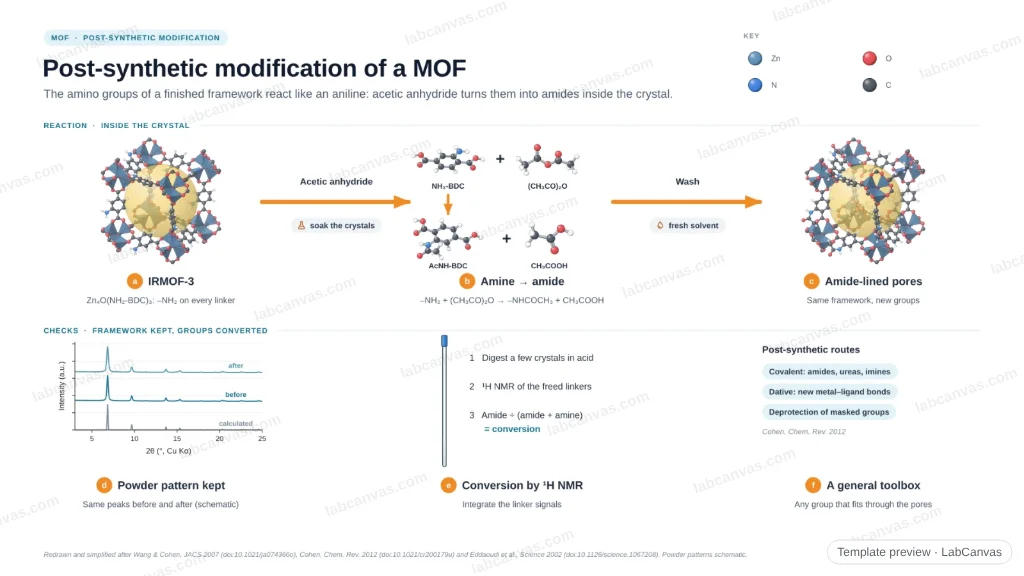
Functional groups can be added to a framework after it has formed. The amino groups that line the pores of IRMOF-3 react with acetic anhydride like an aniline would, turning into amides throughout the crystal while the framework stays intact. The powder pattern confirms the structure is kept, and ¹H NMR of digested crystals gives the conversion.
Updated 3 cited papers82 editable layers
At a glance
- Category
- Metal–organic frameworks
- Method
- Post-synthetic modification
- Approach
- Bottom-up
- Starting materials
- IRMOF-3, Zn₄O(NH₂-BDC)₃, made from zinc nitrate and 2-aminoterephthalic acid
- Product
- The same cubic framework with acetamide groups (–NHCOCH₃) on the linkers
- Key result
- Covalent modification inside the crystal without loss of the framework (Wang & Cohen 2007)
- Figure
- 1920 × 1080 px (16:9), 82 editable layers, 9 generated objects
Step by step
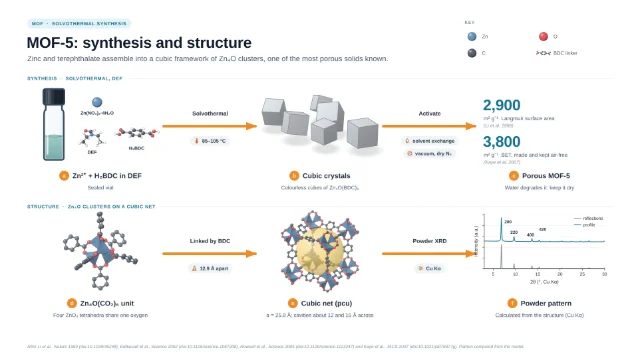
- FrameworkIRMOF-3: the MOF-5 net with an amino group on every linker (Eddaoudi et al. 2002)
- AcylateCrystals in a solution of acetic anhydride: –NH₂ → –NHCOCH₃, acetic acid released (Wang & Cohen 2007)
- Check the frameworkPowder pattern unchanged: the crystal survives the reaction
- Measure conversionCrystals digested in acid; ¹H NMR of the linkers gives the ratio of amide to amine
Strengths
- Groups that would not survive MOF synthesis can be added afterwards
- One parent framework gives many products
Limitations
- Reagents must fit through the pores
- Conversion can be incomplete deep in large crystals
Uses
- Tuning pore chemistry for adsorption and separation
- Anchoring catalysts and metal sites
Papers this template follows
- Wang & Cohen, “Postsynthetic Covalent Modification of a Neutral Metal−Organic Framework”, J. Am. Chem. Soc. 2007. doi:10.1021/ja074366oprimary
- Cohen, “Postsynthetic Methods for the Functionalization of Metal–Organic Frameworks”, Chem. Rev. 2012. doi:10.1021/cr200179ureview
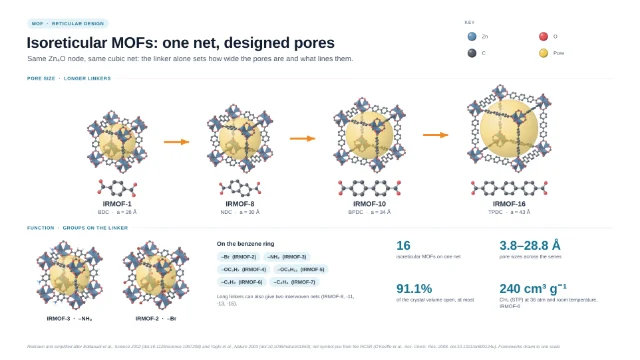
- Eddaoudi et al., “Systematic Design of Pore Size and Functionality in Isoreticular MOFs and Their Application in Methane Storage”, Science 2002. doi:10.1126/science.1067208method origin
Redrawn and simplified after Wang & Cohen, JACS 2007 (doi:10.1021/ja074366o), Cohen, Chem. Rev. 2012 (doi:10.1021/cr200179u) and Eddaoudi et al., Science 2002 (doi:10.1126/science.1067208). Powder patterns schematic.
How templates are written and checked: editorial guidelines.
Questions
What does the “Post-synthetic modification of a MOF” template show?
Functional groups can be added to a framework after it has formed. The amino groups that line the pores of IRMOF-3 react with acetic anhydride like an aniline would, turning into amides throughout the crystal while the framework stays intact. The powder pattern confirms the structure is kept, and ¹H NMR of digested crystals gives the conversion.
What are the steps shown in “Post-synthetic modification of a MOF”?
1. Framework: IRMOF-3: the MOF-5 net with an amino group on every linker (Eddaoudi et al. 2002). 2. Acylate: Crystals in a solution of acetic anhydride: –NH₂ → –NHCOCH₃, acetic acid released (Wang & Cohen 2007). 3. Check the framework: Powder pattern unchanged: the crystal survives the reaction. 4. Measure conversion: Crystals digested in acid; ¹H NMR of the linkers gives the ratio of amide to amine.
What are the starting materials and the product?
Starting materials: IRMOF-3, Zn₄O(NH₂-BDC)₃, made from zinc nitrate and 2-aminoterephthalic acid. Product: The same cubic framework with acetamide groups (–NHCOCH₃) on the linkers.
Which papers is “Post-synthetic modification of a MOF” based on?
Wang & Cohen, “Postsynthetic Covalent Modification of a Neutral Metal−Organic Framework”, J. Am. Chem. Soc. 2007 (doi:10.1021/ja074366o); Cohen, “Postsynthetic Methods for the Functionalization of Metal–Organic Frameworks”, Chem. Rev. 2012 (doi:10.1021/cr200179u); Eddaoudi et al., “Systematic Design of Pore Size and Functionality in Isoreticular MOFs and Their Application in Methane Storage”, Science 2002 (doi:10.1126/science.1067208).
Can I edit the “Post-synthetic modification of a MOF” template?
Yes. Open it in the LabCanvas editor: all 82 layers are editable, including 9 generated objects (structures, plots, equipment) with their own settings. Change the text, colours and layout, then export PNG, TIFF, SVG or PDF.
Do I need an account to use this template?
Not to view it here. To open and edit it, sign in to LabCanvas or create a free account (the free plan keeps one design of each kind). Downloading the figure is part of LabCanvas Pro (US$19 a month or US$199 a year).