Graphical abstract template · Metal–organic frameworks · Hydrothermal synthesis · Bottom-up
MIL-101(Cr): supertetrahedra and giant cages
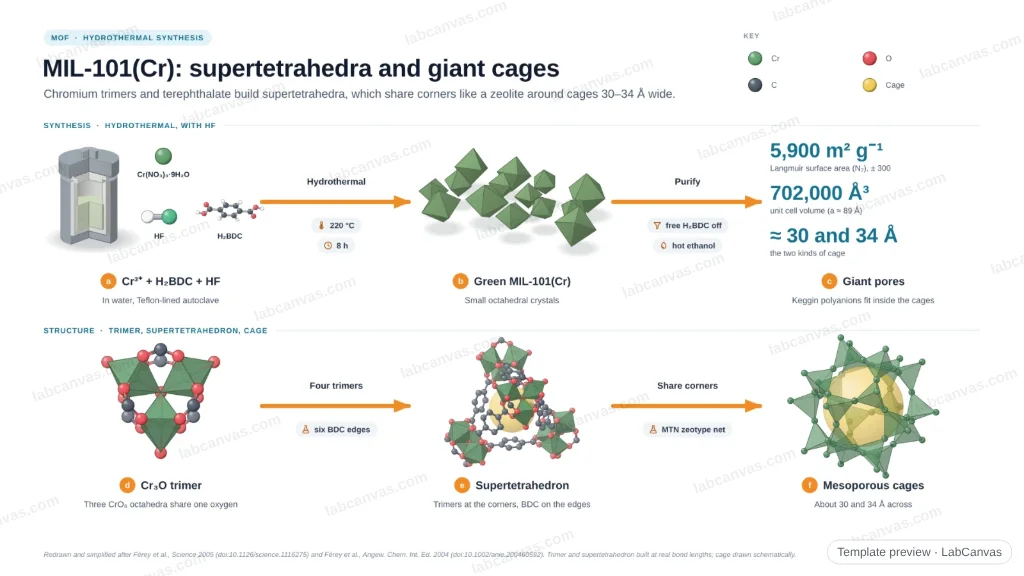
MIL-101 is a chromium terephthalate made hydrothermally with HF. Trimers of CrO₆ octahedra and terephthalate links form supertetrahedra, which share corners like the tetrahedra of a zeolite (MTN topology). The result is a cubic cell of about 702,000 ų with mesoporous cages about 30 and 34 Å across and a Langmuir surface area near 5,900 m² g⁻¹.
Updated 3 cited papers85 editable layers
At a glance
- Category
- Metal–organic frameworks
- Method
- Hydrothermal synthesis
- Approach
- Bottom-up
- Starting materials
- Chromium(III) nitrate nonahydrate, terephthalic acid (H₂BDC) and hydrofluoric acid in water
- Product
- Green MIL-101(Cr) powder, Cr₃F(H₂O)₂O(BDC)₃·nH₂O (cubic, a ≈ 89 Å)
- Key result
- Cell volume ≈ 702,000 ų; Langmuir surface area ≈ 5,900 ± 300 m² g⁻¹ (N₂) (Férey et al. 2005)
- Figure
- 1920 × 1080 px (16:9), 85 editable layers, 13 generated objects
Step by step
- HydrothermalCr(NO₃)₃·9H₂O, H₂BDC, HF and water in a Teflon-lined autoclave, 220 °C for 8 h
- PurifyFree terephthalic acid filtered off; washing in hot ethanol
- TrimersThree CrO₆ octahedra share one μ₃-oxygen; F⁻/OH⁻ and water complete the chromium sites
- SupertetrahedraFour trimers at the corners, six BDC along the edges
- CagesSupertetrahedra share corners (MTN zeotype net): two kinds of mesoporous cage, about 30 and 34 Å
Strengths
- Mesoporous cages that admit large molecules
- High surface area and pore volume
Limitations
- HF and chromium in the synthesis
- Free terephthalic acid must be removed
Uses
- Nanomold for monodisperse nanomaterials (Keggin polyanions in the cages)
- Adsorption and catalysis
- Drug storage and release (Horcajada et al. 2006)
Papers this template follows
- Férey et al., “A Chromium Terephthalate-Based Solid with Unusually Large Pore Volumes and Surface Area”, Science 2005. doi:10.1126/science.1116275primary
- Férey et al., “A Hybrid Solid with Giant Pores Prepared by a Combination of Targeted Chemistry, Simulation, and Powder Diffraction”, Angew. Chem. Int. Ed. 2004. doi:10.1002/anie.200460592further reading
- Horcajada et al., “Metal–Organic Frameworks as Efficient Materials for Drug Delivery”, Angew. Chem. Int. Ed. 2006. doi:10.1002/anie.200601878further reading
Redrawn and simplified after Férey et al., Science 2005 (doi:10.1126/science.1116275) and Férey et al., Angew. Chem. Int. Ed. 2004 (doi:10.1002/anie.200460592). Trimer and supertetrahedron built at real bond lengths; cage drawn schematically.
How templates are written and checked: editorial guidelines.
Questions
What does the “MIL-101(Cr): supertetrahedra and giant cages” template show?
MIL-101 is a chromium terephthalate made hydrothermally with HF. Trimers of CrO₆ octahedra and terephthalate links form supertetrahedra, which share corners like the tetrahedra of a zeolite (MTN topology). The result is a cubic cell of about 702,000 ų with mesoporous cages about 30 and 34 Å across and a Langmuir surface area near 5,900 m² g⁻¹.
What are the steps shown in “MIL-101(Cr): supertetrahedra and giant cages”?
1. Hydrothermal: Cr(NO₃)₃·9H₂O, H₂BDC, HF and water in a Teflon-lined autoclave, 220 °C for 8 h. 2. Purify: Free terephthalic acid filtered off; washing in hot ethanol. 3. Trimers: Three CrO₆ octahedra share one μ₃-oxygen; F⁻/OH⁻ and water complete the chromium sites. 4. Supertetrahedra: Four trimers at the corners, six BDC along the edges. 5. Cages: Supertetrahedra share corners (MTN zeotype net): two kinds of mesoporous cage, about 30 and 34 Å.
What are the starting materials and the product?
Starting materials: Chromium(III) nitrate nonahydrate, terephthalic acid (H₂BDC) and hydrofluoric acid in water. Product: Green MIL-101(Cr) powder, Cr₃F(H₂O)₂O(BDC)₃·nH₂O (cubic, a ≈ 89 Å).
Which papers is “MIL-101(Cr): supertetrahedra and giant cages” based on?
Férey et al., “A Chromium Terephthalate-Based Solid with Unusually Large Pore Volumes and Surface Area”, Science 2005 (doi:10.1126/science.1116275); Férey et al., “A Hybrid Solid with Giant Pores Prepared by a Combination of Targeted Chemistry, Simulation, and Powder Diffraction”, Angew. Chem. Int. Ed. 2004 (doi:10.1002/anie.200460592); Horcajada et al., “Metal–Organic Frameworks as Efficient Materials for Drug Delivery”, Angew. Chem. Int. Ed. 2006 (doi:10.1002/anie.200601878).
Can I edit the “MIL-101(Cr): supertetrahedra and giant cages” template?
Yes. Open it in the LabCanvas editor: all 85 layers are editable, including 13 generated objects (structures, plots, equipment) with their own settings. Change the text, colours and layout, then export PNG, TIFF, SVG or PDF.
Do I need an account to use this template?
Not to view it here. To open and edit it, sign in to LabCanvas or create a free account (the free plan keeps one design of each kind). Downloading the figure is part of LabCanvas Pro (US$19 a month or US$199 a year).