Graphical abstract template · Metal–organic frameworks · Modulated synthesis · Bottom-up
UiO-66: modulators and missing-linker defects
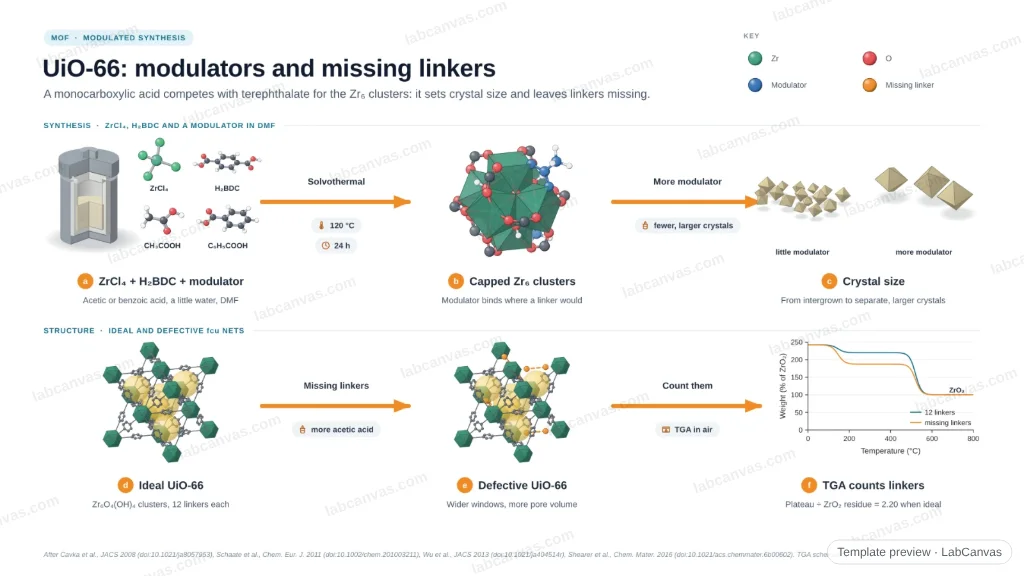
Monocarboxylic acids added to the synthesis of UiO-66 compete with terephthalate for the Zr₆ clusters. With more modulator the crystals grow separate and larger, and more linkers go missing, their places taken by modulator, hydroxide or water. The defects open up the framework, and thermogravimetry counts them: an ideal UiO-66 plateau is 2.20 times its ZrO₂ residue.
Updated 5 cited papers83 editable layers
At a glance
- Category
- Metal–organic frameworks
- Method
- Modulated synthesis
- Approach
- Bottom-up
- Starting materials
- ZrCl₄ and terephthalic acid in DMF, with a monocarboxylic acid modulator (acetic or benzoic acid) and a little water
- Product
- UiO-66 crystals of controlled size with missing-linker defects
- Key result
- Ideal UiO-66 is Zr₆O₄(OH)₄(BDC)₆ with 12 linkers per cluster (fcu); it dehydroxylates to Zr₆O₆(BDC)₆ on heating (Valenzano et al. 2011)
- Figure
- 1920 × 1080 px (16:9), 83 editable layers, 15 generated objects
Step by step
- SolvothermalZrCl₄ and H₂BDC in DMF, 120 °C for 24 h (Cavka et al. 2008); water is essential for well-ordered products (Schaate et al. 2011)
- ModulateBenzoic or acetic acid competes with the linker for the Zr₆ clusters; with more modulator the products change from intergrown to separate crystals of tunable size (Schaate et al. 2011)
- DefectsMore acetic acid leaves more linkers missing, and synthesis time also tunes them (Wu et al. 2013); the sites are capped by modulator, hydroxide or water
- CountTGA in air: the plateau before the linkers burn, divided by the ZrO₂ residue, is 2.20 for Zr₆O₆(BDC)₆ and lower for defective samples (Shearer et al. 2016)
Strengths
- Porosity and crystal size tuned in one step
- Defects add pore volume and open Zr sites
Limitations
- Defect levels depend on modulator, water and time
- Very defective samples are less stable
Uses
- Catalysis at open Zr sites
- Tuned gas adsorption
Papers this template follows
- Cavka et al., “A New Zirconium Inorganic Building Brick Forming Metal Organic Frameworks with Exceptional Stability”, J. Am. Chem. Soc. 2008. doi:10.1021/ja8057953method origin
- Schaate et al., “Modulated Synthesis of Zr-Based Metal–Organic Frameworks: From Nano to Single Crystals”, Chem. Eur. J. 2011. doi:10.1002/chem.201003211primary
- Wu et al., “Unusual and Highly Tunable Missing-Linker Defects in Zirconium Metal–Organic Framework UiO-66 and Their Important Effects on Gas Adsorption”, J. Am. Chem. Soc. 2013. doi:10.1021/ja404514rprimary
- Shearer et al., “Defect Engineering: Tuning the Porosity and Composition of the Metal–Organic Framework UiO-66 via Modulated Synthesis”, Chem. Mater. 2016. doi:10.1021/acs.chemmater.6b00602further reading
- Valenzano et al., “Disclosing the Complex Structure of UiO-66 Metal Organic Framework: A Synergic Combination of Experiment and Theory”, Chem. Mater. 2011. doi:10.1021/cm1022882further reading
After Cavka et al., JACS 2008 (doi:10.1021/ja8057953), Schaate et al., Chem. Eur. J. 2011 (doi:10.1002/chem.201003211), Wu et al., JACS 2013 (doi:10.1021/ja404514r), Shearer et al., Chem. Mater. 2016 (doi:10.1021/acs.chemmater.6b00602). TGA schematic.
How templates are written and checked: editorial guidelines.
Questions
What does the “UiO-66: modulators and missing-linker defects” template show?
Monocarboxylic acids added to the synthesis of UiO-66 compete with terephthalate for the Zr₆ clusters. With more modulator the crystals grow separate and larger, and more linkers go missing, their places taken by modulator, hydroxide or water. The defects open up the framework, and thermogravimetry counts them: an ideal UiO-66 plateau is 2.20 times its ZrO₂ residue.
What are the steps shown in “UiO-66: modulators and missing-linker defects”?
1. Solvothermal: ZrCl₄ and H₂BDC in DMF, 120 °C for 24 h (Cavka et al. 2008); water is essential for well-ordered products (Schaate et al. 2011). 2. Modulate: Benzoic or acetic acid competes with the linker for the Zr₆ clusters; with more modulator the products change from intergrown to separate crystals of tunable size (Schaate et al. 2011). 3. Defects: More acetic acid leaves more linkers missing, and synthesis time also tunes them (Wu et al. 2013); the sites are capped by modulator, hydroxide or water. 4. Count: TGA in air: the plateau before the linkers burn, divided by the ZrO₂ residue, is 2.20 for Zr₆O₆(BDC)₆ and lower for defective samples (Shearer et al. 2016).
What are the starting materials and the product?
Starting materials: ZrCl₄ and terephthalic acid in DMF, with a monocarboxylic acid modulator (acetic or benzoic acid) and a little water. Product: UiO-66 crystals of controlled size with missing-linker defects.
Which papers is “UiO-66: modulators and missing-linker defects” based on?
Cavka et al., “A New Zirconium Inorganic Building Brick Forming Metal Organic Frameworks with Exceptional Stability”, J. Am. Chem. Soc. 2008 (doi:10.1021/ja8057953); Schaate et al., “Modulated Synthesis of Zr-Based Metal–Organic Frameworks: From Nano to Single Crystals”, Chem. Eur. J. 2011 (doi:10.1002/chem.201003211); Wu et al., “Unusual and Highly Tunable Missing-Linker Defects in Zirconium Metal–Organic Framework UiO-66 and Their Important Effects on Gas Adsorption”, J. Am. Chem. Soc. 2013 (doi:10.1021/ja404514r); Shearer et al., “Defect Engineering: Tuning the Porosity and Composition of the Metal–Organic Framework UiO-66 via Modulated Synthesis”, Chem. Mater. 2016 (doi:10.1021/acs.chemmater.6b00602); Valenzano et al., “Disclosing the Complex Structure of UiO-66 Metal Organic Framework: A Synergic Combination of Experiment and Theory”, Chem. Mater. 2011 (doi:10.1021/cm1022882).
Can I edit the “UiO-66: modulators and missing-linker defects” template?
Yes. Open it in the LabCanvas editor: all 83 layers are editable, including 15 generated objects (structures, plots, equipment) with their own settings. Change the text, colours and layout, then export PNG, TIFF, SVG or PDF.
Do I need an account to use this template?
Not to view it here. To open and edit it, sign in to LabCanvas or create a free account (the free plan keeps one design of each kind). Downloading the figure is part of LabCanvas Pro (US$19 a month or US$199 a year).